
NEW
Font size
 Worksheets
REVIEW: The Fossil Record
Total questions: 20
Worksheet time: 18mins
If you know the age of a fossil, you know the relative age of the ________________ it was found inside.
sticky tar
rock
amber
ice
Geologists use radioactive dating to..
determine the relative ages of rock layers.
tell the difference between molds and casts.
tell where one soil horizon ends and the next one begins.
determine the absolute ages of rocks.

What are the oldest fossils and why?
B, C- because they are closest to the top
A, B- because they are closest to the bottom
They are all the same age- because they are all found on layer 2
A, B- because they are found closest to the top

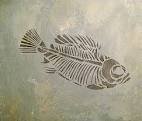
If scientists found this fossil, what could they infer?
what fish are like today
that this fish lacked oxygen
that water once covered the area where this fossil was found
Fossils of fish are found under land where cows now live. What does this tell you?
the fish were dropped their by flying birds
this land was once under the ocean
fish used to live on land

Fossil A is an ancient mollusk, an organism that needs water to survive. Why do you think that the mollusk went extinct in this particular sample of the fossil record?
When the ocean levels rose in layer 4, the mollusk went extinct because they cannot live in water
For some reason, the ocean disappeared causing the mollusk to thrive
For some reason, the ocean disappeared causing the mollusk to go extinct
When the ocean level rose in layer 4, the mollusk thrived because they need water

When did fossil A become extinct?
Layer 1
Layer 2
Layer 3
Layer 4

Organisms D and C clearly lived in an aquatic (water) environment. Organism A does not look like it lived in the water. What is the most likely explanation for this?
The fossil in layer A died on land and was carried to the water
The fossils in layer C and D did not live in the same location as the fossil in layer A
The environment changed over a long period of time. It used to be under water, but is not anymore


What is the best reason that fossil #4 is NOT a good index fossil?
It is not widespread
it is not short-lived (in numerous layers)
It is in half of the outcrops

If you found an index fossil in a layer of rock in Montana and a similar fossil in a layer of rock in Texas, you would know that:
the fossils and rock layers are the same age
the fossils from Montana are older
the fossils from England are older
none of the above
Which of the follow is INCORRECT about an index fossil?
The fossil must have lived only during a short part of the Earth's history.
Many fossils of the organism must be found in the rock layers.
The fossil must be found over a wide area of the Earth and be unique.
The fossil must only be found in one area.
Scientists found the petrified fossil of a small mink-like animal with a long body and short legs that they claimed lived 40 million years ago. They presumed the animal was a prehistoric ancestor of the modern dog. What should they study to justify their assumptions?
analogous structures between the animal and dogs
location of the fossil and habitat of the dogs
homologous structures between the animal and dogs
feeding habits of the animal as compared to the dogs
Students were asked to relate the rock cycle to dinosaur fossil formation. Which flowchart best represents the process that formed the dinosaur fossils in Mississippi?
Compaction and cementation of sedimentary rock occurs. ➨ Dinosaur remains are deposited in sediments.
Dinosaur remains are deposited in sediments. ➨ Compaction and cementation of sedimentary rock occurs.
Heat and pressure convert metamorphic rock to sedimentary rock. ➨ Dinosaur remains are deposited in metamorphic rock.
Dinosaur remains are deposited in metamorphic rock. ➨ Heat and pressure convert metamorphic rock to sedimentary rock.

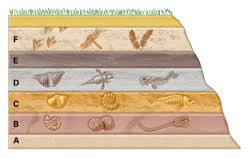
The diagram shows undisturbed layers of rock containing a variety of fossils. What can MOST LIKELY be inferred about the evolutionary history of this area?
The area was once a saltwater sea and was later replaced by a forest.
The area was once a forest and was later replaced by a freshwater lake.
The area was once a freshwater lake and was later replaced by a desert.
The area was once a saltwater sea and was later replaced by a desert.

