
 Worksheets
Unit 3 Review: Introduction to Chemical Bonding
Total questions: 25
Worksheet time: 13mins
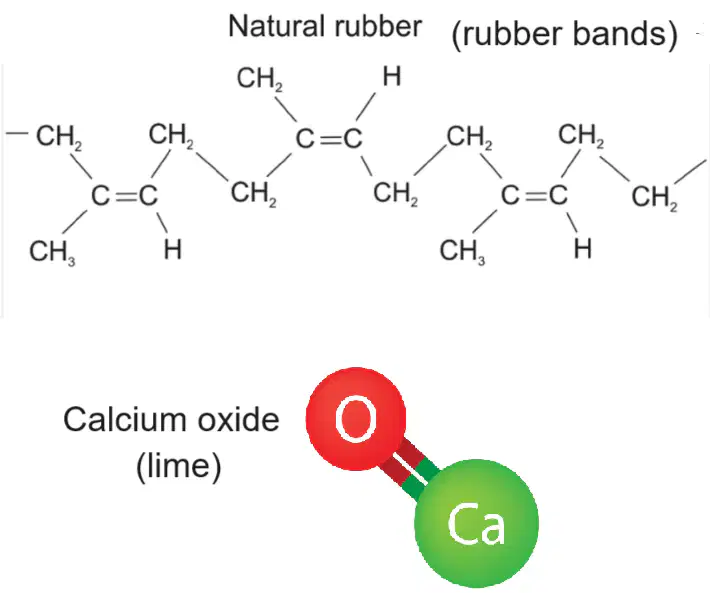
Which statement correctly describes the two materials shown?
The rubber polymer used in rubber bands is a short molecule that creates inflexible materials.
The rubber polymer used in rubber bands is a long molecule that creates flexible materials.
Calcium oxide, also known as lime, is a short molecule so it makes flexible materials.
Calcium oxide, also known as lime, is a long molecule so it makes inflexible materials.
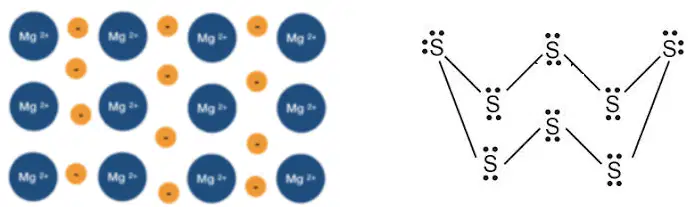
An engineer is creating a new material that will conduct electricity. Which element would the engineer choose? Why?
Sulfur. It is a good insulator
Magnesium. It is a good insulator.
Sulfur. It has contains that have the ability to conduct electricity.
Magnesium. It contains ions that have the ability to conduct electricity.
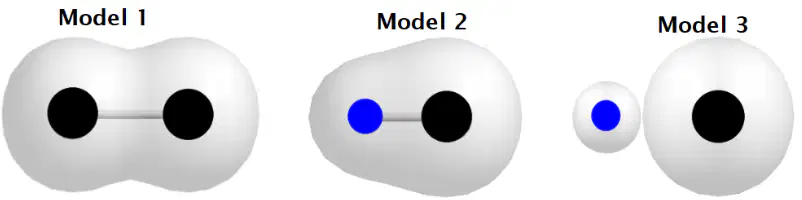
Which model shown could represent a diatomic molecule of I2?
Model 1
Model 2
Model 3
None
Which model could represent a compound that is soluble in water, conducts heat and electricity, and has a high melting point?
Model 1
Model 2
Model 3
None
Which of the following questions would a chemistry student need to ask before writing the name of a binary chemical compound?
Are both elements nonmetals?
What is the mass number of each element?
Is one of the elements a metal?
How many valence electrons does the cation have?
What is the correct name and formula for the binary ionic compound formed from Mn4+ and O2-?
Mn2O4, Manganese oxide
Mn4O2, Manganese(IV) oxide
MnO2, Manganese(IV) dioxide
MnO2, Manganese(IV) oxide
What is the correct name for the compound with the formula N2O5?
nitrogen pentoxide
nitrogen (V) oxide
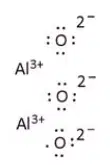
What is the chemical formula of the ionic compound shown?
Al2O3
AlO
Al3O2
Al3O3
What type of chemical bonding is shown in the model?
nonpolar covalent
polar covalent
ionic
metallic
What is the correct name for CuO?
copper oxide
copper monoxide
copper (II) oxide
copper (I) oxide
What is the correct formula for carbon tetrachloride?
C4Cl
CCl3
CCl4
CCl5

What type of chemical bond would form between magnesium and chlorine?
nonpolar covalent
polar covalent
ionic
metallic
What type of chemical bond would form between fluorine and chlorine?
nonpolar covalent
polar covalent
ionic
metallic
Which of the following binary ionic compounds has the general formula X2Y?
Na2O because the sodium cation has a +2 charge and binds to Group 6A nonmetals in a 1:2 ratio
Na2O because the sodium cation has a +1 charge and binds to Group 6A nonmetals in a 2:1 ratio
CaCl2 because the calcium cation has a +2 charge and binds to Group 7A nonmetals in a 2:1 ratio
CaCl2 because the calcium cation has a +1 charge and binds to Group 7A nonmetals in a 1:2 ratio
Name this ionic compound, BaSO4.
Barium sulfate
Barium sulfur tetroxide
Barium sulfide
Barium sulfide oxide
When writing the formula for a binary ionic compound containing a transition metal, a chemistry student needs to answer which of the following questions?
What is the oxidation number of the anion?
What does the Roman numeral represent?
What is the atomic number of the metal cation?
In which family does the metal belong?
Which is the correct formula for calcium phosphate?
Ca3P2
CaPO4
Ca3PO4
Ca3(PO4)2
Which statement correctly explains the number of sodium atoms needed to make sodium sulfide?
1 sodium atom is needed because sodium donates one valence electron to sulfur.
1 sodium atom is needed because sodium accepts one valence electron from sulfur.
2 sodium atoms are needed because each sodium donates one valence electron to sulfur.
2 sodium atoms are needed because each sodium accepts one valence electron from sulfur.
Which question would a chemistry student need to ask to write the formula of a binary ionic compound formed with Group 5A nonmetals?
Will Group 5A nonmetals lose valence electrons to bond with Group 2A metals in an X3Y2 formula?
Will Group 5A nonmetals lose valence electrons to bond with Group 2A metals in an X2Y3 formula?
Will Group 5A nonmetals gain valence electrons to bond with Group 2A metals in an X3Y2 formula?
Will Group 5A nonmetals gain valence electrons to bond with Group 2A metals in an X2Y3 formula?
Why do atoms form chemical bonds?
To achieve a complete octet and lower their overall energy.
Ionic bonds are formed when
When atoms share valence electrons, a _______ bond is formed.
In naming covalent compounds, when does the first element get a prefix?
What is the correct name for the compound with the formula CO2?
carbon monoxide
carbon dioxide
carbon oxide
carbon peroxide
What is the oxidation number chromium in the ionic compound CrO3?
+3
+2
+6
+1

