wayground logo

Free Printable Worksheets

Font size

S
M
L
XL
Worksheets

Grade 7th math review

Total questions: 148

Worksheet time: 7hrs 51mins

Name
Class
Date
1.
What is a square?
a)
Something you multiply by the 3rd power
b)
A shape
c)
A number you multiply by itself
2.
What is a square root
a)
A number to the second power
b)
A square that has roots on it
c)
Square roots are numbers that produce a specified quantity when multiplied by itself
3.
Square root of 16 is....
a)
8
b)
4
c)
2
d)
3
4.
True or false? 9² is 18
a)
True
b)
False
5.
Is 225 a perfect square?
a)
Yes
b)
No
6.
The square root of 256 is...
a)
15
b)
18
c)
13
d)
16
7.
-√144
a)
12
b)
13
c)
-12
d)
None of the above
8.
the square root √-25 is..
a)
5
b)
-5
c)
8
d)
none of the above
9.
b²=361
b=...
a)
19
b)
20
c)
16
d)
17
10.
The √40 is between which two integers?
a)
7 & 8
b)
6 & 7
c)
5 & 6
d)
4 & 5
11.
4
a)
Is a perfect square.
b)
Is not a perfect square.
12.
132
a)
26
b)
196
c)
144
d)
169
13.
The √20 is between which two integers?
a)
2 & 3
b)
3 & 4
c)
4 & 5
d)
5 & 6
14.
√ 36
a)
4
b)
6
c)
12
15.
∛8
a)
2
b)
-2
c)
±2
d)
None
16.
Find the cube root(s): ∛1
a)
1
b)
-1
c)
±1
d)
none
17.
The area of a square painting is 81 cm2.  What is the side length of the painting?
a)
40.5 cm
b)
162 cm
c)
6,561 cm
d)
9 cm
18.
Solve.
√9  ×  √100
a)
30
b)
-200
c)
900
d)
90
19.

What is index notation?

a)

Numbers

b)

Just multiply numbers

c)

A shorthand way for writing long numbers

20.

What is 33 in expanded form?

a)

3 x 3

b)

3 + 3

c)

3 x 3 x 3

21.

What is 67in expanded form?

a)

6 x 6 x 6 x 6 x 6 x 6 x 6

b)

6 + 6 + 6 + 6 + 6 + 6 + 6

c)

6 x 7

22.
Solve 53
a)
8
b)
15
c)
75
d)
125
23.
Solve 93
a)
729
b)
27
c)
12
d)
525
24.

Write in index notation.

2 x 3 x 3 x 5 x 5 x 5 x 2

a)

2 x 32 x 52

b)

22 + 32 + 53

c)

22 x 32 x 53

25.

Write in index notation.

7 x 7 x 7 x 7 x 7 x 10

a)

75 + 10

b)

75 x 10

c)

75 x 101

26.
Which is the base and which is the power? 52
a)
5 is base and 2 is power
b)
5 is base and power
c)
2 is base and 5 is power
d)
2 is base and power
27.

              16\sqrt{16}  =

a)

   16

b)

4×44\times4  

c)

4

d)

  16×16\sqrt{16\times16}  

28.

Write  323125\frac{32}{3125}  in index form by using base of  25\frac{2}{5}  .

a)

(25)2\left(\frac{2}{5}\right)^2  

b)

(25)3\left(\frac{2}{5}\right)^3  

c)

(25)4\left(\frac{2}{5}\right)^4  

d)

(25)5\left(\frac{2}{5}\right)^5  

29.

Write 81 in base of 3.

a)

31

b)

32

c)

33

d)

34

30.

Write 0.00032 in base of 0.2.

a)

0.23

b)

0.24

c)

0.25

d)

0.26

31.

(-4)7

what is the base?

a)

-4

b)

4

c)

7

d)

-7

32.

Which one is not the index form of 64?

a)

82

b)

26

c)

43

d)

322

33.

Which number is a factor of 10

a)

3

b)

4

c)

5

d)

8

34.
Find the HCF of 12 and 15 ?
a)
2
b)
2 x 3
c)
3
d)
60
35.
Find the HCF of 40 and 60?
a)
10
b)
20
c)
30
d)
None of the above
36.
What is the LCM of 6 and 8 ?
a)
12
b)
18
c)
24
d)
36
37.
Find the HCF of 30 and 36
a)
2
b)
3
c)
4
d)
6
38.

Which answer lists all the factors for 40?

a)

1,2,4,5,8,12,14,40

b)

1,2,3,4,5,8,10

c)

1,2,4,5,8,10,20,40

d)

1,2,4,5,6,7,8,9,10

39.
What is the LCM of 4 and 12? 
a)
4
b)
8
c)
12
d)
16
40.

Derek advises a patient to have a scale every 4 months and a polish every 6 months. If they have a scale and polish today, how long will they wait before they can have both during the same appointment?

a)

HCF

b)

LCM

41.

There are two loaf cakes. One is 35cm long and one is 21cm long. They want to cut the cake up and sell the slices, but all the slices must be equal. What is the largest slices that they can cut them into?

a)

HCF

b)

LCM

42.

Find the LCM of 8 and 24 ...

a)

24

b)

48

c)

32

d)

64

43.

HCF and LCM of 20 and 14 are...

a)

2 dan 140

b)

2 dan 70

c)

3 dan 140

d)

3 dan 70

44.

Prime factorization of 240 are . . . .

a)

23 x 3 x 5

b)

24 x 3 x 5

c)

25 x 3 x 5

d)

26 x 3 x 5

45.
Find the HCF of 25 and 35
a)
10
b)
5
c)
7
d)
1
46.

Which shows the prime factorization of 84?

a)

2×2×3×72\times2\times3\times7

b)

2×2×3×3×72\times2\times3\times3\times7

c)

4×214\times21

d)

7×217\times21

47.

The Lowest Common Multiple (LCM) of 24 and 60 is:

a)

90

b)

120

c)

30

d)

10

48.
24 x (4-2) ÷ 6
a)
8
b)
2
c)
6
d)
5
49.
7 x (7-4) ÷ 3
a)
8
b)
6
c)
7
d)
5
50.
40 + (72÷9) ÷ 8
a)
6
b)
25
c)
41
d)
15
51.
23 + (30÷10) x 4
a)
35
b)
104
c)
12
d)
45
52.
16 ÷ 2 x 4 - 3
a)
5
b)
-1
c)
25
d)
29
53.
90 - 52 x 3
a)
15
b)
240
c)
195
54.
What would you solve first?
3 x 48 / (15 - 3)
a)
3 x 48
b)
48 / 15
c)
15 - 3 
d)
48-12
55.
15 + 7 × 2 – 11 + 35=
a)
38
b)
251
c)
53
d)
50
56.
What step would I do second ? (4-2) x 9 + 7 =
a)
multiplication
b)
subtraction
c)
addition
d)
dividing
57.
What would be my first step? 3 + 4 x 6 - 4 =
a)
addition
b)
multiplication
c)
subtraction
d)
exponents
58.
What would be the second step in this problem? (3 + 4) 9 + 3 =
a)
parenthesis
b)
multiplication
c)
addition
d)
exponent
59.
20 ÷ 2 + (3 x 1)
a)
13
b)
4
c)
43
d)
21
60.
Solve:
12 / (4 - 2)
a)
1
b)
2
c)
4
d)
6
61.
2 + (9- 4)
a)
16
b)
77
c)
79
62.
2 ÷ 1 + 2 + 9 ÷ 9
a)
13/9
b)
5
c)
1   1/3
d)
13
63.
Simplify the following:  
-8 + (15 - 3) ÷ 4
a)
-5
b)
1
c)
-11
d)
11
64.
[ (10-6) + (18-6)]
a)
48
b)
124
c)
148
d)
186
65.
[ (18+5) + (14-2)]
a)
176
b)
167
c)
67
d)
76
66.
[ (6+4)2 x 3] - 32
a)
309
b)
391
c)
2700
d)
291
67.
 16 + [ 3 x (9-6)]
a)
43
b)
52
c)
33
d)
93
68.
14 + [ (16-7) + 4]
a)
33
b)
36
c)
39
d)
31
69.
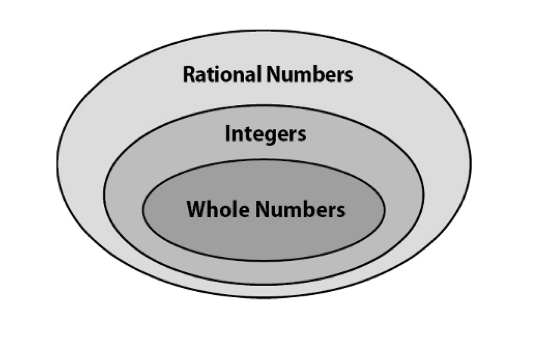
Where would you place -6?
a)
In the whole number circle because it's a whole number, integer, and rational number.
b)
In the integer circle because it's an integer and rational number only.
c)
In the rational circle because it's only a rational number.
d)
I'm not sure because I don't know what rational means.
70.
Does the graphic organizer correctly group the numbers?
a)
Yes
b)
No
71.
Explain the error
a)
-1.2 isn't an integer.
b)
-2 isn't a whole number and 3.4 isn't a rational number.
c)
-2 isn't a whole number and -1.2 isn't an integer.
d)
The numbers are graphed correctly.
72.
Does this graphic organizer correctly group the numbers?
a)
Yes
b)
No
73.
-14 could NOT be which type of number?
a)
Integer
b)
Whole
c)
Rational
74.
Classify the Number: -23
a)
Rational
b)
rational, integer
c)
integer
d)
rational, whole
75.
Which statement is true?
a)
Every rational number is an integer
b)
Every whole number is a counting number
c)
Every integer is a whole number
d)
Every whole number is a rational number
76.
-3.5 is an integer
a)
True
b)
False
77.
6 is a rational number
a)
True
b)
False
78.
-9 is an integer
a)
True
b)
False
79.

Which of the following does not represent a whole number?

a)

9

b)

6.0

c)

12/4

d)

-12/3

80.

Which of the following could the diagram represent?

a)

I: rational, II: natural

b)

I: integer, II: whole

c)

I: integer, II: rational

d)

I: whole, II: natural

81.

Which Venn diagram correctly represents the relationship between rational numbers and irrational numbers?

a)
b)
c)
d)
82.

Rachel states that -5.5 is an integer because it is negative.

Is she correct?

Why or why not?

a)

Yes, because all negatives are integers.

b)

Yes, because all integers have decimals.

c)

No, because integers do not have decimals.

d)

No, because integers cannot be negative.

83.

Which could be the value of D?

a)

-10

b)

0

c)

34\frac{3}{4}

d)

2.5

84.

Which could NOT be the value of B?

a)

5

b)

12\frac{1}{2}

c)

-12.5

d)

32\sqrt{32}

85.
Which of the following is rational?
a)
.211232112421125. . . .
b)
π
c)
√25
d)
√12
86.
What is the definition of an integer
a)
All positive and negative whole numbers
b)
Decimals or fractions that terminate for repeat
c)
All positive whole numbers
d)
0
87.
List all the classifications of numbers that apply to the real number. 
-18/6
a)
Rational
b)
Rational, Integer, Whole
c)
Natural, Whole, Integer, Rational
d)
Rational, Integer
88.

-14 could be classified as all of these EXCEPT?

a)

Integer

b)

Real

c)

Rational

d)

Whole

89.
Solve.
9.6 x 10
a)
960
b)
96
c)
.096
d)
9.6
90.
Solve.
7
÷
100
a)
700
b)
0.007
c)
0.07
d)
70
91.
Solve.
0.8 x 6
a)
4.8
b)
.48
c)
480
d)
48
92.
Solve.
8 x 1.2
a)
96
b)
8.16
c)
816
d)
9.6
93.
Solve.
960
÷
10
a)
96
b)
9.6
c)
0.096
d)
960
94.
Solve.
0.65 x 2
a)
0.13
b)
130
c)
1.3
d)
13
95.
Solve.
0.96 x 10
a)
96
b)
.96
c)
9.6
d)
960
96.
Solve.
0.75 x 2
a)
1.5
b)
14.10
c)
150
d)
.15
97.
Solve.
7 x 0.9
a)
630
b)
63
c)
0.63
d)
6.3
98.
Solve.
0.14
÷
2
a)
7
b)
0.07
c)
0.007
d)
70
99.
Solve.
7 x 0.3
a)
21
b)
2.1
c)
0.21
d)
210
100.
Solve.
Double 4.8
a)
8.16
b)
9.6
c)
816
d)
96
101.
Solve.
6 x 16
a)
96
b)
90
c)
112
d)
84
102.
Solve.
0.63 x 10
a)
10000000
b)
0.63
c)
63
d)
6.3
103.
Solve.
Double 2.9
a)
58
b)
4.18
c)
5.8
d)
418
104.
Solve.
0.63 x 10
a)
63
b)
6.3
c)
0.63
d)
0.063
105.
Solve.
0.3 x 4
a)
1.2
b)
12
c)
0.12
d)
120
106.
Solve.
12.6
÷
3
a)
4.22
b)
0.42
c)
42
d)
4.2
107.
Solve.
0.74 x 2
a)
148
b)
1.48
c)
0.148
d)
0.0148
108.
Solve.
10 x (Double 4.8)
a)
816
b)
96
c)
.96
d)
8.16
109.
Solve.
Halve 8.4
a)
16.8
b)
42
c)
4.2
d)
168
110.
Solve.
10 x 0.21
a)
21
b)
210
c)
0.21
d)
2.1
111.
Solve.
19.2
÷
2
a)
8.1
b)
9.6
c)
96
d)
.96
112.
Solve.
54
÷
10
a)
0.54
b)
5.4
c)
54
d)
540
113.
Solve.
0.76 x 100
a)
760
b)
7.6
c)
76
d)
0.76
114.
Solve.
10 x 0.58
a)
58
b)
5.8
c)
0.58
d)
580
115.
How many significant figures does the following number have: 0.002040
a)
6
b)
4
c)
3
d)
2
116.
How many significant figures does the following number have: 0.998005
a)
9
b)
10
c)
6
d)
5
117.
How many significant figures does the following number have: 100.00210
a)
7
b)
5
c)
10
d)
8
118.
How many significant figures does the following number have: 100.3
a)
4
b)
3
c)
5
d)
2
119.
How many significant figures does the following number have: 2001800.
a)
1
b)
4
c)
6
d)
7
120.
How many significant figures does the following number have: 56.040
a)
2
b)
3
c)
4
d)
5
121.

Round off 0.010229 to four sig figs

a)

1022

b)

1023

c)

0.01023

d)

0.01022

122.

Round up 1047.78 to three sig figs

a)

104

b)

105

c)

1050

d)

1050.00

123.
How many significant figures: 153.0 mL
a)
1
b)
2
c)
3
d)
4
124.
How many significant figures: 0.012 km
a)
1
b)
2
c)
3
d)
4
125.

If the denominator can only be written as a product of primes containing only 2 and 5 it is …..

a)

Terminating

b)

Recurring

126.

What kind of fraction is 23What\ kind\ of\ fraction\ is\ \frac{2}{3}  

a)

Terminating

b)

Recurring

127.

What kind of fraction is 38What\ kind\ of\ fraction\ is\ \frac{3}{8}  

a)

Terminating

b)

Recurring

128.

What kind of fraction is 19What\ kind\ of\ fraction\ is\ \frac{1}{9}  

a)

Terminating

b)

Recurring

129.

What kind of fraction is 425What\ kind\ of\ fraction\ is\ \frac{4}{25}  

a)

Terminating

b)

Recurring

130.

0.3 written as a fraction is:0.\overline{3}\ written\ as\ a\ fraction\ is:  

a)

310\frac{3}{10}  

b)

39\frac{3}{9}  

131.

0.35 written as a fraction is:0.\overline{35}\ written\ as\ a\ fraction\ is:  

a)

3599\frac{35}{99}  

b)

35100\frac{35}{100}  

132.

How do you find common denominators?

a)

Find the GCF

b)

Find the LCM

c)

Make up a number

d)

Choose a number divisible by 100

133.

What is the common denominator of 1/4 and 2/3?

(a)  

134.

What is the difference of 2/3 and 1/4?

a)

5/12

b)

2/12

c)

3/4

d)

2/7

135.

What is 6-4?

(a)  

136.

What is 6  23\frac{2}{3}  -  4  14\frac{1}{4}  

a)

2 12\frac{1}{2}  

b)

23\frac{2}{3}  

c)

2 38\frac{3}{8}  

d)

512\frac{5}{12}  

137.

What is 3-6?

a)

3

b)

0

c)

9

d)

Can't do it

138.

Can we subtract these mixed numbers properly?
5 78\frac{7}{8}  - 1  38\frac{3}{8}  

a)

Yes

b)

No

139.

What are the 2 strategies we have when the numerator from the top fraction is smaller than the bottom numerator? Choose all that apply.

a)

Change JUST the top to an improper fraction

b)

Change BOTH to an improper fraction

c)

Regroup from the whole number and add a whole to the original fraction in fraction form.

d)

Change from a mixed number to a simplified fraction

e)

Make an equivalent fraction for the bottom fraction only.

140.

How do we change mixed numbers to improper fractions?

a)

Add the denominator and numerator, then multiply the whole number

b)

Add the whole number and numerator, then multiply the denominator

c)

Multiply the denominator and numerator, then add the whole number

d)

Multiply the denominator and whole number, then add the numerator.

141.

Turn this mixed number into an improper fraction.

4 274\ \frac{2}{7}  

a)

248\frac{24}{8}  

b)

287\frac{28}{7}  

c)

307\frac{30}{7}  

142.

Subtract and find the answer in simplest form.

5295\frac{2}{9}  - 2 23\frac{2}{3}  

a)

2 59\frac{5}{9}  

b)

3 06\frac{0}{6}  

c)

3 49\frac{4}{9}  

143.

4 181 584\ \frac{1}{8}-1\ \frac{5}{8}  
Find the difference in simplest form

a)

38\frac{3}{8}  

b)

3

c)

12\frac{1}{2}  

d)

12\frac{1}{2}  

144.

32173-2\frac{1}{7}  

a)

6/7

b)

67\frac{6}{7}  

c)

5/7

d)

67\frac{6}{7}  

145.

6 14 2 686\ \frac{1}{4\ }-2\ \frac{6}{8}  


a)

3 12\frac{1}{2}  

b)

34\frac{3}{4}  

c)

12\frac{1}{2}  

d)

14\frac{1}{4}  

146.

Solve this equation:

4 56 2 134\ \frac{5}{6\ }-2\ \frac{1}{3}  


a)

12\frac{1}{2}  

b)

13\frac{1}{3}  

c)

56\frac{5}{6}  

147.


Solve. Find the difference in simplest form.
6 24 2 256\ \frac{2}{4}-\ 2\ \frac{2}{5}  


a)

27\frac{2}{7}  

b)

220\frac{2}{20}  

c)

12\frac{1}{2}  

d)

110\frac{1}{10}  

148.


Find the difference in simplest form.
8 57 7 238\ \frac{5}{7}-\ 7\ \frac{2}{3}  


a)

34\frac{3}{4}  

b)

121\frac{1}{21}  

c)

1   124\frac{1}{24}  

d)

1   324\frac{3}{24}