wayground logo

Free Printable Worksheets

Font size

S
M
L
XL
Worksheets

GEO UNIT2

Total questions: 110

Worksheet time: 2hrs 44mins
Name
Class
Date
1.

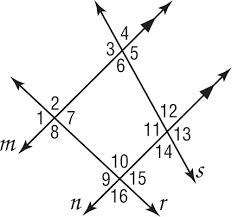
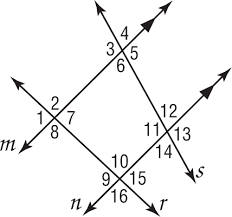
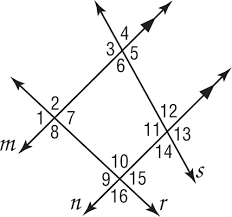
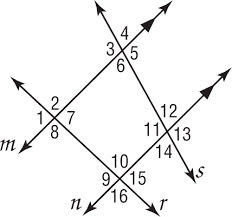
2 and 8\angle2\ and\ \angle8 can best be described as

a)

corresponding angles

b)

a linear pair

c)

vertical angles

d)

alternate interior angles

2.

Name a pair of corresponding angles.

a)

1 and 16\angle1\ and\ \angle16

b)

6 and 11\angle6\ and\ \angle11

c)

2 and 10\angle2\ and\ \angle10

d)

2 and 9\angle2\ and\ \angle9

3.

Name a pair of same-side interior angles.

a)

2 and 15\angle2\ and\ \angle15

b)

6 and 11\angle6\ and\ \angle11

c)

8 and 16\angle8\ and\ \angle16

d)

8 and 7\angle8\ and\ \angle7

4.

Name a pair of alternate interior angles.

a)

2 and 6\angle2\ and\ \angle6

b)

10 and 11\angle10\ and\ \angle11

c)

10 and 12\angle10\ and\ \angle12

d)

4 and 6\angle4\ and\ \angle6

5.

Name a pair of alternate exterior angles.

a)

3 and 16\angle3\ and\ \angle16

b)

3 and 5\angle3\ and\ \angle5

c)

1 and 16\angle1\ and\ \angle16

d)

3 and 13\angle3\ and\ \angle13

6.

12 and 13\angle12\ and\ \angle13  can best be described as

a)

corresponding angles

b)

a linear pair

c)

vertical angles

d)

alternate exterior angles

7.

12 and 16\angle12\ and\ \angle16  can best be described as

a)

alternate exterior angles

b)

alternate interior angles

c)

vertical angles

d)

corresponding angles

8.

6 and 7\angle6\ and\ \angle7  can best be described as

a)

adjacent angles

b)

a linear pair

c)

same-side interior angles

d)

corresponding angles

9.

Name a pair of same-side exterior angles.

a)

2 and 3\angle2\ and\ \angle3

b)

8 and 9\angle8\ and\ \angle9

c)

1 and 4\angle1\ and\ \angle4

d)

14 and 15\angle14\ and\ \angle15

10.

Name a pair of angles that form a linear pair.

a)

5 and 6\angle5\ and\ \angle6

b)

5 and 3\angle5\ and\ \angle3

c)

5 and 12\angle5\ and\ \angle12

d)

5 and 13\angle5\ and\ \angle13

11.

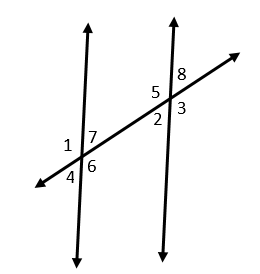
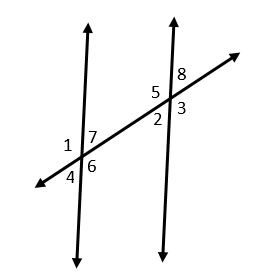
1) Given the two parallel lines cut by a transversal.


What is the vertical angle to angle 4?

a)

Angle 2

b)

Angle 6

c)

Angle 8

d)

Angle 7

12.

2) Given the following two parallel lines cut by a transversal.


Which pair of angles represents corresponding angles?

a)

1\angle1  and  6\angle6  

b)

6\angle6  and 5\angle5  

c)

7\angle7  and 8\angle8  

d)

4\angle4  and 8\angle8  

13.

3) Given the following two parallel lines cut by a transversal.


Which pair of angles represents alternate interior angles?

a)

3\angle3  and 8\angle8  

b)

7\angle7  and 2\angle2  

c)

7\angle7  and 8\angle8  

d)

4\angle4  and 8\angle8  

14.

4) Given the following two parallel lines cut by a transversal.


Which pair of angles represents alternate exterior angles?

a)

4\angle4  and 8\angle8  

b)

7\angle7  and 5\angle5  

c)

1\angle1  and  2\angle2  

d)

6\angle6  and  5\angle5  

15.

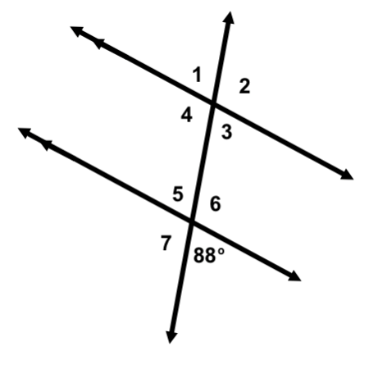
5) True or False.

If the following parallel lines are cut by a transversal, would 
2\angle2  and  6\angle6   be corresponding?

a)

True

b)

False

16.

10)Given the two parallel lines cute by a transversal,

What is the measure of  5\angle5  ?


(a)  

17.

11) Given the two parallel lines cut by a transversal,

What is the measure of 4\angle4  if  m8=76°m\angle8=76\degree  ?


(a)  

18.

3\angle3  and  7\angle7  are ___.  

a)

Alternate Interior Angles

b)

Alternate Exterior Angles

c)

Same-side Interior Angles

d)

Corresponding Angles

e)

None of these

19.

5\angle5  and 6\angle6  are ___.  

a)

Alternate Interior Angles

b)

Alternate Exterior Angles

c)

Same-side Interior Angles

d)

Corresponding Angles

e)

None of these

20.

2 \angle2\  and 3\angle3  are ___.  

a)

Alternate Interior Angles

b)

Alternate Exterior Angles

c)

Same-side Interior Angles

d)

Corresponding Angles

e)

None of these

21.
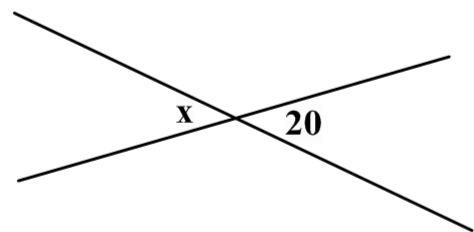
Find the missing angle.  Find x.
a)
20o
b)
70o
c)
160o
d)
180o
22.
If m∠1 = 30°, then m∠3 = 
a)
30°
b)
60°
c)
150°
d)
undetermined
23.
a)
15
b)
16
c)
18
d)
19
24.
What is the measure of the missing angle?
a)
39°
b)
129°
c)
119°
d)
129°
25.
Find the m∠1
a)
67
b)
113
c)
180
d)
23
26.
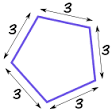
Is the figure a polygon? What type?
a)
No, Quadrilateral
b)
Yes, Hexagon
c)
Yes, Octagon
d)
No, Octagon
27.
A polygon with five sides.
a)
Triangle
b)
Quadrilateral
c)
Pentagon
d)
Heptagon
28.
A four-sided polygon
a)
Triangle
b)
Pentagon
c)
Quadrilateral
d)
Hexagon
29.
How many sides does a Triangle have?
a)
4
b)
3
c)
2
d)
6
30.
How many sides does a Quadrilateral have?
a)
4
b)
3
c)
6
d)
9
31.
How many sides does a Pentagon have?
a)
4
b)
3
c)
5
d)
9
32.
How many sides does a Hexagon have?
a)
6
b)
4
c)
3
d)
9
33.
How many sides does an Octagon have?
a)
4
b)
3
c)
9
d)
8
34.
What is a polygon?
a)
A closed figure made up of straight line segments
b)
An open figure made up of straight line segments
c)
A closed figure made up of curved edges
d)
An closed figure made up of crossed line segments
35.
 What is the name of this polygon?
a)
a pentagon
b)
a quadrilateral
c)
an octagon
d)
a triangle
36.
Polygon or Non-Polygon?
a)
Polygon
b)
Non-Polygon
37.
A polygon has to have
a)
at least two sides
b)
at least three sides
c)
four or more sides
d)
no sides
38.
How many sides does a decagon have?
a)
12
b)
9
c)
7
d)
10
39.
A polygon with equal side lengths and angle measures.
a)
Regular Polygon
b)
Equilateral Polygon
c)
Equiangular Polygon
d)
Irregular Polygon
40.
Tell whether the polygon is regular or irregular.  Tell whether it is concave or convex.
a)
Regular; Concave
b)
Irregular; Convex
c)
Irregular; Concave
d)
Regular; Concave
41.
Tell whether the polygon is regular or irregular. Tell whether it is concave or convex
a)
Regular, Concave
b)
Regular, Convex
c)
Irregular, Concave
d)
Irregular, Convex
42.
Tell whether the figure is regular or irregular...concave or convex.
a)
Regular - Convex
b)
Regular - Concave
c)
Irregular - Convex
d)
Irregular - Concave
43.
Convex or Concave?
a)
Convex
b)
Concave
44.
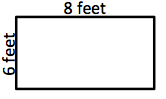
What is the area of the rectangle?
a)
48 sq feet
b)
48 sq inches
c)
28sq feet
d)
28 feet
45.
What is the perimeter of the rectangle?
a)
15 cm
b)
16 cm
c)
15 sq cm
d)
15 cm
46.
Area = Length X Width 
If the Length is 10 cm and the Width is 2 cm was is the area? 
a)
12 sq. cm 
b)
12 cm 
c)
20 sq. cm 
d)
20 cm 
47.
Perimeter of triangle??
a)
20 cm
b)
28 cm
c)
27 cm
d)
56 cm
48.
What is the perimeter?
a)
12
b)
15
c)
18
d)
3
49.
What is the area of a square with a length of 4 cm?
a)
16 cm
b)
16 square cm
c)
8 cm
d)
8 square cm 
50.
What does "circumference" mean?
a)
Space a circle takes up
b)
Distance around a circle
c)
Line from one side of a circle to another
d)
Line from center of circle to side
51.
Find the area of the circle
a)
43.96
b)
153.86
c)
87.82
d)
307.72
52.
Find the circumference of a circle with a radius of 13.5 mm.
a)
37.68mm
b)
18.84mm
c)
84.78 mm
d)
none of the above
53.
The radius of the circle is 9 meters.  What is the circle's circumference rounded to the nearest hundredths?
a)
9 meters
b)
28.26 meters
c)
28.27 meters
d)
18 meters
54.
Find the circumference (to the nearest whole number)
a)
88 in
b)
44 in
c)
116 square in
d)
None of the above
55.

Area of triangle

a)

30

b)

15

c)

12

d)

22

56.
A slide is also called a _________.
a)
Translation
b)
Reflection
c)
Rotation
d)
Transformation
57.
A turn is also called a ___________.
a)
Translation
b)
Reflection
c)
Rotation
d)
Transformation
58.
Name the transformation.
a)
Translation
b)
Reflection
c)
Rotation
59.
 Describe the Transformation
a)
Translation
b)
Rotation
c)
Reflection
60.
Identify the transformation.
a)
Reflection across y axis
b)
Reflection across x-axis
c)
180 Rotation
d)
Translation 2 units down
61.
Write a rule for the translation.
a)
 (x -1, y  + 2)
b)
 (x -2, y  + 1)
c)
 (x +2, y  - 1)
d)
(x +1, y  -  2)
62.

ΔDEF\Delta DEF   will undergo a transformation to create  ΔDEF\Delta D'E'F'   in the coordinate plane. Which transformation below will NOT result in  ΔDEFΔDEF\Delta DEF\cong\Delta D'E'F'  ?

a)

(x, y)(3x, y1)(x,\ y)→(-3x,\ y-1)  

b)

(x, y)(x+2, y5)(x,\ y)→(x+2,\ y-5)  

c)

(x, y)(x, y+3)(x,\ y)→(-x,\ y+3)  

d)

(x, y)(x,y)(x,\ y)→(-x,-y)  

63.

The figure shows two perpendicular lines, and , intersecting at a point P in the interior of a trapezoid. Line is parallel to the bases and bisects both legs of the trapezoid. Line bisects both the bases of the trapezoid. Which transformation will carry the figure onto itself?

a)

a reflection across line rr .

b)

a reflection across line ss .

c)

a rotation of 90°90\degree about point PP .

d)

a rotation of 180°180\degree about point PP .

64.

Zach and Naomi are studying geometric transformations. Zach is able to move the triangle AA to  AA'  using the following sequence of basic transformations:

        1. Reflection across the x-axis.
        2. Reflection across the y-axis.
        3. Translation two units to the right.
Naomi claims that the same three transformations, done in any order will always produce the same result. Zach disagrees. Who is correct?

a)

Zach

b)

Naomi

c)

Both are correct

d)

Both are incorrect

65.

ΔABC\Delta ABC  is shown in the coordinate plane. The triangle will be translated 4 units down and 5 units to the right to create  ΔABC\Delta A'B'C' . Which of the following parts of the image will NOT be the same as the corresponding part in the pre-image  (ΔABC)\left(\Delta ABC\right)

a)

the perimeter of  ΔABC.\Delta A'B'C'.  

b)

the measure of  A\angle A  

c)

the coordinates of  CC'  

d)

the slope of  ABA'B'  

66.

ΔABC\Delta ABC  is shown the coordinate plane. It will be rotated 90 degrees clockwise about the origin to form  ΔABC\Delta A'B'C'  . Which of the following figures shows the correct orientation of  ΔABC\Delta A'B'C'  in the coordinate plane?

a)
b)
c)
d)
67.

ΔABC\Delta ABC  is shown the coordinate plane. It will be rotated 90 degrees clockwise about the origin to form  ΔABC\Delta A'B'C'  . What will be the coordinates of  A, BA',\ B' and  CC' ?  

a)

A(1,2),  B(3,3), C(2,5)A'\left(1,-2\right),\ \ B'\left(3,-3\right),\ C'\left(2,-5\right)  

b)

A(2,1), B(3,3), C(5,2)A'\left(2,-1\right),\ B'\left(3,-3\right),\ C'\left(5,-2\right)  

c)

A(1,2), B(3,3), C(2,5)A'\left(-1,2\right),\ B'\left(-3,3\right),\ C'\left(-2,5\right)  

d)

A(1,2), B(3,3), C(2,5)A'\left(-1,-2\right),\ B'\left(-3,-3\right),\ C'\left(-2,-5\right)  

68.

Octagon PQRSTVWZPQRSTVWZ is a regular octagon with its center at point  CC  . Which transformations will map octagon  PQRSTVWZPQRSTVWZ   onto itself? Select ALL that apply.

a)

reflection over  QV\overline{QV}

b)

reflecting over  RW\overline{RW}  

c)

reflecting over  TZ\overline{TZ}  

d)

rotating  45°45\degree  clockwise around point  ZZ  

e)

rotating  90°90\degree  counterclockwise around point  CC  

69.

ΔJKL\Delta JKL  will undergo a transformation to create  ΔJKL\Delta J'K'L'  in the xy coordinate plane. Which transformations will result in  ΔJKLΔJKL\Delta JKL\cong\Delta J'K'L' ?  Select all that apply.

a)

(x, y) (x, y)\left(x,\ y\right)\rightarrow\ \left(-x,\ -y\right)  

b)

(x, y) (x, y)\left(x,\ y\right)\rightarrow\ \left(-x,\ y\right)  

c)

(x, y) (x, y5)\left(x,\ y\right)\rightarrow\ \left(x,\ y-5\right)  

d)

(x, y) (x+3,  y5)\left(x,\ y\right)\ \rightarrow\left(x+3,\ \ y-5\right)  

e)

(x, y) (2x, 3y)\left(x,\ y\right)\rightarrow\ \left(2x,\ 3y\right)  

70.
Point (-5,2) is reflected over the y axis.  Where is the new point located?
a)
(5,2)
b)
(-5,-2)
c)
(-5,2)
d)
(5,-2)
71.
Which of the following describes the sequence of transformations shown?
a)
Reflect across the x-axis and then rotate -90 degrees around the origin
b)
Rotate -90 degrees around the origin and then translate down.
c)
Reflect across the x-axis and then reflect across the y-axis.
d)
Translate up and then rotate 90 degrees about the origin.
72.
Which answer shows a reflection across the y-axis?
a)
a
b)
b
c)
c
d)
d
73.
Find K' if the figure is reflected across the x-axis
a)
(4, 1))
b)
(-1, -4)
c)
(1, -4)
d)
(1, 4)
74.
What is the algebraic notation of a figure is Translated 9 units right and 3 units down?
a)
(x, y) --> (x - 9, y + 3)
b)
(x, y) --> (x + 9, y - 3)
c)
(x, y) --> (x + 3, y - 9)
d)
(x, y) --> (9x, 3y)
75.
The dashed figure is the image of the solid figure.  What is the Algebraic Notation for the Translation?
a)
(x, y) --> (x - 7, y + 4)
b)
(x, y) --> (x + 7, y - 4)
c)
(x, y) --> (x + 4, y - 7)
d)
(x, y) --> (7x, 4y)
76.
What is the name of this 3D solid?
a)
Cone
b)
Triangular Prism
c)
Hexagonal Pyramid
d)
Cylinder
77.
What is the name of this 3D solid?
a)
Rectangular Tetrahedron 
b)
Rectangular Prism
c)
Rectangular Pyramid
d)
Sphere
78.
What is the name of this 3D solid?
a)
Cone
b)
Square Pyramid
c)
Triangular Prism
d)
Hexagonal Pyramid
79.
What is the name of this 3D solid?
a)
Triangular Prism
b)
Triangular Pyramid
c)
Square Prism
d)
Square Pyramid 
80.

What is the name of this 3D solid?

a)

Cube

b)

Triangular Prism

c)

Rectangular Pyramid

d)

Cone

81.

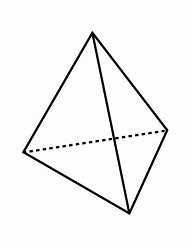
What is the name of this polyhedron?

a)

Square Pyramid

b)

Rectangular Prism

c)

Triangular Prism

d)

Triangular Pyramid

82.

The flat side of a polyhedron is called:

a)

vertex

b)

face

c)

edge

d)

street

83.

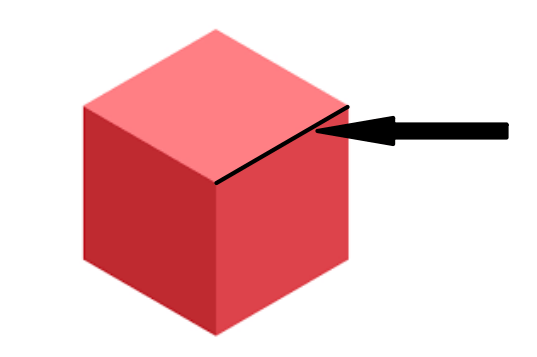
Name the indicated segment in the polyhedron.

a)

edge

b)

outside

c)

face

d)

vertex

84.

How many faces does a square pyramid have?

a)

8 faces

b)

6 faces

c)

4 faces

d)

5 faces

85.
Number of Faces?
a)
7
b)
5
c)
4
d)
15
86.

All of the faces on a pyramid that are NOT the base must be

a)

rectangles

b)

triangles

c)

squares

87.

A pyramid has _______ base(s).

a)

1

b)

2

88.

A prism has _______ base(s).

a)

1

b)

2

89.

Pyramids and prisms both belong to this category of shapes

a)

polygons

b)

parallelograms

c)

polyhedrons

90.
What shape will the horizontal cross-section of a sphere be?
a)
Dome
b)
Circle
c)
Ellipse
d)
Rectangle
91.
What shape will the horizontal cross-section of a cone be?
a)
Dome
b)
Circle
c)
Pyramid
d)
Triangle
92.
What shape will the vertical cross -section of a cylinder be?
a)
Circle
b)
Triangle
c)
Rectangle
d)
Ellipse
93.
What shape will the vertical cross-section of a cube be?
a)
Square
b)
Triangle
c)
Trapezoid
d)
Circle
94.

Describe the cross section.

a)

triangle

b)

rectangle

c)

trapezoid

d)

square

95.
Describe the cross section.
a)
rectangle
b)
square
c)
oval
d)
circle
96.
Describe the cross section.
a)
circle
b)
oval
c)
semi-circle
d)
trapezoid
97.
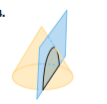
What shape does this cross section make?
a)
circle
b)
Trapezoid
c)
Rectangle
d)
Parallelogram
98.
Describe the cross section.
a)
triangle
b)
rectangle
c)
oval
d)
trapezoid
99.

A plane intersects a hexagonal prism. The plane is perpendicular to the base of the prism. Which two-dimensional figure is the cross section of the plane intersecting the prism?

a)

triangle

b)

trapezoid

c)

hexagon

d)

rectangle

100.

A plane intersects a hexagonal prism. The plane is parallel to the base of the prism. Which two-dimensional figure is the cross section of the plane intersecting the prism?

a)

triangle

b)

trapezoid

c)

hexagon

d)

rectangle

101.

Select the 2D object that can be rotated to form the 3D object shown.

a)
b)
c)
d)
102.

. Triangle ABC, with vertices at A(0,0), B(3,5), and C(0,5) is graphed on the set of axes above. Which figure is formed when triangle ABC is rotated continuously about BC?

a)
b)
c)
d)
103.

Select the 2D object that can be rotated to form the 3D object shown.

a)
b)
c)
d)
104.

If the rectangle below is continuously rotated about side w, which solid figure is formed?

a)

pyramid

b)

cylinder

c)

rectangular prism

d)

cone

105.

Which 2-D shape could be revolved about the vertical line to create the 3-D solid?

a)
b)
c)
d)
106.

Which 3 dimensional object would result from rotating the figure around the axis drawn?

a)

sphere

b)

triangular prism

c)

Cylinder

d)

cone

107.

Which 3 dimensional object would result from rotating the figure around the axis drawn?

a)

sphere

b)

doughnut

c)

washer

d)

cone

108.

what common object would resemble this circle rotated around the x axis?

a)

ball

b)

can

c)

donut

d)

lamp

109.

Identify the solid of revolution generated by revolving the region around the fixed line 𝓁.

a)
b)
c)
d)
110.

Identify the solid of revolution generated by revolving the region around the fixed line 𝓁.

a)
b)
c)
d)