
 Worksheets
Atmosphere & Weather
Total questions: 40
Worksheet time: 26mins
All of the weather on Earth is caused by:
Tectonic plates colliding at convergent plate boundaries.
The uneven heating of Earth by the Sun.
The moon's gravitational pull on the Earth.
Oceanic currents causing upwelling and downwelling.
Which map best represents the surface wind pattern around Northern Hemisphere high-pressure and low-pressure centers?


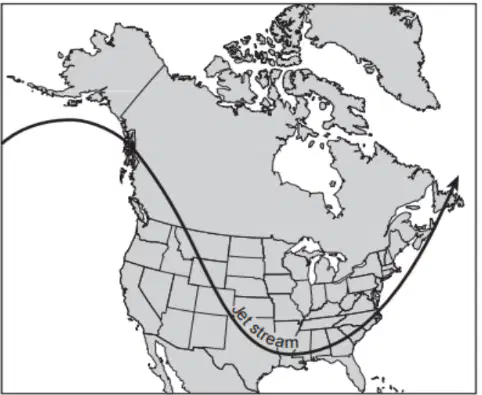
The map to the left shows a position of the polar jet stream over North America in January. Which map best shows the air-mass movements associated with this jet stream position?


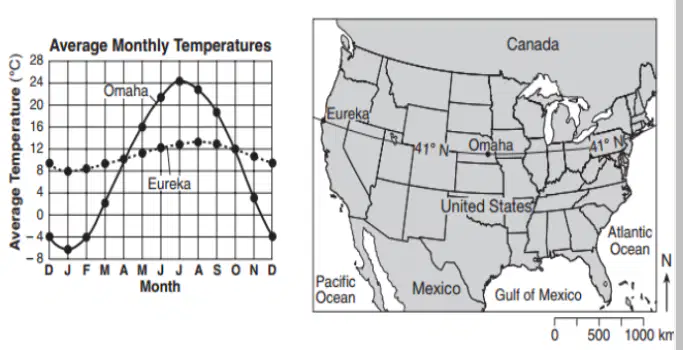
The average monthly temperatures for Eureka, California, and Omaha, Nebraska, are plotted on the graph. The map indicates the locations of these two cities. What explains why Omaha has a greater variation in temperature throughout the year than Eureka.
Omaha is closer to the equator than Eureka, causing the temperature to vary.
The high elevation of Omaha allows for the temperature to vary throughout the year.
Eureka is close to the coast line which helps regulate its temperature to vary throughout the year.
The Polar Continental wind and the Tropical Maritime winds cause the greater changes in Omaha throughout the year.
Climates are classified according to two major factors:
precipitation and temperature
elevation and precipitation
latitude and temperature
elevation and latitude
Which of the following is not a requirement in the formation of thunderstorms?
abundant source of moisture
disturbance in the atmosphere
mechanism to cause the air to rise
electricity within the convection zone
A city located on the coast of North America has warmer winter and cooler summers than a city a the same elevation and latitude located near the center of North America. Which statement best explains the difference between the cities' climates?
Ocean surfaces have a lower specific heat than land surfaces.
Wind speeds are usually greater over land surfaces than over ocean surfaces.
Ocean surfaces change temperature more slowly than land surfaces.
Warm, moist air rises when it meets cool, dry air.
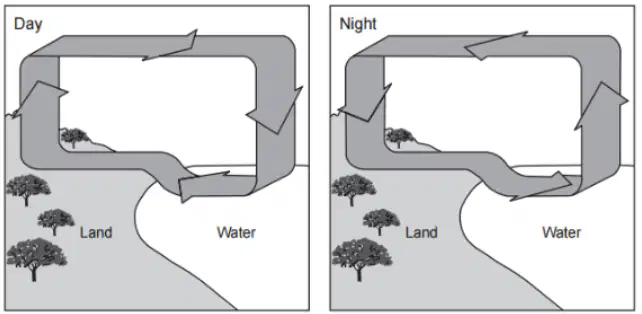
The diagram to the left represents the circulation of air above Earth's surface at a coastal location during the day and night. The local air movement is best described as an example of......
convection resulting from temperature and pressure differences above land and water
conduction between Earth's surface and the atmosphere above it
great radiation from the warmer ocean during the day and from the warmer land at night
condensation of water vapor during the day, and evaporation of water during the night
What causes a hurricane to lose energy?
heating from below by land
lack of warm, moist air
moving into cold water
both b & c
Which event followed a massive volcanic eruption and led to the cooling of global temperatures?
the outflow of magma over Earth's surface
thunderstorms that developed near the eruption
the addition of ash particles into the atmosphere
the release of carbon dioxide and methane gases
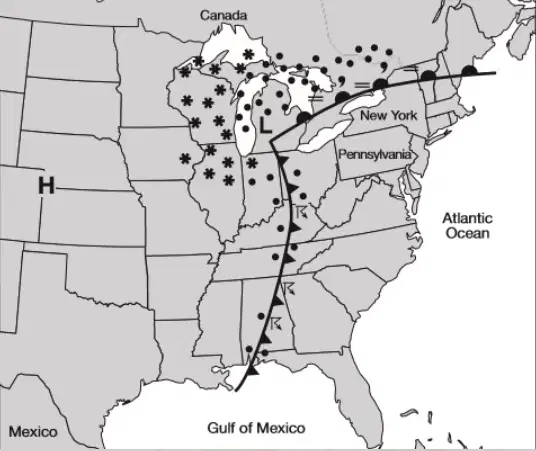
The map to the left is a portion of eastern North America shows a high-pressure center (H) and a low-pressure center (L), frontal boundaries, and present weather conditions. Which weather condition is shown along the cold front?
snow
fog
thunderstorms
haze
The farther you live from an ocean, the more likely your climate will be a .....
tropical climate
marine climate
subtropical climate
continental climate
Which event is inferred by most scientists to be responsible for a climate change that has recently led to a decrease in the size of most glaciers?
an increase in the amount of vegetative cover in the tropics
an increase in the amount of greenhouse gases in Earth's atmosphere
a decrease in the rate of divergence of lithospheric plates along a mid-ocean ridge
a decrease in the amount of insolation reaching Earth's surface
The greenhouse effect is...
the process by which gases hold heat in the atmosphere
the reflection of solar energy into the atmosphere
gradual increase in the temperature of the atmosphere
the absorption of energy by clouds
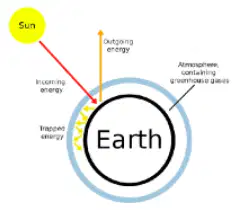
The greenhouse effect is the process by which energy from a planet's atmosphere warms the planet's surface to a temperature above what it would be without its atmosphere. Which method of energy transfer is primarily responsible for energy being lost from Earth into Space?
radiation
convection
solidification
conduction
Most of the hurricanes that affect the east coast of the United States originally form over the ......
cool land of the southeastern United States in spring
warm land of the southern United States
warm waters of the Atlantic Ocean in the summer
cool waters of the Atlantic Ocean in the spring
Convection takes place because...
cold air is less dense than warm air.
warm and cold is less dense than warm air.
cold air is more dense than warm air.
warm air is more dense than humid air.
When a rapidly moving cold air mass overtakes a slow-moving warm air mass, the result is a(n)....
a cold front
warm front
occluded front
stationary front
Low pressure systems, including hurricanes rotates ____________________ in the Northern Hemisphere.
West to East
clockwise
counterclockwise
North to South
Heat transfer between two substances that are in contact is called...
thermal energy
conduction
convection
radiation
The (a) is the layer of the atmosphere that contains the ozone layer.
(a) is the amount of water vapor in the atmosphere at a given location on Earth's surface.
Rain, snow, sleet, and hail are the four main types of (a) .
(a) is the long-term average of variations in weather for a particular area.
A (a) measures temperature using either the Fahrenheit or Celsius scale.
A (a) is a violent, whirling column of air in contact with the ground.
The calm center of a hurricane is called the (a) .
A (a) occurs when hurricane-force winds drive a mound of ocean water toward coastal areas where it washes over the land.
(a) are extended periods of well-below-average rainfall.
(a) is the study of Earth's climate and the factors that cause past, present, and future climatic changes.
(a) are short-term periods with specific-weather conditions caused by regular variations in daylight, temperature, and weather patterns.
(a) is a rise in global temperatures.
Which is a long-term climate change?
an ice age
summer
El Nino
fall
Which could be a result of global warming?
increased volcanic activity
expansion of polar ice caps
rising sea levels
decreased levels of atmospheric carbon dioxide
A heat island is an example of which type of climate?
dry climate
microclimate
tropical climate
polar climate
Which would work against the development of a thunderstorm?
stable air
moisture
unstable air
rising air
Which does not describe a type of damaging thunderstorm wind?
microburst
land breeze
downburst
macroburst
Which is not one of Earth's three basic wind systems or zones?
trade winds
prevailing westerlies
polar easterlies
polar jet streams
Which gas has increased in concentration by about 0.011 percent over the past 150 years?
nitrogen
water vapor
oxygen
carbon dioxide
Which is the primary cause of wind?
pressure imbalances
movement of water
pollution
air saturation

