
 Worksheets
P6 Waves - The Electromagnetic Spectrum
Total questions: 20
Worksheet time: 11mins
Name
Class
Date
1.
What is the Electromagnetic Spectrum?
a)
The range of wavelengths and frequencies of the electromagnetic spectrum.
b)
The range of wavelengths and amplitudes of the electromagnetic spectrum.
c)
The range of frequencies and amplitudes of the electromagnetic spectrum.
2.
Put these even groups of the EM spectrum in the correct order?
a)
Radio, Microwave, Infrared, Visible Light, Ultraviolet, X-rays, Gamma Rays
b)
Radio, Infrared, Microwave, Visible Light, X-rays, Ultraviolet, Gamma Rays
c)
Microwave, Radio, Infrared, Visible Light, Ultraviolet, X-rays, Gamma Rays
d)
Radio, Microwave, Infrared, Visible Light, Ultraviolet, Gamma Rays, X-rays
3.
Which of these EM waves have the lowest frequency
a)
Radio
b)
Microwave,
c)
Infrared,
d)
Visible Light
4.
Which of these EM waves have the highest frequency
a)
Ultraviolet
b)
Microwave
c)
X-ray
d)
Gamma rays
5.
Which is the only group of the EM spectruym that human eyes can detect
(a)
6.
What colour of visible light has the longest wavelength and the lowest frequency
a)
red
b)
orange
c)
yellow
d)
green
e)
blue
7.
What colour of visible light has the shortest wavelength and the highest frequency
a)
violet
b)
red
c)
orange
d)
yellow
e)
green
8.
How are gamma rays created?
a)
By changes in an atoms nucleus
b)
By electrons being discharged from atoms
9.
How are radio waves produced?
a)
By electrons oscillating in an electrical circuit.
b)
By metal ions oscillating in an electrical circuit.
10.
What happens when an electric circuit absorbs radio waves?
a)
It causes electrons in the circuit to oscillate causing an alternating current in the circuit that has the SAME frequency as the radio wave.
b)
It causes electrons in the circuit to oscillate causing an alternating current in the circuit that has a DIFFERENT frequency as the radio wave.
11.
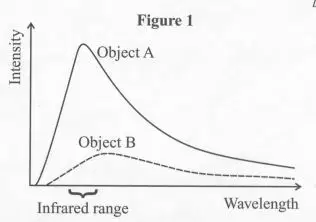
1.2 Figure 1 shows a graph of intensity against wavelength for two objects at different temperatures.
Name the part of the electromagnetic spectrum that the peak wavelength of object B lies in. [1]
a)
microwaves
b)
radio
c)
infrared
d)
visible light
e)
ultraviolent
12.
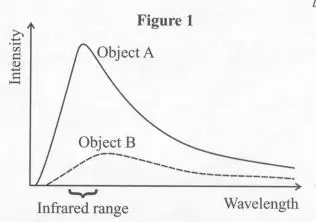
The peak wavelength for object A lies within the infrared range of the electromagnetic spectrum.
Describe an example of infrared radiation transferring energy from a source to an absorber. [2]
4 lines
13.
A man is wearing mirrored sunglasses. Anyone looking at him can see their reflection in the glasses but cannot see his eyes. The man can still see through the glasses.
State what happens to the light as it passes from the surroundings to the mirrored sunglasses. It is...
a)
Reflected
b)
Absorbed
c)
Transferred
14.
The electromagnetic spectrum includes the complete range of electromagnetic waves placed in order of:
a)
increasing amplitutde
b)
increasing wavelength
c)
increasing frequency
15.
Which of the following lists the electromagnetic waves in order of increasing wavelength?
a)
X-rays, visible light, radio waves
b)
gamma rays, microwaves, UV rays
c)
infrared rays, radio waves, x-rays
16.
Which of the following lists the electromagnetic waves in order of decreasing frequency?
a)
X-rays, microwaves, infrared rays
b)
UV rays, visible light, x-rays
c)
infrared rays, microwaves, radio waves
17.
A wave with a large wavelength will have a ______ frequency and _____ energy
a)
high, low
b)
high, high
c)
low, high
d)
low, low
18.

Which has the LONGEST wavelength and, therefore, the lowest frequency/energy
a)
Gamma Rays
b)
Radio Waves
c)
Visible Light
d)
Infrared rays
19.

Which has the SHORTEST wavelength and, therefore, the highest frequency/most energy
a)
Radio waves
b)
Ultraviolet Rays
c)
Gamma Rays
d)
X-rays
20.

Which color has the longest wavelength?
a)
Yellow
b)
Red
c)
Green
d)
Purple
100 %

