
Font size
 Worksheets
Quiz 2 - Topics 1, 2, 3
Total questions: 64
Worksheet time: 5hrs 20mins
Aria, Ethan, and Sophia are working on a science project about atoms. They need to identify the three basic parts of an atom. What should they list?
Protons, electrons, and neutrons
Protons, electrons, and photons
Protons, electrons, and ions
Protons, electrons, and isotopes
What is the goal of atoms when forming covalent bonds?
To gain electrons
To lose electrons
To share electrons
To transfer electrons
Valence electrons are those that are
closest to the nucleus.
freely floating between atoms.
in the outermost energy level of the atom.
unable to become involved in chemical bonding.
Which of the following is not a way that ions can form?
gaining electrons
gaining protons
losing electrons
All of the above are ways that ions can form.
Of the choices below, which of the following most likely contains covalent bonds?
PCl5
RbCl
PbCl2
MoCl6

The table shows information for four different elements
A cube of an unknown element has a shiny, silvery color. The side of the cube measures 2.0 cm and the cube has a mass of 14.56 g.
Based on the information in the table, which element makes up the cube?
barium
beryllium
phosphorus
chromium

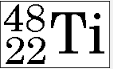
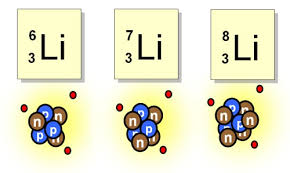

What is the name of the pictured isotope( 1735Cl )?

Isotopes are atoms of the same element with different #’s of __________ & therefore different __________.
neutrons ; atomic numbers
protons ; atomic numbers
electrons ; mass numbers
neutrons ; mass number
Which of these best describes the basis on which new scientific ideas are accepted or rejected?
Popular support
Moral and ethical beliefs
Carefully collected and analyzed data
Historical support
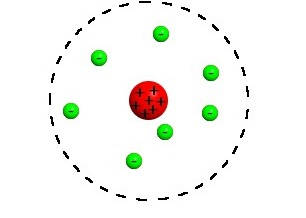
This model this model was the first to show a nucleus, consisting of protons and neutron. Electrons surround the nucleus but are not shown in distinct energy levels.
The "Rutherford Model" of the atom
The "Plum Pudding Model" of the atom
The "Quantum Mechanical Model" of the atom

This model was developed after J.J. Thompson discovered electrons, a particle smaller than an atom. It shows electrons floating freely in a positive region.
The "Plum Pudding Model" of the atom
The "Rutherford Model" of the atom
Democritus's model of the atom
The "Quantum Mechanical Model" of the atom

Which scientist proposed the "plum pudding model" of the atom?
J. J. Thomson
Joseph Proust
Ernest Rutherford
Antoine Lavoisier
John Dalton
Who was the first to propose that matter consist of indivisible particle of matter called atoms?
John Dalton
Aristotle
Democritus
Plato
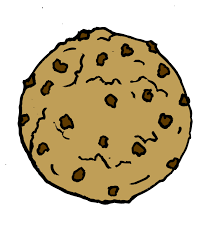
In the atomic model nicknamed the "plum pudding" model, what do the plums represent?
the nucleus
the atom
the electrons
the positive material
The cathode-ray tube was used to discover the ____ by ____.
electron by Thomson
electron by Dalton
proton by Thomson
proton by Dalton
electron by Rutherford
What are electrons?
an atom’s central regions, which is made up of protons and neutrons
subatomic particles that have negative charges
subatomic particles that have neutral charges
subatomic particles that have positive charges

What were J. J. Thomson's major contributions to the atomic theory? (Select all that apply)
Discovered the electron
Discovered the nucleus
Studied cathode ray tubes
Proposed a model of the atom with electrons moving around the nucleus
Proposed the "plum pudding" model of the atom
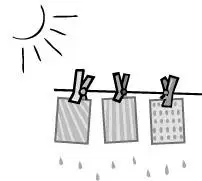
A swimming team wants to select one of three fabrics for their new swimsuits. Each fabric is made of a different material. The team decides to do the following experiment:
They cut the same size pieces from each fabric and wet each piece with the same amount of water. They hang the pieces in the sunlight and they check every two minutes to see if any of the pieces are dry.
What can the team find out about the different fabrics from doing just this experiment?
If the type of fabric affects how long it takes the pieces of fabric to dry
If the type of fabric, the amount of water, and the amount of light affect how long it takes the pieces of fabric to dry.
If the amount of water affects how long it takes the pieces of fabric to dry.
If the amount of water and the amount of light affect how long it takes the pieces of fabric to dry.
What is a hypothesis?
the thing changed on purpose in the experiment
an explanation about what you observed
using your 5 senses to gather data
an educated guess about the outcome of an experiment
The part of the experiment that remains unaffected by the independent variable. Used to compare dependent variable to.
constants
control group
independent
dependent


a factor that is not changed in an experiment; all the parts that stay the same to keep the experiment fair and consistent
variable
control group
constant
evidence
Ms. Frizzle wanted to know what color flower attracted the most butterflies. She already had white flowers planted, but she added red and purple flowers to her garden. Every day she watched the flowers from 10 -11 in the morning and counted how many butterflies landed on each colored flower. Each flower was planted in the band courtyard and was watered at 3:30 every day.
White flowers is the ______________
independent variable
constant
dependent variable
control
An ion with 5 protons, 6 neutrons, and a charge of +3 has an atomic number of
3
5
6
8
Which of the following statements best compares the wavelengths of the regions of the electromagnetic spectrum?
Ultraviolet waves are longer than visible light waves
Radio waves are shorter than visible light waves.
Microwaves are shorter than x-rays.
Infrared waves are longer than gamma rays
Under which condition is light produced with respect to the hydrogen spectrum?
Electrons release energy as they return to the ground state
Electrons absorb energy as they return to the ground state.
Electrons release energy as they move to an excited state
Protons absorb energy as they move to an excited state

Marshall is interested in how temperature affects the volume of a substance. He conducts an experiment in which he measures the volume of a given mass, in milliliters (ml), at various temperatures, in Kelvin (K). He plots his results, as shown in the graph. From the graph, which of the following can Marshall correctly conclude?
Mass may change form, but it can neither be created nor destroyed
Temperature is inversely proportional to the volume of a given mass
Temperature is directly proportional to the volume of a given mass
Energy may change form, but it cannot be created nor destroyed
In what ways is a model similar to the thing it represents?
A model can be different from the thing it represents in either its size or the materials it is made of
A model must be identical to the thing it represents in every way.
A model must be identical to the thing it represents in every way except that it can be a different size
A model must be identical to the thing it represents in every way except that it can be made out of different materials
Which of the following is an example of a physical change?
Hydrogen combined with oxygen forms water
Liquid nitrogen exposed to air becomes nitrogen gas
Iron exposed to air produces rust
Sulfur combined with oxygen produces sulfur dioxide
Which element has a larger radius?
Bromine (Br)
Potassium (K)
Gallium (Ga)
Arsenic (As)
Which has a higher ionization energy?
Hydrogen (H)
Lithium (Li)
Potassium (K)
Cesium (Cs)
Which has a higher ionization energy?
Xenon (Xe)
Rubidium (Rb)
Strontium (Sr)
Iodine (I)
Which element has the highest electronegativity?
Fluorine (F)
Iodine (I)
Bromine (Br)
Chlorine (Cl)

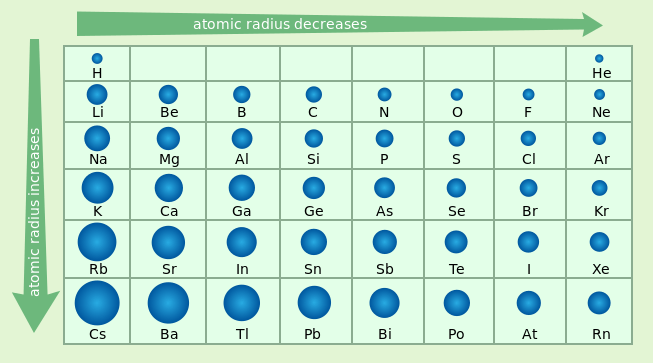

Which statement correctly and completely identifies a trend?
Atomic radius decreases across a period and increases down a group.
Electronegativity decreases across a period and decreases down a group.
Ionization energy increases across a period and increases down a group.
Ionic radius increases across a period and increases down a group.
Valence electrons are the
outer most electrons in an atom
total electrons in an atom

This could be the dot diagram of
Mg
Cl
C
O

This is a correct dot diagram for nitrogen (N)
true
false

This is a correct dot diagram for neon (Ne)
true
false

Given the hypothesis that the element zinc prevents cancer, which of the following procedures BEST exemplifies the nature of scientific investigation?
Give zinc supplements to a group of rats and not to another group. After a period of time, determine if there is a higher incidence of cancer in the control group.
Rely on testimony of friends and relatives, as well as conduct a survey to see if there is a concentration of cancer in the people not taking zinc supplements.
Analyze zinc, looking for allotropic forms
Do research on zinc and its uses throughout history to determine if there is evidence that zinc prevents incidence of cancer
Helium is a noble gas with how many electrons in one energy level?
2
6
3
8
What is the overall charge of the ionic compound NaCl
+1
+2
+3
0
Cations lose
their cats
Their electrons
Their anions
their bonds
Anions gain...
Their onions
respect
electrons
binaries
Which of the following includes an example of a chemical property of an element?
Sodium reacts with other elements
Silicon is shiny and is a poor conductor of electricity.
Sulfur is not shiny and is not malleable
Aluminum is a solid at room temperature and is a poor thermal insulator

