
 Worksheets
APWHM 2.1/2.2 Quiz
Total questions: 18
Worksheet time: 11mins
Which Empire contributed greatly to the second golden age of the Silk Road?
Mongol
Abbasid
Song
Byzantine
What role did the city of Kashgar play in the Silk Road?
Kashgar provided entertainment for those traveling along the Silk Road
Kashgar provided the only Christian churches along the Silk Road
Kashgar provided food and water to travelers along the Silk Road
Kashgar provided travelers with most luxurious accommodations along the Silk Road
Why were caravanserais around 100 miles apart?
Travelers liked to rest every 100 miles
Travelers would travel an average of 100 miles per day
Camels couldn’t travel more than 100 miles without getting too tired
Camels needed to drink water every 100 miles
Which of the following factors helps explain the rise of urban centers and the increase in trade in Afro-Eurasia during the second half of the thirteenth century?
The increase in all forms of coerced labor to build housing
The decline of the Mongol khanates across Asia
The reopening of Indian Ocean trade networks by Chinese explorers
The availability of safe and reliable transport along land-based trade routes
Which of the following was a major cause for the growth of cities throughout Afro-Eurasia from 800 C.E. to 1350 C.E.?
The spread of mercantilism
The decline in epidemic diseases
The rise of interregional commerce
The decreasing need for agricultural workers
"The road you travel from Tana to Cathay (China) is perfectly safe, whether by day or by night, according to what the merchants say who have used it .... Cathay is a province which contained a multitude of cities and towns. Among others there is one in particular, that is to say the capital city, to which is great resort of merchants, and in which there is a vast amount of trade; and this city is called Cambalec. And the said city hath a circuit of one hundred miles, and is all full of people and houses and of dwellers in the said city." ~Francesco Pegolotti, The Merchant's Handbook, c. 1471
Which objects or ideas was the author most likely writing about that represented continuity or change in Chinese trade?
silver, gems, and gold went from Europe to China; wool, horses, and the ideas of Islam went from China to Europe
silk, paper, and Christianity went from Europe to China; gunpowder, silver, and Buddhism went from China to Europe
silver, gems, and gold went from Europe to China; silk, paper, and gunpowder went from China to Europe
paper and Christianity went from Europe to China; silk, gunpowder, horses, and wool went from China to Europe
Genghis Khan had the reputation as a
Fair and just leader
Terrifying warrior
Unapproachable leader
Timid warrior
What did Mongols do with the weapons and technology of peoples they conquered?
Burned it in the center of the city
Ignored it
Stole the scholars who made it
Incorporated it into their own military
Hulegu and most of the Mongols living in the Il-Khanate converted to:
Christianity
Buddhism
Hinduism
Islam
The Mongols reintroduced a system of long distance, peaceful, interregional trade from 1250-1350 called the
Golden Silk Road
The Golden Horde
Pax Mongolica
Mongol Yoke
“It is widely accepted that the rise of the Mongol Empire greatly expanded trade and the circulation of goods. . . . Since the fall of the Uighur Empire [in the ninth century], Mongolia was a region removed from the main trade routes. Thus the Mongols irrupted into the wider world as a relatively unknown society. As the Mongol Empire dominated Eurasia, envoys, merchants and travelers came to the court of the Mongols . . . and participated in . . . the exchange of goods, ideas, technology and people precipitated by the Mongol conquests.”
Timothy May, United States historian, academic article, 2016
The breakup of the Mongol Empire into separate khanates during the mid-thirteenth century was most connected to which of the following developments?
The spread of the bubonic plague following the expansion of trade along the Silk Roads weakened the Mongol Empire demographically and militarily.
Mongol traditions emphasized tribal and personal loyalties and made it difficult to establish long-lasting centralized dynastic rule, which led to civil war.
Rebellions in China overthrew Mongol rule there and led to the reestablishment of Han Chinese rule under the Ming dynasty.
The attempts of Mongol rulers to force their subjects to convert to Islam led to widespread rebellions in Central and East Asia.
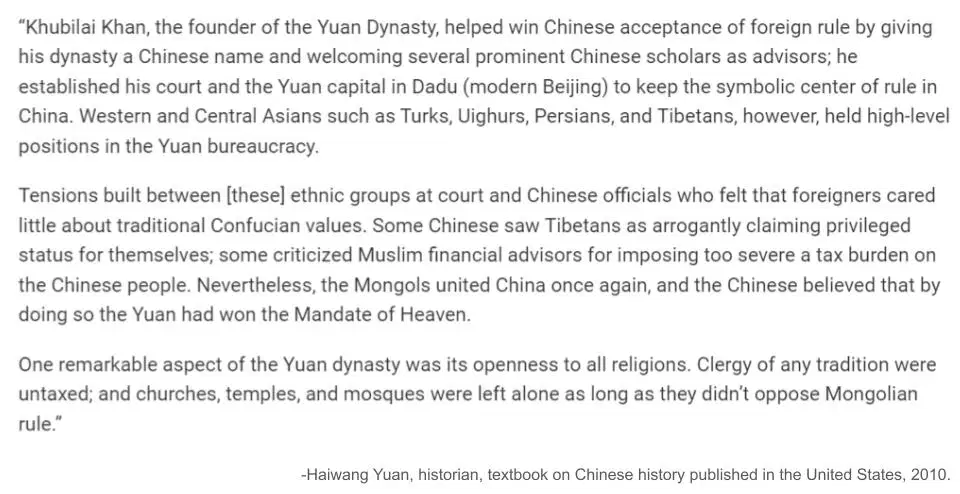
(click image to enlarge) Which piece of evidence from the passage would best support the argument that the Mongols contributed to the integration of cultures across Eurasia by the end of the thirteenth century?
Khubilai Khan established his dynasty's capital on the site of present-day Beijing
Turks, Uighurs, and Persians served in high-level positions in the Yuan bureaucracy.
Some Chinese opposed Mongol rule and the appointment of foreign Yuan officials
Some Chinese opposed having Muslim and Tibetan officials at the Mongol court.
(click image to enlarge) The expansion of the Mongol Empire led most directly to the
spread of feudal land regulations in to East Asia
fall of the European Crusader States in Syria and Palestine into Muslim hands
collapse of previously existing states, such as the Song dynasty of China
adoption of Islamic systems of rule by Arab and Turkic states in the Middle East
(click image to enlarge) All of the following are factually accurate. Which would most strongly support the author's claim regarding the Yuan dynasty and religious tolerance in the third paragraph?
Khubilai Khan introduced paper currency intended for use everywhere
Tibetans were often recruited to serve in the Yuan dynasty's military forces
The Yuan rulers welcomed European travelers and merchants
The Yuan rulers financed the building of Christian churches in China
Which Khan Ruled over China?
Hugelu
Kublai
Odekki
Jekky
Match the following historical developments to the theme that is MOST appropriate.
Silk Roads, paper money, and flying cash
Economics
The fall of Baghdad, the fall of the Song Dynasty, and the rise of the Mongol Empire
Politics
The magnetic compass and the stern rudder
Innovation / Technology
The spread of the Black Death from Asia to Europe due to infected fleas on rats, which followed the trade caravans
Environment
Match the following definitions to the appropriate terms.
Roadside inns found along the silk roads that were spaced about 100 miles apart
Caravanserai
Trading cities that grew along the Silk Roads
Samarkand & Kashgar
System of credit that allowed a merchant to deposit paper money under his name in one location and withdraw the same amount at another location
Flying cash
Chinese invention; used paper bills as currency instead of heavy metal coins
Paper money
Large Chinese ship for carrying trade goods
Junk
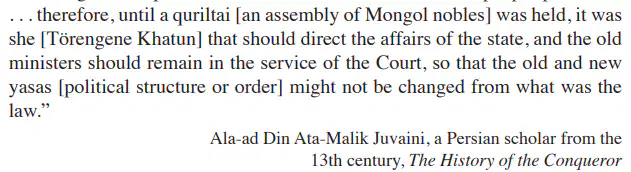
Based on the passage, what can be inferred about the status of women in Mongol society compared to women in the Song Dynasty and Dar al-Islam c. 1250?
The Mongol culture was more accepting of women in power than the cultures of the Song Dynasty or Dar al-Islam.
The women in the Song Dynasty ran the government while the men were subject to foot-binding.
The women in Dar al-Islam ran the government while the men were held as concubines in harems.
Women were of essentially equal status throughout all societies c. 1250.

