wayground logo

Free Printable Worksheets

Font size

S
M
L
XL
Worksheets

HM2 Module 2 Review

Total questions: 84

Worksheet time: 3hrs 48mins

Name
Class
Date
1.

Find the measure of the indicated angle.

a)

30°30\degree  

b)

25°25\degree  

c)

155°155\degree  

d)

65°65\degree  

2.

Find the measure of the indicated angle.

a)

135°135\degree  

b)

55°55\degree  

c)

45°45\degree  

d)

60°60\degree  

3.

Find the measure of the indicated angle.

a)

45°45\degree  

b)

33°33\degree  

c)

123°123\degree  

d)

147°147\degree  

4.

What is the value of the missing angle?

a)

105

b)

80

c)

55

d)

25

5.

Find the measure of the missing angles.

a)

A

b)

B

c)

C

d)

D

6.
Find the value of the base angle. 
a)
30
b)
120
c)
60
d)
180
7.
Find the value of x.
a)
35º
b)
70º
c)
110º
d)
145º
8.
a)
72
b)
67
c)
65
d)
54
9.
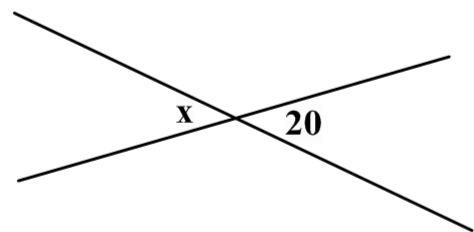
Find the missing angle.  Find x.
a)
20o
b)
70o
c)
160o
d)
180o
10.
What is the value of x?
a)
37
b)
72
c)
108
d)
18
11.
Find the value of x.
a)
14
b)
60
c)
35
d)
180
12.

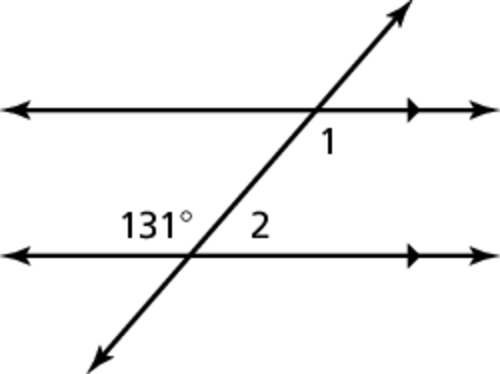
Find  m2.m\angle2.  

a)

131°131\degree  

b)

180°180\degree  

c)

49°49\degree  

13.

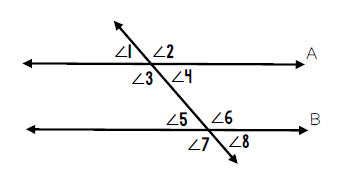
Angle 3 and Angle 6 are examples of which type of angle pair?

a)

Alternate exterior angles

b)

Alternate interior angles

c)

Vertical angles

d)

Corresponding angles

14.

Angle 1 and Angle 5 are examples of which type of angle pair?

a)

Alternate exterior angles

b)

Alternate interior angles

c)

Vertical angles

d)

Corresponding angles

15.

Which of the following is an example of corresponding angles?

a)

8 and 4\angle8\ and\ \angle4  

b)

5 and 7\angle5\ and\ \angle7  

c)

1 and 7\angle1\ and\ \angle7  

d)

3 and 5\angle3\ and\ \angle5  

16.

If the  m7 = 115°,m\angle7\ =\ 115\degree,  find the measure of  2.\angle2.  

a)

115°115\degree  

b)

65°65\degree  

c)

180°180\degree  

d)

Cannot be determined

17.

If the  m5 = 63°,m\angle5\ =\ 63\degree,  find the measure of  3.\angle3.  

a)

63°63\degree  

b)

117°117\degree  

c)

180°180\degree  

d)

Cannot be determined

18.
What type of angle pair is ∠1 and ∠3?
a)
alternate interior angles
b)
 supplementary angles
c)
corresponding angles
d)
vertical angles 
19.

If lines are parallel with a transversal, then these two angles are?

a)

Corresponding Angles

b)

Exterior Alternate Angles

c)

Interior Alternate Angles

d)

Vertical Angles

20.

If lines are parallel with a transversal, then these two angles are...

a)

Supplementary Angles

b)

Corresponding Angles

c)

Alternate Exterior Angles

d)

Parallel Angles

21.

Identify each pair of angles.

a)

alternate exterior

b)

same-side interior

c)

corresponding

d)

alternate interior

22.

Identify each pair of angles.

a)

corresponding

b)

alternate exterior

c)

alternate interior

d)

same-side interior

23.

Identify each pair of angles.

a)

vertical

b)

corresponding

c)

alternate exterior

d)

alternate interior

24.
Angle Q and B are...
a)
Supplementary
b)
Congruent
25.
Angle C and P are...
a)
Alternate Interior Angles
b)
Consecutive Interior Angles
c)
Corresponding Angles
d)
Alternate Exterior Angles
26.
Angle C and P are...
a)
Supplementary
b)
Congruent
27.
Angle R and C are...
a)
Alternate Interior Angles
b)
Consecutive Interior Angles
c)
Corresponding Angles
d)
Alternate Exterior Angles
28.
Angle R and C are...
a)
Supplementary
b)
Congruent
29.
Angle S and B are...
a)
Supplementary
b)
Congruent
30.
Angle P and A are...
a)
Supplementary
b)
Congruent
31.

What equation matches the table?

a)

y=6x

b)

y=x+10

c)

y=x -10

d)

y=x ÷ 6

32.

Write the equation for the table...

a)

y=x-4

b)

y=x+8

c)

y=x-8

d)

y=x+4

33.
Zara made an initial deposit to a bank account and then added a fixed amount every week. The table shows the money in her account. Which equation represents the situation?
a)
y = 30x + 100
b)
y = 20x + 120
c)
y = 120x + 120
d)
y = 50x + 100
34.
The table shows Eli’s distance from home as he rides his bike at a steady rate after meeting a friend. . Write an equation in y = mx + b form that represents the miles, y, that Eli goes in x hours. 
a)
y = 2x + 2
b)
y = 12x + 12
c)
y = 12x + 2
d)
y = 2x + 12
35.

Which equation corresponds to the values in this table?

a)

y = 4 - x

b)

y = 4 - x2

c)

y = x2 - 4

d)

y = -2x - 1

36.

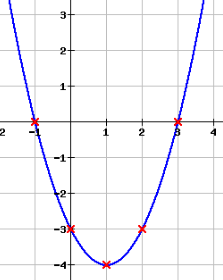
Given the vertex, what is the equation for this quadratic?

a)

y=(x2)24y=\left(x-2\right)^2-4  

b)

y=(x+1)23y=\left(x+1\right)^2-3  

c)

y=(x1)23y=\left(x-1\right)^2-3  

d)

y=(x+2)24y=\left(x+2\right)^2-4  

37.

What type of function does this table represent? What is the function's SECOND DIFFERENCE.

a)

Linear, 2nd difference is -3

b)

Linear, 2nd difference is 3

c)

Linear, 2nd difference is 0

d)

Quadratic, 2nd difference is -3

e)

Quadratic, 2nd difference is 0

38.

What type of function does this table represent? What is the function's SECOND DIFFERENCE.

a)

Linear; 2nd Difference is 3

b)

Linear; 2nd Difference is 3, 6, 9, 12

c)

Quadratic; 2nd Difference is 3

d)

Quadratic; 2nd Difference is -3

e)

Quadratic; 2nd Difference is 3, 6, 9, 12

39.

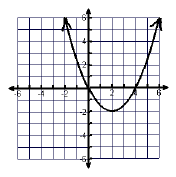
Use the graph to determine the X-intercepts

a)

(-1,0) and (-3,0)

b)

(1,0) and (3,0)

c)

(0,1) and (0,3)

d)

(0,-1) and (0,-3)

40.
What is the equation for axis of symmetry?
a)
y=3
b)
x=3
c)
x=5
d)
x=1
41.

The vertex of the given quadratic function is at its minimum.

a)

True

b)

False

42.

Name the vertex to the given quadratic graph

a)

(2,3)

b)

(3,2)

c)

(0,-1)

d)

(4,-1)

43.
Which of the following equations matches standard form of a quadratic?
a)
ax + by = c
b)
y = a(x - h)2 + k
c)
y = ax2 + bx + c
d)
y = mx + b
44.
What is the range of this function?
a)
(- ∞,+∞)
b)
[0, +∞)
c)
[-2, +∞)
d)
[2, +∞)
45.

What is the decreasing interval on the function shown?

a)

(, 1)\left(-\infty,\ 1\right)

b)

(, 2)\left(-\infty,\ 2\right)

c)

(2, )\left(2,\ \infty\right)

d)

(1, )\left(1,\ \infty\right)

46.

Identify the y-intercept.

a)

(0,3)

b)

(3,0)

c)

(1,0)

d)

(2,-1)

47.
Use the picture to find  the vertex and axis of symmetry
a)
 Vertex (3,8) Axis x=3
b)
Vertex (3,8) Axis y=3
c)
Vertex (8,3) Axis x=3
d)
Vertex (8,3) Axis y=3
48.

Which parabola would open down?

a)

f(x)=x2

b)

f(x)=-x2+3x-6

c)

f(x) = x2-16

d)

f(x)=2x2-5x+7

49.

The graph of a Quadratic function is shown. Select ALL the statements that are true about the graph.

a)

it has a minimum

b)

it has a maximum

c)

the x - intercepts are (1, 0) and (3, 0)

d)

The y - intercept is (0, 0)

e)

The axis of symmetry is x = 2

50.
What is the domain of the graph?
a)
All real numbers
b)
To infinity and beyond
c)
y ≥ 0
d)
x ≥ 0
51.
What is the range of the graph?
a)
All real numbers
b)
To infinity and beyond
c)
y ≥ 0
d)
x ≥ 0
52.

The set of all y values used in a function's graph is called what?

a)

Increasing interval

b)

Decreasing interval

c)

Domain

d)

Range

53.

The set of all x values used in a function's graph is called what?

a)

Increasing interval

b)

Decreasing interval

c)

Domain

d)

Range

54.
What is the range of this function?
a)
(- ∞,+∞)
b)
[0, +∞)
c)
[-2, +∞)
d)
[2, +∞)
55.
What are the x- intercepts?
a)
x= 0 and x= -4
b)
x= 0 and x= 4
c)
y= 0
d)
x= 2
56.

What is the increasing interval on the function shown?

a)

(, 1)\left(-\infty,\ 1\right)

b)

(, 2)\left(-\infty,\ 2\right)

c)

(2, )\left(2,\ \infty\right)

d)

(1, )\left(1,\ \infty\right)

57.

What is the decreasing interval on the function shown?

a)

(, 1)\left(-\infty,\ 1\right)

b)

(, 2)\left(-\infty,\ 2\right)

c)

(2, )\left(2,\ \infty\right)

d)

(1, )\left(1,\ \infty\right)

58.

Find the decreasing interval

a)

(infinity, -2)

b)

(-infinity, 2)

c)

(2, infinity)

d)

(-2, infinity)

59.

Identify the positive interval.

a)

(-∞, -1)

b)

(-∞, -1) U (3, ∞)

c)

(-1, 3)

d)

(-3, ∞)

60.

Identify the negative interval.

a)

(1, ∞)

b)

(-∞, 1)

c)

(0, 0)

d)

None

61.

Identify the negative interval.

a)

(-∞, -1) U (3, ∞)

b)

(-1, 3)

c)

(-∞, -1)

d)

(3, ∞)

62.
Match the description to its equation.
-Moves left 2
a)
A
b)
B
c)
C
d)
D
63.
Match the description to its equation.
Moves right 7
a)
A
b)
B
c)
C
d)
D
64.
Describe the transformation of y = (x - 4)2
a)
Shift UP
b)
Shift DOWN
c)
Shift LEFT
d)
Shift RIGHT
65.
Describe the transformation of y = x2 - 5
a)
Shift UP
b)
Shift DOWN
c)
Shift LEFT
d)
Shift RIGHT
66.
Which transformation transforms the graph of
f(x) = x2 to the graph of g(x) = (x + 4)2?
a)
a vertical shift 4 units up
b)
a vertical shift 4 units down
c)
a horizontal shift 4 units to the left
d)
a horizontal shift 4 units to the right
67.
Describe the transformation of
f(x) = x2 -8 when compared to the parent function
a)
Vertical shift sp 8 units
b)
Vertical shift down 8 units
c)
Horizontal shift right 8 units
d)
Horizontal shift left 8 units
68.
If the blue graph is
f(x) = x
the red must be...
a)
g(x) = (x + 3)2
b)
g(x) = (x - 3)2
c)
g(x) = x+ 3
d)
g(x) = x- 2
69.
If the a value is negative:
a)
vertical shift down
b)
horizontal shift to the left
c)
reflection across the x-axis
d)
vertical shift down
70.
Compare the function y = 0.3x2 to the parent function y = x2
a)
Wider
b)
Narrower
71.
Compare the function y = 5x2 to the parent function y = x2
a)
Wider
b)
Narrower
72.

How did we transform from y=x2 to

y = -3x2

a)

reflection in x-axis and shifts down

b)

reflection x-axis and narrower

c)

wider

d)

reflection x-axis and wider

73.
Which function has a translation of 2 units right and a vertical stretch by a factor of 5?
a)
f(x)= 5(x - 2)2
b)
f(x) = 5(x + 2)2
c)
f(x) = (x - 2)2 - 5
d)
f(x) = (x + 2)2 + 5
74.
Which function has a translation of 7 units down and reflects over the x-axis?
a)
f(x) = -(x - 7)2 + 1
b)
f(x) = (x + 7)2 + 1
c)
f(x) = -(x - 1)2 - 7
d)
f(x) = (x + 1)2 - 7
75.

What is the parent function of a quadratic?

a)

y=xy=x

b)

y=x2y=x^2

c)

y=a(xh)2+ky=a\left(x-h\right)^2+k

d)

y=mx+by=mx+b

76.
In the equation f(x)=5(x+3)2-10 what does the 5 do?
a)
Vertical stretch by 5
b)
Horizontal compress by 5
c)
Reflect
d)
Move up 5
77.
Match the equation to its description.
a)
Vertical Stretched by 2 and translation up 4
b)
 Vertical Compressed by 2 and translation up 4
c)
Horizontal Stretched by 2 and translation left 4
d)
Horizontal Compressed by 2 and translation right 4
78.

How did we transform from the parent function?

y = -1/5x2 + 7 (Choose ALL that apply.)

a)

reflection over the x-axis

b)

vertical shift up 7

c)

vertical stretch of 1/5

d)

vertical shift down 7

e)

vertical compression of 1/5

79.

Describe the transformation: y=-3(x-2)2-4.

*Mark all that apply.

a)

reflection across x-axis

b)

Vertical Stretch by factor of 3

c)

Vertical Compression by factor of 3

d)

down 4

e)

right 2

80.
If given the equation y = 3(x + 5)2 - 4, what is the vertex of the parabola?
a)
(5, -4)
b)
(-5, -4)
c)
(-15, -4)
d)
(15, -4)
81.

Find the vertex:

g(x)=2(x4)2+8g\left(x\right)=2\left(x-4\right)^2+8  

a)

( 4 , 8 ) 

b)

( -4 , -8 ) 

c)

( 4 , -8 )

d)

( -4 , 8 )

82.

Find the vertex:

f(x)=13(x+1)2f\left(x\right)=\frac{1}{3}\left(x+1\right)^2

a)

( 1 , 0 ) 

b)

( 0 , 1 ) 

c)

( -1 , 0 )

d)

( 0 , -1 )

83.

What is the vertex for the parabola? f(x)=3(x+1)27f(x)=-3(x+1)^2-7  

a)

(-1, -7)

b)

(-2, 7)

c)

(1, -7)

d)

(1, 7)

84.

Find the vertex:

g(x)=2(x+4)26g\left(x\right)=-2\left(x+4\right)^2-6

a)

( 4 , 6 ) 

b)

( -4 , -6 ) 

c)

( 4 , -6 )

d)

( -4 , 6 )