wayground logo

Free Printable Worksheets

NEW

Font size

S
M
L
XL
Worksheets

Honors Bio- Cells Review

Total questions: 31

Worksheet time: 22mins
Name
Class
Date
1.
Where is the DNA found in a eukaryotic cell? 
a)
floating around in the cytoplasm 
b)
in the nucleus 
2.
Has membrane bound organelles
a)
Prokaryote
b)
Eukaryote
c)
both
3.
Plants and animal cells are examples of ___ cells 
a)
prokaryotic cells 
b)
eukaryotic cells 
4.
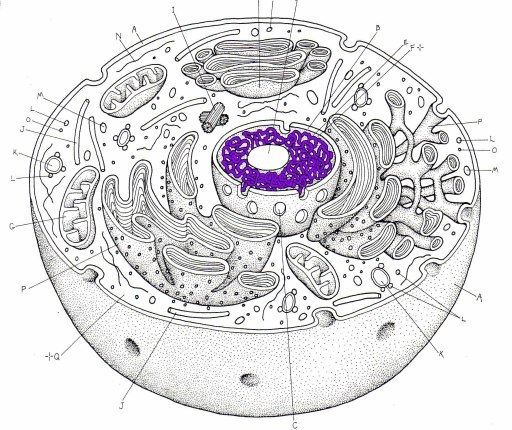
What kind of cell is this?
a)
Eukaryotic
b)
Prokaryotic
5.
Animal, fungi, plant, and protista cells are all examples of which type of cell?
a)
Eukaryotic
b)
Prokaryotic
c)
Both prokaryotic and eukaryotic
6.

Which of the following do all cells on Earth have?

a)

DNA

b)

Cytoplasm

c)

Cell Membrane

d)

Ribosomes

e)

All of the above

7.
The function of the plasma membrane is....
a)
to regulate what enters and leaves the cell.
b)
fight bacteria and viruses that enter the cell.
c)
provide rigid support and protection to the cell.
d)
make sure each cell can move
8.

____ cells have a cell membrane.

a)

No

b)

All

c)

Only prokaryote

d)

Only eukaryote

9.
What is NOT TRUE about the cell membrane
a)
It controls what enters and leaves the cell
b)
Semipermeable
c)
Phospholipid bilayer
d)
Contains digestive enzymes
10.
Consists of a jellylike substance that contains many organelles.
a)
ribosomes
b)
cytoplasm
c)
chloroplasts
d)
cell wall
11.

Which organelle contains genetic material?

a)

Endoplasmic Reticulum

b)

Golgi Complex

c)

Nucleolus

d)

Nucleus

12.
What is the function of the vacuole?
a)
Sac that stores water, nutrients, and waste products
b)
Sac filled with digestive chemicals
c)
Jelly-like substance within the plasma membrane
d)
stack of membranes that packages chemicals
13.
Where does photosynthesis occur?
a)
mitochondria
b)
stomata
c)
xylem
d)
chloroplast
14.
I make proteins for the cell. What am I?
a)
ribosome
b)
mitochondria
c)
chloroplast
d)
lysosome
15.
What can only be found in plant cells?
a)
Cell membrane
b)
Vacuole
c)
Chloroplast
d)
Mitochondrion
16.
What cell part is NOT found in all cells?
a)
Cell Wall
b)
Cell Membrane
c)
Cytoplasm
d)
Genetic Material
17.
Where are proteins made?
a)
Golgi body
b)
Mitoichondria
c)
Chromosomes
d)
Ribosomes
18.
A rigid layer that lies outside the cell's  membrane is...
a)
Cytoskeleton
b)
Cilia
c)
Cell Wall
d)
Flagella
19.
Only eukaryotic cells have....
a)
membrane-bound organelles 
b)
DNA
c)
ribosomes
d)
cell membranes 
20.
This organelle eliminates waste. 
a)
Nucleus
b)
ER
c)
Vacuole
d)
Lysosome
21.

The organelle that modifies, sorts, and packages proteins and other materials from the ER for storage in the cell or release from the cell:

a)

Endoplasmic Reticulum

b)

Golgi Apparatus

c)

Vacuoles and Vesicles

d)

Ribosome

22.

The organelle that breaks down lipids, carbohydrates, and proteins into small molecules that can be used by the rest of the cell:

a)

Lysosome

b)

Cytoskeleton

c)

Golgi Apparatus

d)

Chloroplast

23.

The organelle that helps the cell maintain its shape and is also involved in movement:

a)

Mitochondrion

b)

Lysosome

c)

Cytoskeleton

d)

Cell Membrane

24.

The organelle that organizes cell division:

a)

Nucleus

b)

Centrioles

c)

Cytoskeleton

d)

Ribosome

25.
What is the relationship between a protein, the cell, and DNA?
a)

DNA is produced by protein which is produced in the cell

b)

Protein is composed of DNA which is produced in the cell

c)

DNA controls the production of protein in the cell

d)

A cell is composed of DNA and protein

26.

Attached ribosomes are found attached to what organelle?

a)

Golgi

b)

Smooth ER

c)

Rough ER

d)

Nucleus

27.

The function of the Smooth ER is to:

a)

make proteins

b)

make lipids

c)

modify proteins

d)

get rid of waste

28.

The instructions for how to link the amino acids together to make a protein are found where?

a)

in DNA, in the nucleus

b)

In ribosomes, in the cytoplasm

c)

In the cell membrane

d)

in the Rough ER

29.

Which of the following is NOT a place where a protein made by an attached ribosome may end up?

a)

in the cytoplasm

b)

released (secreted) from the cell

c)

embedded in the cell membrane

d)

in a lysosome as an enzyme

30.

Which of the following helps single cells move, in a whip like fashion?

a)

Cilia

b)

Flagella

c)

Centrioles

d)

Cytoskeleton

31.

Which of the following will help a multicellular organism move materials, such as mucus in the lungs.

a)

Cilia

b)

Flagella

c)

Cytopalsm

d)

Cytoskeleton