
 Worksheets
Civics ch 4 review
Total questions: 58
Worksheet time: 2hrs 10mins

What was America's first Constitution?
The Declaration of Independence
The Bill of Rights
The Articles of Confederation
The US Constitution

Who was Daniel Shays?
The President of the Proclamation of 1763
A farmer who loved his country and never did anything illegal
A founding father
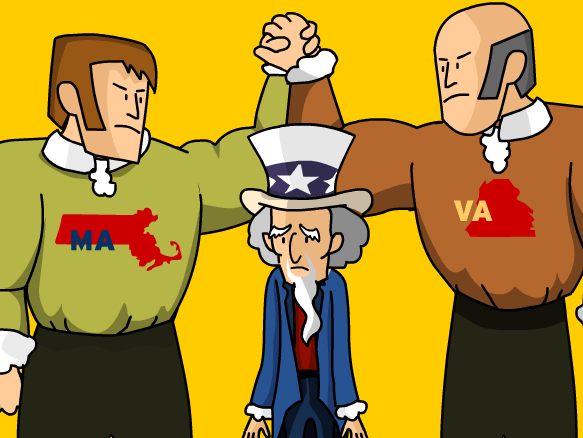
A farmer who led a revolt in Massachusetts

Which branch of government was included in the Articles of Confederation?
The Legislative branch
The Executive branch
The Federal
The Judicial

What is a Constitution?
A former plan for government
A formal plan of government
A formal pair of shoes
A formal plan of action

The idea that a group of states would be held under a federal government?
Articles of Consideration
Declaration of Dependence
The US Constitution
Federalism

Which was NOT a power of Congress under the Articles of Confederations?
Raising an army
Dealing with foreign countries
Issuing taxes
Printing money

What diplomatic problem was America having with England under the Articles of Confederation?
The British kept American merchants out of the West Indies
The British loyalists were owed money from the American government.
The British would not leave valuable forts in the Great Lakes Region
All of the above

What officially ended the American Revolutionary War?
The Treaty of Paris
The Declaration of Independence
The Stamp Act
The Treaty of America

What was the biggest weakness of the Articles of Confederation that lead to problems with Britain?
They could not tax
States were not required to meet military quotas
They could not deal with foreign governments
None of the above

Weaknesses in the Articles of the Confederation led to the effort to draft a new constitution.
Maybe
True
Possibly
False
State delegates met in _____________ for the Constitutional Convention.
Virginia
Connecticut
Philadelphia
Massachusetts
Who was the president of the Constitutional Convention?
George Mason
Thomas Jefferson
Benjamin Franklin
George Washington
The ______________________ decided how many votes each state would have in the Senate and the House of Representatives.
The Great Compromise
The Bill of Rights
The VA Declaration of Rights
The Magna Carta
The structure of the new national government included three separate branches of government. Choose the three (3) branches of government.
Legislative
Republic
Executive
Senate
Judicial
Many farmers lost their homes and land because they couldn't pay taxes. Soon there was a rebellion that would be called:
Massachusetts Rebellion
Taxation Rebellion
Shay's Rebellion
Under the Articles of Confederation, which level of government held most of the power?
National
State
The Constitution created a system where power is shared equally by the national and state governments. This system is known as which of the following?
unitary
federalism
confederacy

What document was written during the Revolutionary War that worked as a plan for government?
Common Sense
The Olive Branch Petition
The Declaration of Independence
The Articles of Confederation

Who served as leader of the Constitutional Convention?
Alexander Hamilton
Ben Franklin
George Washington

Small states thought lawmaker number should be equal. Large states wanted to base the number of lawmakers on the population of the state. A compromise that was made is called the:
The 3/5 Compromise
The Great Compromise
Shay's Rebellion
The delegates decided to have a 2-part legislature that would have the :
House and the Senate
White House and Supreme Court
State House and White House

After independence which was the first document that was used to govern the United States of America?
Declaration of Independence
U.S. Constitution
Articles of Confederation
Mayflower Compact
The Declaration of Independence refers to King George III as a "tyrant" and "unfit to be the ruler of a free people." What is one way that the U.S. Constitution prevents government leaders from becoming tyrants?
By setting the length of each term served by a senator or representative
By separating governing powers among three different branches of government
By determining which government officials would be paid for their service
By establishing a method for amending the Constitution when necessary
The United States Congress may pass laws, and they go into effect if the President signs the law. However the Supreme Court can declare a law unconstitutional. This is an example of
supremacy
veto power
federalism
checks and balances

