
 Worksheets
Wade Unit 2
Total questions: 42
Worksheet time: 26mins
The Archey's frog is a small endangered frog found in the forests off the coast of New Zealand. The frog is preyed upon by introduced species such as cats and rats. In 1980, the population decreased to only 5 individuals and every individual today is a descendant of a single female. Which of the following is best illustrated in the decline of the Archey's frog?
Carrying capacity
Population bottleneck
Population overshoot
Type I survivorship
Which of the following would be categorized as a cultural ecosystem service of forests?
Recreation and scenic areas for tourism
Timber and landscape materials
Mushroom and plant harvests
Soil stabilization and air purification
Which of the following would most likely result from the deforestation of large areas of forests caused by slash-and-burn agriculture?
Increased ozone thinning because of the release of CFCs
Decreased acid rain because of the sequestration of SO2
Increased global temperature because of the release of CO2
Deceased evaporation because of the loss of the tree canopy
Based on the theory of island biogeography, which of the following is the most likely reason that an island in the ocean that is 8 kilometers from a continent would have a higher number of species than one that is 20 kilometers from a continent?
There are more species that have the ability to travel 8 kilometers than can travel 20 kilometers.
Islands that are closer to continents always have a wider range of habitats than more distant islands do.
There are smaller populations of each species on islands that are at greater distances from continents.
Islands that are closer to continents always have more ecological niches than more distant islands do.
Which of the following is a measure of the biodiversity of an ecosystem?
The total number of individuals of a single animal species
The density of individuals in a hectare
The total number of different plant species
The soil depth at which burrowing insects are located

Which of the following best describes the frog species' range of tolerance to acidic conditions?
The frogs can tolerate any pH greater than 6.
The frogs can tolerate a pH between 4.5 and 6.
The frogs can tolerate a pH between 3.5 and 5.
The frogs can tolerate any pH less than 4.

Based on the data in the table, which ecosystem is in the earliest stages of succession?
Ecosystem A
Ecosystem B
Ecosystem C
Ecosystem D

Which of the following would be most likely to occur in the scenarios that have experienced habitat loss and/or fragmentation in the diagram?
Increase in territory size of large mammals
Increase in genetic diversity of native species
Decrease in the number of specialist species
Decrease in the abundance of invasive species
For which of the following reasons do small isolated islands have a greater rate of species extinction than larger, less isolated islands?
Small isolated islands are more likely to receive more migrating species.
Small isolated islands provide opportunities for a greater diversity of species.
Because of their size, small isolated islands accumulate more species by chance.
Small isolated islands have a lower availability of resources.
Because they have fewer available niches, small isolated islands are targeted and colonized by species.
Which of the following statements about levels of biodiversity is correct?
Genetic biodiversity is a measure of the total number of genes in a community.
A narrow distribution of habitats leads to an increase in species diversity.
Global hotspots are areas where species diversity is thriving due to habitat restoration.
A population with high genetic biodiversity is better able to respond to environmental stressors.
Which of the following best explains how environmental stressors, such as wildfires, can affect biodiversity in an ecosystem?
After an environmental stress, a genetic bottleneck may occur, which will increase genetic diversity.
Habitat diversity will increase the available niches if the landscape becomes more uniform after a disturbance.
Ecosystems with more species diversity are more likely to recover after a disturbance than ecosystems with low species diversity.
Smaller populations are less likely to go extinct than larger populations, so the species diversity will remain constant.
Which of the following statements best describes how the moths adapted to the new environment over time?
The moths adapted to the new environment through isolation.
The moths adapted to the new environment through primary succession.
The moths adapted to the new environment by changes in the genetics of the population.
The moths adapted to the new environment by becoming a generalist species.

Which of the following best identifies and describes the process that is illustrated in the diagram above?
Primary succession, because the result is a mature forest with a variety of shade-intolerant shrubs and grasses
Primary succession, because the process in the diagram begins with bare rock.
Secondary succession, because intermediate plant species like grasses and weeds are present
Secondary succession, because the result is a mature forest with a variety of shade-tolerant trees

Which of the following best describes the role of the moss in the transition to stage III in the process
It serves as a soil seed bank in the leaf litter
It breaks down rock and adds organic nutrients to the soil
It provides shade and reduces surface temperatures
It provides habitat for birds and mammals

In which stage are most species present considered pioneer species?
I
II
III
IV
Small populations of animals, such as those typically found in islands, are prone to extinction because
they contain a high degree of genetic variability
they tend to have more predators
they are more vulnerable to unpredictable events
they are usually generalist species
Which of the following illustrates the community with the highest biodiversity?


Based on the laws of thermodynamics, which of the following is the applied mathematical routine used to estimate the biomass of the mice in the pyramid?
18,705 kg × 10
18,705 kg/10 × 100
18,705 kg × 0.10 × 0.10
18,705 kg/0.10

Which of the following pathways indicate how nitrogen is added to the largest nitrogen reservoir?
Nitrifying bacteria and lightning
Decomposing plant and animal material
Denitrifying bacteria and volcanic activity
Nitrates taken up by plant roots
The net annual primary productivity of a particular wetland ecosystem is found to be 8,000 kcal/m2 per year. If respiration by the aquatic producers is 12,000 kcal/m2 per year, what is the gross annual primary productivity for this ecosystem, in kcal/m2 per year?

Which environment is characterized by the highest diversity of tree species?
A
B
C
D
E

Which environment would most likely be characterized by dry scrub with frequent fires?
A
B
C
D
E
The ultimate source of energy for terrestrial ecosystem is
nutrients in soil
nutrients in vegetation
primary consumers
producers
the Sun
Which of the following best describes the first law of thermodynamics?
Energy always changes from a more useful, more concentrated form to a less useful, less concentrated form.
In a closed system of constant mass, the energy involved in any physical or chemical change is neither created nor destroyed, but merely changed from one form to another.
Heat always flows from a hot body to a cold body.
Entropy of a system increases as the state of disorganization in the system increases.
In a reversible process, the entropy of the system is constant, whereas in an irreversible process, the entropy of the system increases.
The greatest amount of fresh water is found in which of the following?
The atmosphere
Estuaries
Lakes
Rivers and streams
Polar ice caps and glaciers

In the nitrogen cycle illustrated above, nitrification occurs in which of the following steps?
Step 1
Step 2
Step 3
Step 4

The process in the hydrologic cycle in which water vapor is released from leaves into the atmosphere is called
infiltration
transpiration
sublimation
reflection
percolation
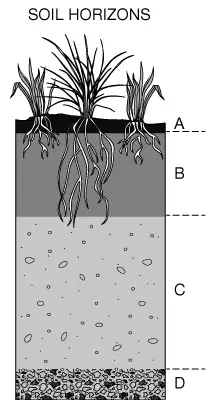
Which soil horizon has very little organic matter and accumulates soluble metals and nutrients that are transported from other soil layers?
A
B
C
D
A farm is experiencing extensive crop loss due to high rains causing overly saturated soils. Which of the following approaches would best help the farmer alleviate the problem?
Fertilizing the area with manure to eliminate the need for inorganic chemical fertilizers
Amending the soil with clay to increase the water-holding capacity of the soil
Amending the soil with sand to increase the permeability of the soil
Using contour plowing to decrease soil erosion
This layer of Earth's atmosphere contains the ozone layer that absorbs the sun's ultraviolet rays.
Troposphere
Stratosphere
Mesosphere
Thermosphere
The primary cause of Earth's seasons is the
constant tilt of Earth's rotational axis with respect to the plane of its orbit around the Sun
changing distance of Earth from the Sun at different times of the year
periodic wobbling of Earth on its axis of rotation
changing relative positions of Earth, its Moon, and the Sun
periodic changes in solar energy output

Based on the graph, which of the following can be concluded about the latitudes of the two locations?
Both locations are at the same latitude.
Location 1 is close to the equator, and Location 2 is in the Northern Hemisphere.
Location 1 is in the Northern Hemisphere, and Location 2 is in the Southern Hemisphere.
Location 1 is in the Southern Hemisphere, and Location 2 is close to the equator.

Which of the following best explains why City B regularly receives less precipitation than City A?
As air rises up the side of the mountain near City B, the temperature and the relative humidity increase, causing increased precipitation on the other side of the mountain over City A.
Air that is forced upward on the side of the mountain near City B leads to the formation of stratospheric clouds.
The urban heat island from City B causes a warmer climate that leads to reduced cloud formation.
The rain shadow effect causes City B to be drier because the mountain blocks precipitation from reaching the city.

Based on the diagram, which of the following changes are most likely to occur in the central and eastern tropical Pacific during El Niño?
The Californian current reverses direction and flows northward.
The Californian current flows southward with increased speed.
The Peruvian current strengthens, leading to cooler-than-average sea-surface temperatures.
The Peruvian current weakens, leading to warmer-than-average sea-surface temperatures.
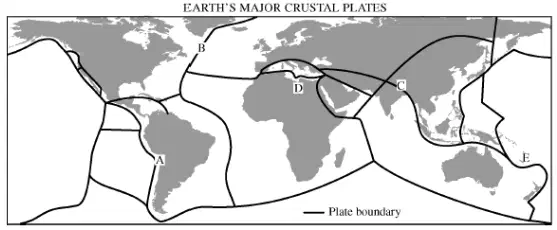
Area where new crust is being created at a divergent plate boundary
A
B
C
D

Area that exhibits a growing nonvolcanic mountain chain due to uplift
A
B
C
D
Of the following, which has the greatest permeability?
Clay
Loam
Sand
Silt
Humus

What are the proportions of sand, silt, and clay for the soil at point T?
Which of the following correctly describes the season and length of day at the Tropic of Cancer at the time of year shown in the diagram?
The Northern Hemisphere is tilted away from the Sun, so it is winter at the Tropic of Cancer and daylight is approximately twelve hours per day.
The Southern Hemisphere is tilted toward the Sun, so it is summer at the Tropic of Cancer and daylight is greater than twelve hours per day.
The Northern Hemisphere is tilted away from the Sun so it is winter at the Tropic of Cancer and daylight is less than twelve hours per day.
The Southern Hemisphere is tilted away from the Sun so it is summer at the Tropic of Cancer and daylight is approximately twelve hours per day.
Most oxygen is found in this layer of the atmosphere.
Thermosphere
Exosphere
Troposphere
Mesosphere
Stratosphere
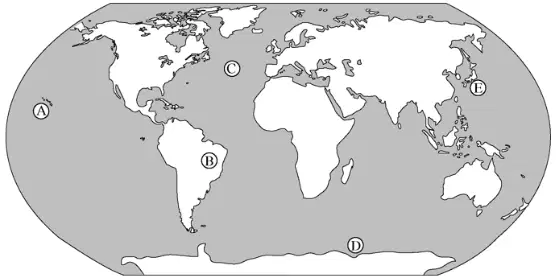
The intraplate location where hot-spot volcanism is occurring
A
B
C
D
E
Most volcanism in the world is associated with
plate boundaries
midcontinental hot spots
faulting
aquifer depletion
desertification

