
Font size
 Worksheets
Cell Reproduction
Total questions: 15
Worksheet time: 8mins
When are living organisms making new cells?
very rarely
all the time
only when they are growing
only when they are trying to repair
Crossing over during meiosis is significant in heredity. This process leads to an increase in which of the following?
genetic variation
number of gametes
the expression of recessive traits
the expression of dominant traits
Which of the following statements regarding binary fission is true? CHOOSE TWO ANSWERS!
Binary fission is a form of sexual reproduction.
Binary fission produces genetically identical offspring.
Binary fission produces genetically different offspring.
Binary fission is the process by which eukaryotes reproduce.
Binary fission is the process by which prokaryotes reproduce.
After meiosis, a parent cell that has 22 chromosomes would have four daughter cells that each have which of the following?
2 chromosomes
11 chromosomes
22 chromosomes
44 chromosomes
What happens in the stage before mitosis in the cell cycle?
Chromosomes condense
Cytoplasm Seperates
Proteins are being synthesized
The cell grows and DNA is replicated
Which of the following cells undergoes meiosis?
skin cell
liver cell
sperm cell
bacterial cell

Which of the following explains the process that is illustrated in the model?
The model shows mitosis since it begins with a diploid cell and results in 2 diploid cells.
The model shows meiosis since it begins with a diploid cell and results in 2 diploid cells.
The model shows mitosis since it begins with a diploid cell and results in 2 haploid cells.
The model shows meiosis since it begins with a diploid cell and results in 2 haploid cells.
Sexual reproduction requires more energy and resources; however, most complex organisms reproduce sexually. What advantage does sexual reproduction give these organisms?
It is a fast process.
It results in more offspring.
It increases genetic diversity.
It requires time to find a mate.
The sperm cells of a dog have 38 chromosomes. How many chromosomes will be in the muscle cells of a dog?
19
38
76
152
The main difference between mitosis and meiosis is that…
DNA replicates during mitosis, but not during meiosis.
Mitosis makes genetically identical copies, meiosis does not.
Sister chromatids separate in mitosis, but not during meiosis.
Mitosis increases chromosome number in each cell while meiosis decreases it.
The process of mitosis ensures that....
DNA is replicated without error.
Cells will divide in the correct time.
Each new cell is genetically different than the parent cell.
Each new cell receives the correct number of chromosomes.

Which of the following explains the process that is illustrated in the model?
The model shows mitosis since it begins with a diploid cell and results in 4 diploid cells.
The model shows meiosis since it begins with a diploid cell and results in 4 diploid cells.
The model shows mitosis since it begins with a diploid cell and results in 4 haploid cells.
The model shows meiosis since it begins with a diploid cell and results in 4 haploid cells.
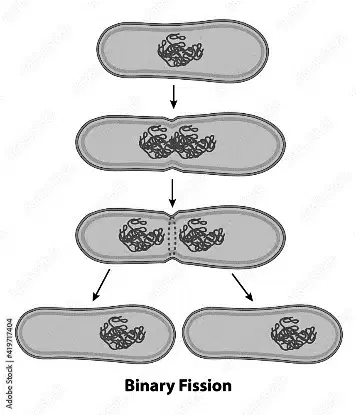
Which of the following explains the process that is illustrated in the model?
The model shows binary fission, a process of sexual reproduction, that forms two cells.
The model shows binary fission, a process of sexual reproduction, that forms four cells.
The model shows binary fission, a process of asexual reproduction, that forms two cells.
The model shows binary fission, a process of asexual reproduction, that forms four cells.
A snail has 24 chromosomes in each of its somatic cells. How does the cell cycle function to maintain this number of chromosomes?
Chromosomes are replicated in mitosis so the daughter cells each have 12 chromosomes.
Chromosomes are replicated in mitosis so the daughter cells each have 24 chromosomes.
Chromosomes are replicated in interphase so the daughter cells each have 12 chromosomes.
Chromosomes are replicated in interphase so the daughter cells each have 24 chromosomes.
Which statements are true of mitosis? CHOOSE TWO ANSWERS!
The offspring will be genetically identical to each other.
The offspring will be genetically identical to the parents.
The offspring will be genetically like both parents, but identical to neither parent.
The offspring will have a different number of chromosomes than either of the parents.

