
NEW
Font size
 Worksheets
AP Chem 3.7-3.10
Total questions: 56
Worksheet time: 55mins
The substance that does the dissolving
Solute
Solvent
Solution
Miscibility
Which of the following would be the MOST soluble in water?
CH4
CO2
NH3
C2H6
2.45 mole of LiBr is dissolved to make a 0.750 L of solution. What is the molarity?
3.27 M
0.306 M
0.0376 M
How many grams of CaCl2 are needed to prepare 125 ml of a 0.500 M solution?
4.00 g
6936 g
6.94 g
How many moles of NH3 are in a 3.0 L solution of a 0.23 M NH3.
0.69 mol
13 mol
0.077 mol
Solid Al(NO3)3 is added to distilled water to produce a solution in which the concentration of nitrate, [NO3-], is 0.10 M. What is the concentration of aluminum ion, [Al3+], in this solution?
0.010 M
0.033 M
0.066 M
0.10 M
0.30 M
Which of the following questions about the components in a mixture could be investigated with a paper chromatography experiment?
Do the components have different densities?
Do the components have different molecular masses?
Do the components have different molecular polarities?
Do the components have different average molecular speeds?
Which of the following is the best piece of laboratory glassware for preparing 500.0 mL of an aqueous solution of a solid?
Volumetric flask
Erlenmeyer flask
Test tube
Graduated beaker
Graduated cylinder
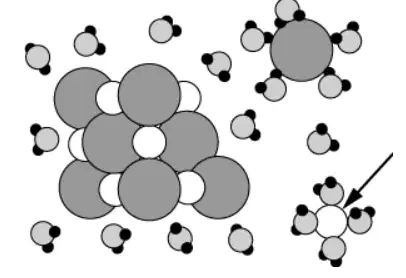
An ionic crystal is added to water and starts to dissolve as shown in the particulate representation above. Based on the orientation of the water molecules, what can be assumed about the charge of the hydrated particle indicated by the arrow?
The particle is positively charged, because the oxygen atoms in water are attracted to it.
The particle is negatively charged, because hydrogen atoms in water are attracted to it.
The particle is both positively and negatively charged, because the water molecules are attracted to it.
The particle is neutral, because the dipoles of the water molecules neutralize the charge of the particle.
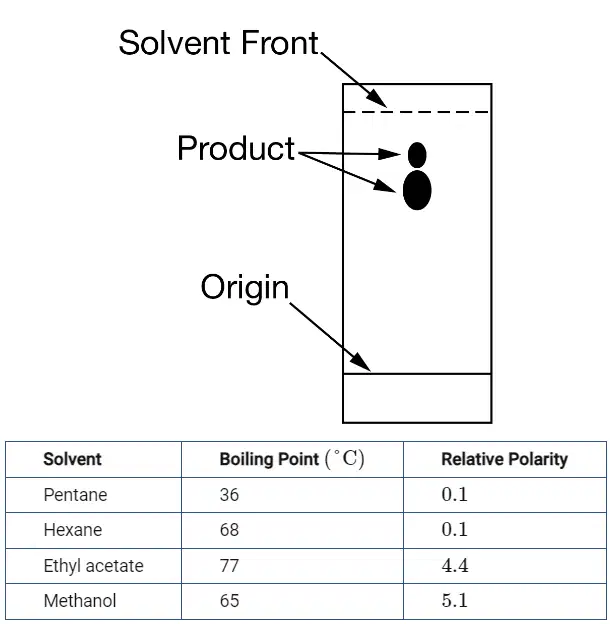
The diagram above shows a thin-layer chromatogram of a mixture of products from a chemical reaction. The separation was performed using 50% ethyl acetate in hexane as the solvent (mobile phase) and silica gel as the polar stationary phase. On the basis of the chromatogram and the information about solvents in the table above, which of the following would be the best way to decrease the distance that the products travel up the plate?
Use pentane instead of hexane in the solvent.
Decrease the percentage of ethyl acetate in the solvent.
Increase the percentage of ethyl acetate in the solvent.
Add up to 5% methanol to the solvent.
A 0.20 mol sample of MgCl2(s) and a 0.10 mol sample of KCl(s) are dissolved in water and diluted to 500 mL. What is the concentration of Cl- in the solution?
0.15 M
0.30 M
0.50 M
0.60 M
1.0 M
A student uses visible spectrophotometry to determine the concentration of CoCl2(aq) in a sample solution. First, the student prepares a set of CoCl2(aq) solutions of known concentration. Then the student uses a spectrophotometer to determine the absorbance of each of the standard solutions at a wavelength of 510nm and constructs a standard curve. Finally, the student determines the absorbance of the sample of unknown concentration.
The original solution used to make the solutions for the standard curve was prepared by dissolving 2.60g of CoCl2 (molar mass 130.g/mol) in enough water to make 100.mL of solution. What is the molar concentration of the solution?
0.200 M
0.500 M
1.00 M
5.00 M
If 50. mL of 1.0 M NaOH is diluted with distilled water to a volume of 2.0 L, the concentration of the resulting solution is
0.025 M
0.050 M
0.10 M
0.50 M
1.0 M
If 200. mL of 0.60 M MgCl2(aq) is added to 400. mL of distilled water, what is the concentration of Mg2+(aq) in the resulting solution? (Assume volumes are additive).
0.20 M
0.30 M
0.40 M
0.60 M
1.2 M
What is the molarity of I-(aq) in a solution that contains 34 g of SrI2 (molar mass 341 g) in 1.0 L of the solution?
0.034 M
0.068 M
0.10 M
0.20 M
0.68 M
When 70. milliliter of 3.0-molar Na2CO3 is added to 30. milliliters of 1.0-molar NaHCO3 the resulting concentration of Na+ is
2.0 M
2.4 M
4.0 M
4.5 M
7.0 M
A 40.0 mL sample of 0.25 M KOH is added to 60.0 mL of 0.15 M Ba(OH)2. What is the molar concentration of OH-(aq) in the resulting solution? (Assume that the volumes are additive.)
0.10 M
0.19 M
0.28 M
0.40 M
0.55 M
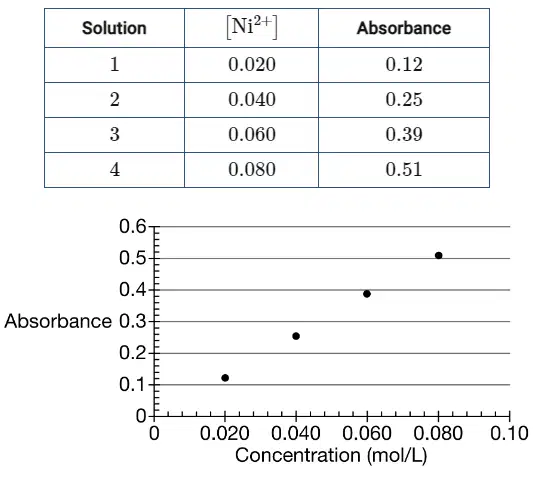
An experiment was performed to investigate the reaction between Zn metal and Ni2+(aq) at different concentrations. Because the Ni2+(aq) ion is green, the extent of the reaction was determined using spectrophotometric analysis. Four 20.0mL standard solutions of Ni2+(aq) were prepared by dissolving NiCl2⋅6H2O (molar mass 240g/mol) in water. The absorbance of each solution was measured; the results are shown both in the table below and in the following plot of the absorbance data.
The concentration of Cl−(aq) ions in solution 2 was...
0.02 M0
0.040 M
0.060 M
0.080 M
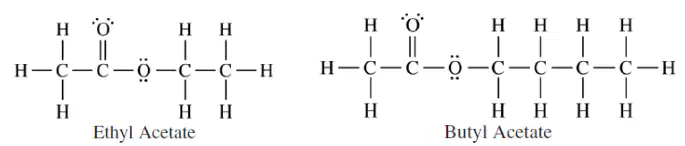
A mixture containing equal numbers of moles of ethyl acetate and butyl acetate was separated using distillation. Based on the diagrams shown above, which of the following identifies the substance that would be initially present in higher concentration in the distillate and correctly explains why that occurs?
Ethyl acetate, because it has fewer C-C bonds to break
Ethyl acetate, because it has a shorter carbon chain and weaker London dispersion forces
Butyl acetate, because it has more C-C bonds to break
Butyl acetate, because it has a longer carbon chain and weaker dipole-dipole attractions
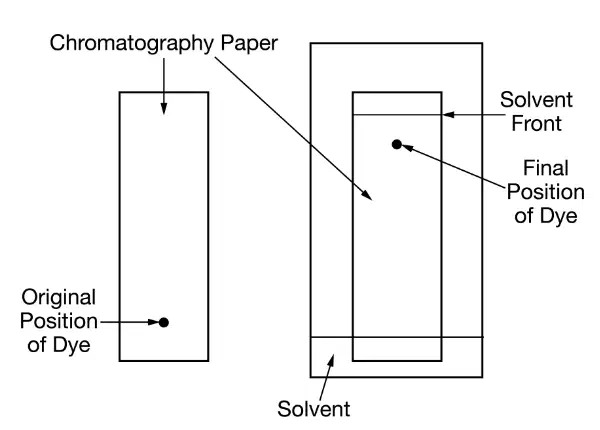
Based on the results of the paper chromatography experiment shown above, which of the following can be concluded about the dye?
It has a small molar mass.
It has weak intermolecular forces.
It has a weaker attraction for the stationary phase that it has for the mobile phase.
It has a stronger attraction for the stationary phase than it has for the mobile phase.
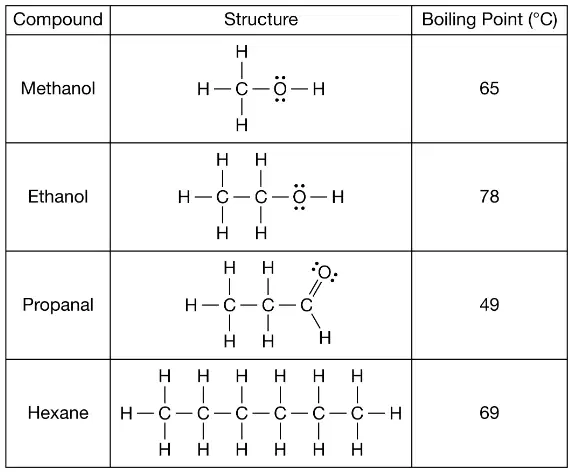
A student obtains a liquid sample of green food coloring that is known to contain a mixture of two solid pigments, one blue and one yellow, dissolved in an aqueous solution of ethanol. Which of the following laboratory setups is most appropriate for the student to use in order to separate and collect a substantial sample of each of the two pigments?
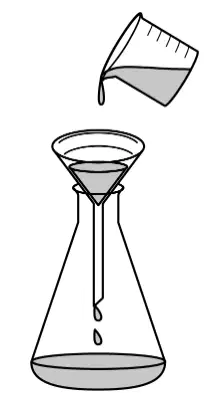
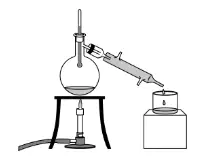
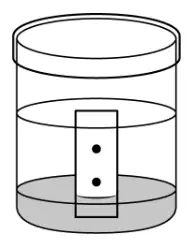
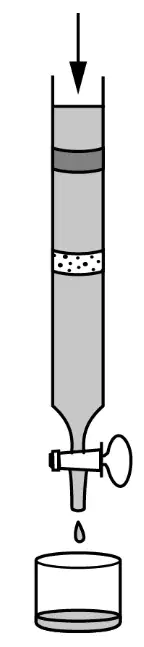
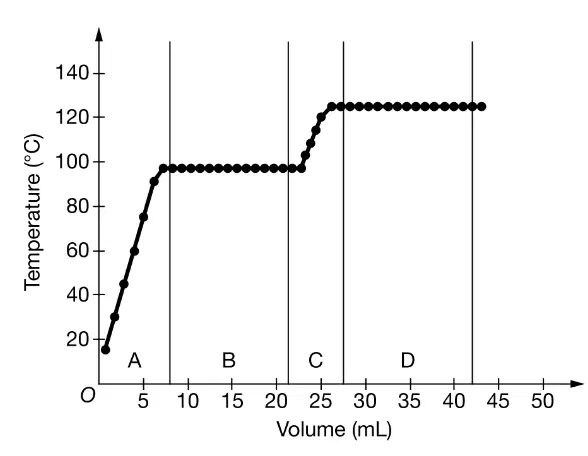
A student performed a fractional distillation of a mixture of two straight-chain hydrocarbons, C7H16 and C8H18. Using four clean, dry flasks, the student collected the distillate over the volume ranges (A, B, C, and D) shown in the graph above. Over what volume range should the student collect the distillate of the compound with the stronger intermolecular forces?
A
B
C
D
On the basis of molecular structure and bond polarity, which of the following compounds is most likely to have the greatest solubility in water?
CH4
CCl4
NH3
PH3
Which of the following pieces of laboratory glassware should be used to most accurately measure out a 25.00 mL sample of a solution?
5 mL pipet
25 mL pipet
25 mL beaker
25 mL Erlenmeyer flask
50 mL graduated cylinder
A student wishes to prepare 2.00 liters of 0.100–molar KIO3 (molecular weight 214). The proper procedure is to weigh out
42.8 grams of KIO3 and add 2.00 kilograms of H2O
42.8 grams of KIO3 and add H2O until the final homogeneous solution has a volume of 2.00 liters
21.4 grams of KIO3 and add H2O until the final homogeneous solution has a volume of 2.00 liters
42.8 grams of KIO3 and add 2.00 liters of H2O
21.4 grams of KIO3 and add 2.00 liters of H2O
For an experiment, a student needs 100.0 mL of 0.4220 M NaCl. If the student starts with NaCl(s) and distilled water, which of the following pieces of laboratory glassware should the student use to prepare the solution with the greatest accuracy?
25 mL volumetric pipet
100 mL Erlenmeyer flask
100 mL graduated cylinder
100 mL volumetric flask
1 L beaker
A 50mL sample of C6H14(l) is mixed with a 50mL sample of H2O(l), and the mixture is shaken vigorously. The two liquids do not stay mixed but instead form two separate layers. The density of hexane is 0.66g/mL, and the density of water is 1.00g/mL. A 1.0g sample of I2(s) is added to the mixture, which is shaken again. Which of the following best predicts what happens to the I2(s)?
I2 will be found mainly in the top layer because it will dissolve more in the H2O(l).
I2 will be found mainly in the bottom layer because it will dissolve more in the H2O(l).
I2will be found mainly in the top layer because it will dissolve more in the C6H14(l).
I2 will be found mainly in the bottom layer because it will dissolve more in the C6H14(l).
Of the following organic compounds, which is LEAST soluble in water at 298 K?
CH3OH, methanol
CH3CH2CH2OH, l-propanol
C6H14, hexane
C6H12O6, glucose
CH3COOH, ethanoic (acetic) acid
Which of the following molecules is least soluble in water?


Approximately what mass of CuSO4 • 5H2O (250 g mol-1) is required to prepare 250 mL of 0.10 M copper(II) sulfate solution?
4.0 g
6.2 g
34 g
85 g
140 g
Which of the following diagrams best represents the AgNO3 solution?
Note: water molecules are represented by the symbol


A 360. mg sample of aspirin, C9H8O4, (molar mass 180. g), is dissolved in enough water to produce 200. mL of solution. What is the molarity of aspirin in a 50. mL sample of this solution?
0.0800 M
0.0400 M
0.0200 M
0.0100 M
0.00250 M
A student prepares a solution by dissolving 60.00 g of glucose (molar mass 180.2 g mol-1) in enough distilled water to make 250.0 mL of solution. The molarity of the solution should be reported as
12.01 M
12.0 M
1.332 M
1.33 M
1.3 M
How many moles of Na+ ions are in 100.mL of 0.100�Na3PO4(aq) ?
0.300 mol
0.100 mol
0.0300 mol
0.0100 mol
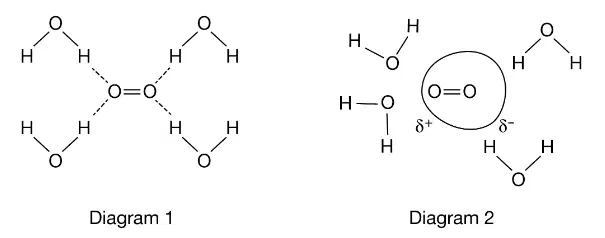
The survival of aquatic organisms depends on the small amount of O2 that dissolves in H2O. The diagrams above represent possible models to explain this phenomenon. Which diagram provides the better particle representation for the solubility of O2 in H2O, and why?
Diagram 1, because O2 molecules can form hydrogen bonds with the H2O molecules.
Diagram 1, because O2 and H2O are polar molecules that can interact through dipole-dipole forces.
Diagram 2, because the polar H2O molecules can induce temporary dipoles on the electron clouds of O2 molecules.
Diagram 2, because the nonpolar O2 molecules can induce temporary dipoles on the electron clouds of H2O molecules.
Which compound is the LEAST soluble in water?
CH3CH2CH2CH3
CH3CH2CH2OH
CH3COCH3
CH3COOH
CH3CH2CH2NH2
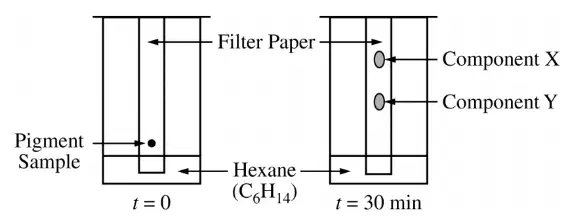
In a paper chromatography experiment, a sample of a pigment is separated into two components, X and Y, as shown in the figure above. The surface of the paper is moderately polar. What can be concluded about X and Y based on the experimental results?
X has a larger molar mass than Y does.
Y has a larger molar mass than X does.
X is more polar than Y.
Y is more polar than X.
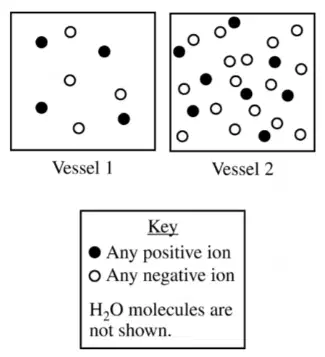
Equal volumes of solutions in two different vessels are represented above. If the solution represented in vessel 1 is KCl(aq), then the solution represented in vessel 2 could be an aqueous solution of
KCl with the same molarity as the solution in vessel 1
KCl with twice the molarity of the solution in vessel 1
CaCl2 with the same molarity as the solution in vessel 1
CaCl2 with twice the molarity of the solution in vessel 1
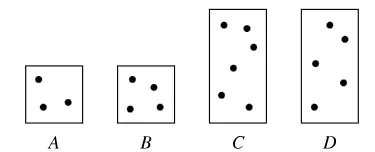
The diagrams above represent aqueous solutions of compound X at various molarities. Each dot represents one mole of the solute, and the volume of solution in the large boxes is twice the volume in the small boxes. Which solution has the highest molarity?
A
B
C
D
How many grams of CaCl2 (molar mass =111g/mol) are needed to prepare 100.mL of 0.100M Cl−(aq) ions?
0.555 g
1.11 g
2.22 g
5.55 g

Based on concepts of polarity and hydrogen bonding, which of the following sequences correctly lists the compounds above in the order of their increasing solubility in water?
Z < Y < X
Y < Z < X
Y < X < Z
X < Z < Y
X < Y < Z

A student obtains a mixture of the liquids hexane and octane, which are miscible in all proportions. Which of the following techniques would be best for separating the two components of the mixture, and why?
Filtration, because the different densities of the liquids would allow one to pass through the filter paper while the other would not.
Paper chromatography, because the liquids would move along the stationary phase at different rates owing to the difference in polarity of their molecules.
Column chromatography, because the higher molar mass of octane would cause it to move down the column faster than hexane.
Distillation, because the liquids would boil at different temperatures owing to the difference in strength of their intermolecular forces.
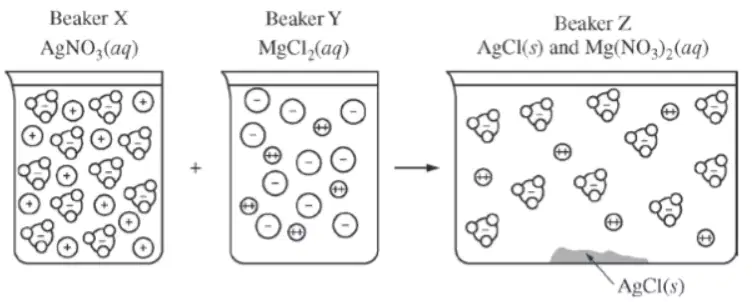
Beaker X and beaker Y each contain 1.0 L of solution, as shown above. A student combines the solutions by pouring them into a larger, previously empty beaker Z and observes the formation of a white precipitate. Assuming that volumes are additive, which of the following sets of solutions could be represented by the diagram above?
Beaker X | Beaker Y| Beaker Z
2.0 M AgNO3 | 2.0 M MgCl2 | 4.0 M Mg(NO3)2 and AgCl(s)
2.0 M AgNO3 | 2.0 M MgCl2 | 2.0 M Mg(NO3)2 and AgCl(s)
2.0 M AgNO3 | 1.0 M MgCl2 | 1.0 M Mg(NO3)2 and AgCl(s)
2.0 M AgNO3 | 1.0 M MgCl2 | 0.50 M Mg(NO3)2 and AgCl(s)
Sodium chloride is LEAST soluble in which of the following liquids?
H2O
CCl4
HF
CH3OH
CH3COOH
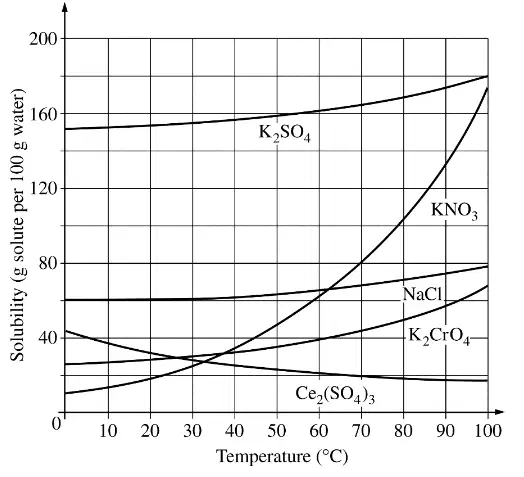
On the basis of the solubility curves shown above, the greatest percentage of which compound can be recovered by cooling a saturated solution of that compound from 90°C to 30°C?
NaCl
KNO3
K2CrO4
K2SO4
Ce2(SO4)3

A student was given samples of four different unknown liquids. The unknown liquids are propylamine, pentane, 2-propanol, and propanoic acid. The structures and molar masses of the compounds are shown in the table above. On the basis of this information, the student designed some experiments to identify the samples.
The student mixed samples of each of the four compounds with water. Only one of the four did not dissolve in water. Based on the structures of the molecules and the strengths and types of their intermolecular forces, the compound that did not dissolve is most likely
propylamine
pentane
2-propanol
propanoic acid
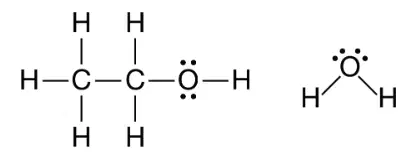
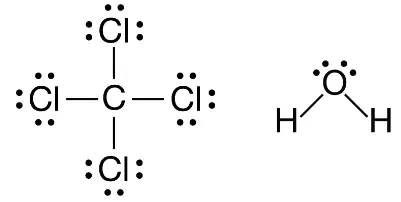
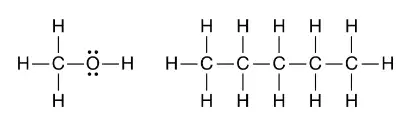
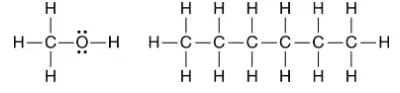
Based on their Lewis diagrams, which of the following pairs of liquids are most soluble in each other?
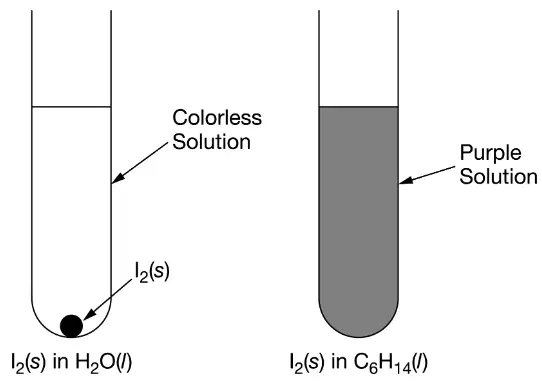
A student places a piece of I2(s) in 50.0 mL of H2O(l), another piece of I2(s) of the same mass in 50.0 mL of C6H14(l), and shakes the mixtures. The results are shown above. What do the results indicate about the intermolecular interactions of the substances?
I2 and H2O have similar intermolecular interactions, and I2 and C6H14 do not.
I2 and C6H14 have similar intermolecular interactions, and I2 and H2O do not.
I2, H2O, and C6H14 all have similar intermolecular interactions.
I2, H2O, and C6H14 have three completely different types of intermolecular interactions.
Which of the following substances has the greatest solubility in C5H12(l) at 1 atm?
SiO2(s)
NaCl(s)
H2O(l)
CCl4(l)
NH3(g)
Which of the following techniques is most appropriate for the recovery of solid KNO3 from an aqueous solution of KNO3?
Paper chromatography
Filtration
Titration
Electrolysis
Evaporation to dryness
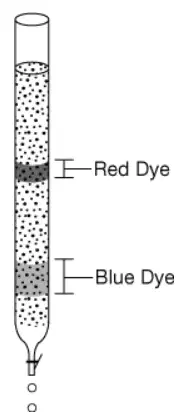
A student placed a sample of a food coloring that contains a mixture of a blue dye and a red dye at the top of a chromatography column filled with a nonpolar stationary phase. When water is poured through the column, two bands of colors are seen in the column, as shown in the diagram above.
Which of the following will most likely be observed if CH3OH(l) is used in the column instead of water? (Assume that both solvents flow through the column at the same rate.)
The dyes will not pass through the column because CH3OH(l) is a nonpolar solvent.
The dyes will pass through the column at a slower rate because CH3OH(l) is a less polar solvent than water.
The dyes will pass through the column at a faster rate because CH3OH(l) has a greater molar mass than water.
No differences will be observed because the polarity of the solvent does not affect the separation of the dyes.
The volume of distilled water that should be added to 10.0 mL of 6.00 M HCl(aq) in order to prepare a 0.500 M HCl(aq) solution is approximately
50.0 mL
60.0 mL
100. ML
110. ML
120. mL
The volume of water that must be added in order to dilute 40 mL of 9.0 M HCl to a concentration of 6.0 M is closest to
10 mL
20 mL
30 mL
40 mL
60 mL
How many mL of 10.0 M HCl are needed to prepare 500. mL of 2.00 M HCl ?
1.00 mL
10.0 mL
20.0 mL
100. mL
200. mL
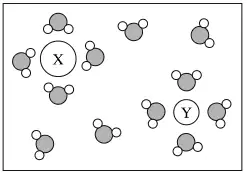
The diagram above represents a solution of ions in water. Which of the following are the most likely identities of ions X and Y?
Ion X is Na+, and ion Y is K+.
Ion X is Na+, and ion Y is F-.
Ion X is Cl-, and ion Y is K+.
Ion X is Cl-, and ion Y is F-.
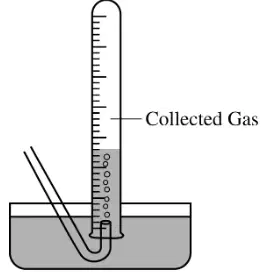
Gases generated in a chemical reaction are sometimes collected by the displacement of water, as shown above. Which of the following gases can be quantitatively collected by this method?
H2
CO2
HCl
SO2
NH3

