
 Worksheets
Unit Three SWA Gov/Econ Test
Total questions: 35
Worksheet time: 18mins
How could a war with an OPEC country impact citizens living in the United States?
Gas prices may increase due to a rise in price of crude oil.
The automobile industry suffers due to a decrease in auto part exports.
The sale of foreign cars decreases due to an increase in tariffs.
Pharmaceutical exports dip as a result of increased tensions.
Based of the definition of specialization and comparative advantage, what area in the world could be said to have a comparative advantage in oil production?
African Countries
European Countires
The Middle East
Central American Countries
Which statement BEST reflects the difference between tariffs and quotas?
Tariffs raise prices on EXPORTS, while quotas set limits on EXPORTS
Tariffs set limits on IMPORTS.
Tariffs raise prices on IMPORTS, while quotas set limits on IMPORTS
Tariffs set limits on EXPORTS
Which statement is the BEST example of human-environmental interaction in Southwest Asia?
The desert is considered a natural barrier between Western Europe and Southwest Asia.
Arab conquests spread Islam into North Africa.
The construction of the Anatolia Dam Project to provide hydroelectric power and irrigation.
The Euphrates and Tigris River flow from Turkey to the Persian Gulf.
Tariffs, quotas, and subsidies are:
Restrictive licenses
Trade barriers
Free trade
Trade incentives
These two nations are anticipating a reduction in water supply as a result of the Anatolia Dam Project in Turkey, downstream from the Tigris and Euphrates.
Iran and Syria
Iraq and Iran
Iraq and Syria
Saudi Arabia and Yemen
Since the Middle East has 1% of the world's freshwater supply shared by 5% of the world's population, and all major rivers in the Middle East cross at least one national boarder, what is MOST LIKELY to happen?
Middle Eastern countries will be forced to import fresh water from other nations.
Middle Eastern countries will be forced by the UN to cooperate and find a solution to water access.
The Arab nations of the Middle East will form a water control alliance to force water control from Israel.
Unequal access to water will surpass access to oil as the major source of conflict in the region.
Which nation's government is classified as a monarchy, with a king as chief executive and head of government?
Saudi Arabia
Israel
Iraq
Iran
Which economy is controlled by supply and demand with NO government involvement?
Market
Mixed
Command
Communism
The government of Israel can be classified as a parliamentary democracy. Which statement provides the BEST definition of this type of government?
A government ruled by an elected legislator and a prime minister.
A government ruled by the wealthiest, upper class society.
A government ruled by a small group distinguished by royalty, wealth, family, or military powers.
A government rules by people who have been selected by talent.
Which term refers to one nation or group of nations isolating another nation by stopping trade?
Quota
Blockade
Boycott
Embargo
Why is a system of currency exchange needed for international trade?
There must be a way to pay for goods purchased from countries with different types of currencies due to nationalism.
Nearly all world currencies are worthless on the world market.
Those buying goods on the world market only accept gold and silver.
This keeps currency values fixed and certain as to keep economic growth steady.
Why is increased female participation in government a sign of democratization?
It shows that a country acknowledges the political superiority of women.
It suggests that a country is willing to let ALL citizens get involved in government.
It demonstrates that a country is politically dominant over most other countries.
It implies that a country is ideologically conservative in its governmental approach.
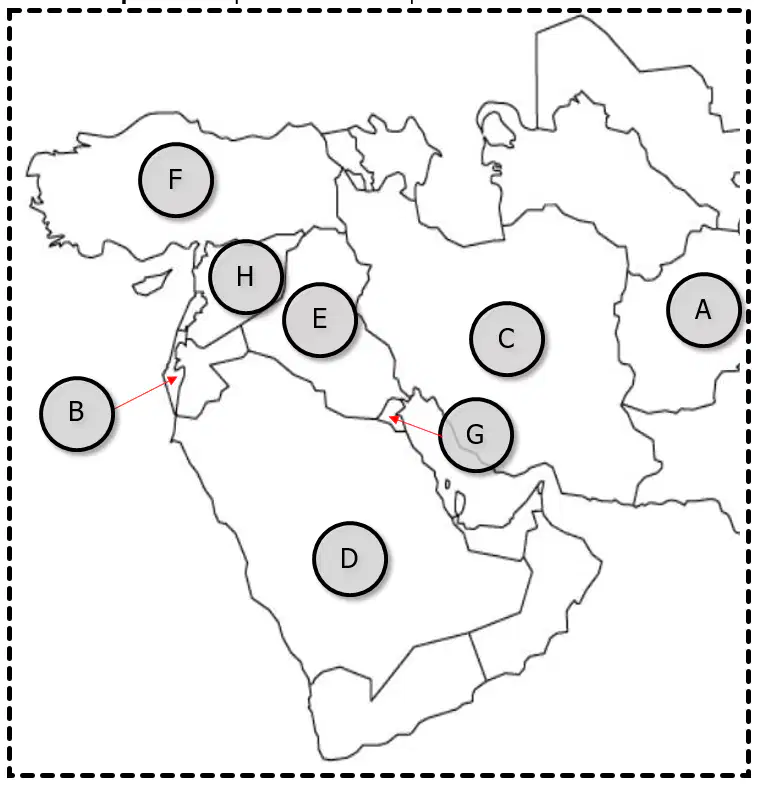
Where is Iraq? (locate letter on map)
E
C
D
B
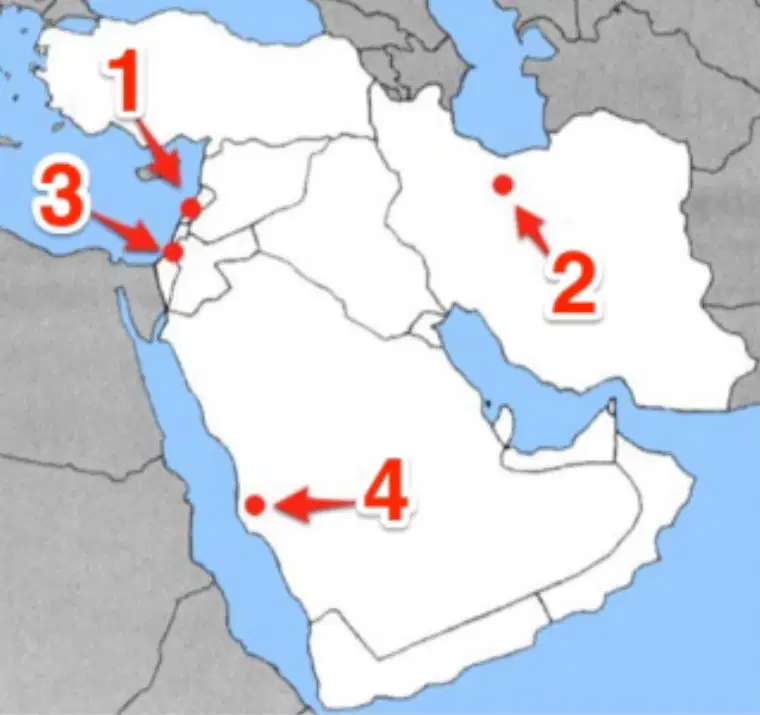
Where is Mecca, Saudi Arabia?
1
2
3
4
Why are Latin American countries in OPEC?
Latin America refused to do business with countries that were not part of OPEC.
Natural resources such as oil are a major economic development for some Latin American countries.
Latin America has a long history of distrust of the U.S. and fears a take-over of oil fears.
Latin American nations need help getting natural resources to other parts of the world.
In 2017, what government did Turkey have and what did they change to? No longer would the country be led by a Prime Minister. Now, the chief executive is a President.
Representative Democracy to a Direct Democracy
Parliamentary Democracy to a Presidential Democracy
Representative Democracy to a Parliamentary Democracy
Constitutional Monarchy to a Royal Democracy
How does a presidential democracy differ from a parliamentary?
The legislative branch in the presidential system is always unicameral
In a parliamentary democracy, the head of state (government) is a member of the legislator
In a presidential democracy, political power is shared between state and federal governments
In a parliamentary democracy there are usually two main political parties; in the presidential system there is only one.
Approximately 50% Iran's economy is planned by the nation's government control and Israel is 10% government controlled, what is probably true?
Israel is more likely to be impacted by the international sanctions than Iran
There are more options for entrepreneurs in Israel than in Iran
Israel's oil industry is more profitable than Iran's
High-tech industries are LESS LIKELY to be successful in Israel than in Iran
What happens to the price of oil when OPEC countries decide to limit production of oil?
Oil prices drop
Oil prices collapse
Oil prices rasie
Oil stops being sold
What is a major indicator of a low standard of living?
Low literacy rates because they are a key part of economic development
Theocratic Rule
Terrorism
High literacy rates because education does not impact the economic system
A country like Turkey moving from government run businesses to privately run businesses shows the economy has made a move in what direction?
From market to command
From market to tradtional
From command to market
From traditionally to command
The United Nations imposes a complete restriction on oil exports from Iraq. What would be the most likely reason for the United Nations to take this action?
Iraq is in violation of a United Nations rule
Iraq needs economic help
Iraq's oil industry needs protection
Iraq's oil is not good enough to be exported
What happens when a country invests in human capital and physical capital?
Gross Domestic Product (GDP) RISES
Standard of living goes down
Gross Domestic Product (GDP) FALLS
Trade increases
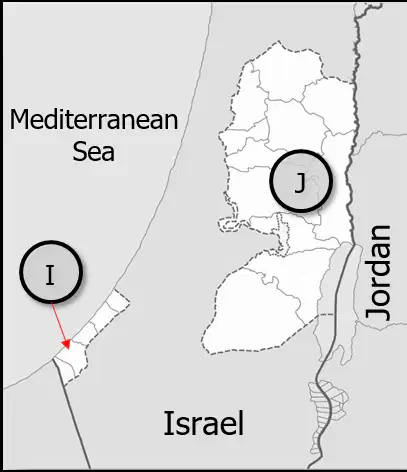
Where is the Gaza Strip? (locate on map)
I
J
Choose all rivers that are found in the Middle East
Euphrates
Yangtze
Jordan
Tigris
What's the main difference between a presidential and parliamentary democracy?
A presidential democracy does not have a parliament equivalent
A presidential democracy allows the POPULATION to choose the chief executive, but a parliamentary democracy allows the LEGISLATURE to choose the chief executive
a parliamentary democracy does not have a judicial branch
Choose TWO responses that describe how the building of dams contributes to the unequal distribution of water in the Middle East
Dams create an abundance of water
Dams make it difficult to access water as they do not have enough power to allow water to reach the people
Dams contribute to price gouging and make water expensive
Dams along the Tigris and Euphrates contribute to shortages in the Persian Gulf
IN economic terms, what is a trade barrier?
Anything that restricts the amount of trade
A location where international trade takes place
A natural, geographic block to trade
Something that encourages free trade
Resources (land), labor, capital, and entrepreneurship are?
Basis of employment
Factors of production
Results of supply and demand
Results of production
Which group has been an example for successfully determining the amount and price of a world-wide commodity?
North Atlantic Treaty Organization (NATO)
Organization of Petroleum Exporting Countries (OPEC)
World Trade Organization (WTO)
The European Union (EU)
In a command economy, how are prices of goods and services determined?
Independent Agencies
Business Owners
The central government
supply and demand
As one of the factors of production/productive resources, capital can be defined as?
The people that purchase goods and services
The supply of labor needed to produce goods
The equipment and factories needed to produce goods
The goods and services a business produces
Countries with a low standard of living, little industrial output, and a low GDP are referred to as?
Command economies
Developing Countries
Developed Countries
Plantation Economies
The largest sector of Israel's economy involves?
gold mining
high tech industries
petroleum products
coffee harvesting

