
 Worksheets
REVIEW 1st quarter
Total questions: 53
Worksheet time: 27mins
Name
Class
Date
1.
Which is of the following describe scientific investigation?
a)
Scientific investigation is solving scientific problems through a step-by-step procedure.
b)
Scientific investigation is solving problems based on personal conclusions.
c)
Scientific investigation is solving problems based on data.
d)
Scientific investigation is solving problems by guessing.
2.
SpongeBob’s favorite shirt was badly stained He wanted to remove the stain and make it clean. He asked his friends and gathered two options. One friend told him to use detergent soap. Another told him to use liquid soap. He then applied the options he gathered The liquid soap removed the stain and SpongeBob was very happy that his shirt was cleaned.
What is the independent variable in the given situation?
a)
the amount of detergent
b)
the type of detergent
c)
the stain removed
d)
the type of shirt
3.
Which of the following shall be considered in performing an experiment?
a)
Identify the variables in the experiment.
b)
Observe and record data based on results.
c)
Use multiple samples to show accuracy and validity.
d)
All the choices are correct.
4.
In the Scientific ways of solving problems acronym PDHECA, what does A stands for?
a)
analysis
b)
application
c)
analogy
d)
abstract
5.
What is the proper way of writing a hypothesis?
a)
Start by having a wild guess.
b)
Write a guess out of suggestion.
c)
Formulate guess out of an observation.
d)
All choices are correct.
6.
Which of the following is the proper way of making a conclusion?
a)
Conclude the results that you wanted to prove only.
b)
Conclude based on the opinion of other people.
c)
Conclude based on results of experimentation.
d)
Conclude based on opinion.
7.
In scientific investigation which is described as an educated guess?
a)
hypothesis
b)
scientific investigation
c)
conclusion
d)
experimentation
8.
What are we going to use to identify the problem?
a)
senses
b)
prediction
c)
data
d)
experiment
9.
Which of the following is an example of a mixture?
a)
air
b)
magnesium chloride
c)
ron rod
d)
gold bar
10.
What is the simplest form of matter that cannot be broken down to anything simpler?
a)
element
b)
compound
c)
solution
d)
colloids
11.
What term is used to describe the substance which consists of two or more elements which have been combined physically?
a)
element
b)
compound
c)
mixture
d)
atom
12.
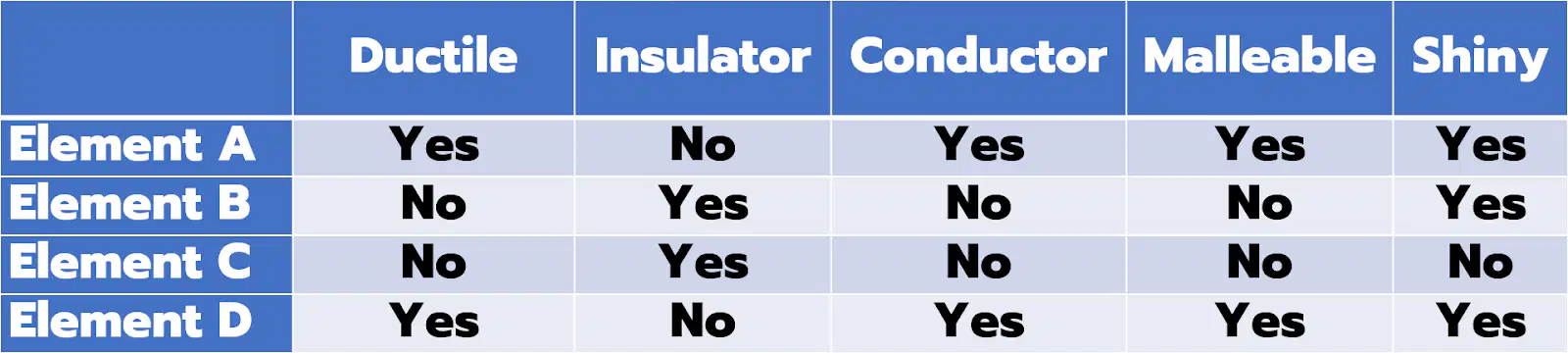
Which samples are non-metallic elements?
a)
B
b)
C
c)
B and C
d)
A and B
13.
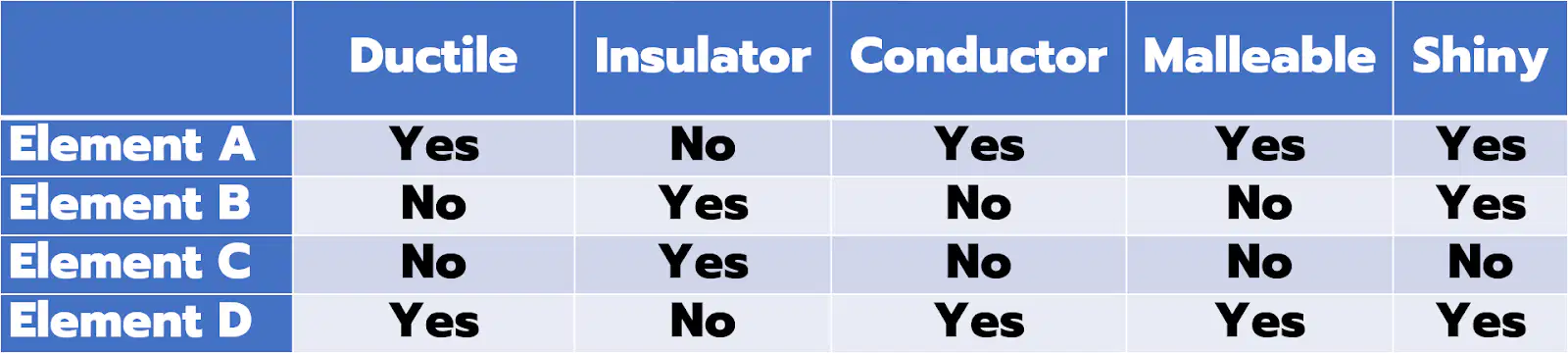
Which samples are metallic elements?
a)
A
b)
B
c)
A and C
d)
A and D
14.
Which of the following examples DOES NOT show malleability?
a)
soda can
b)
glass
c)
aluminum foil
d)
house roofs
15.
Which property is possessed by non-metal?
a)
lustrous
b)
brittle
c)
high melting point
d)
sonorous
16.
What property do copper possess that they are used commonly in wires?
a)
brittleness
b)
malleability
c)
good conductors
d)
insulators
17.
Silicon is an example of a metalloid What property does metalloids possess?
a)
They are good conductors.
b)
They are shiny in appearance.
c)
They have fixed boiling and melting points.
d)
They are sonorous and produce loud sounds.
18.
Which property of metals is described to show a shiny appearance?
a)
luster
b)
conductor
c)
brittle
d)
sonorous
19.
Which of the following describe the property of a non-metal?
a)
a sonorous iron bell
b)
a brittle glass
c)
a lustrous gold ring
d)
a ductile copper wire
20.
Among the following examples, which element is reactive and gaseous in form?
a)
mercury
b)
nickel
c)
oxygen
d)
sodium
21.
Which of the following given metals is liquid in room temperature?
a)
mercury
b)
aluminum
c)
copper
d)
potassium
22.
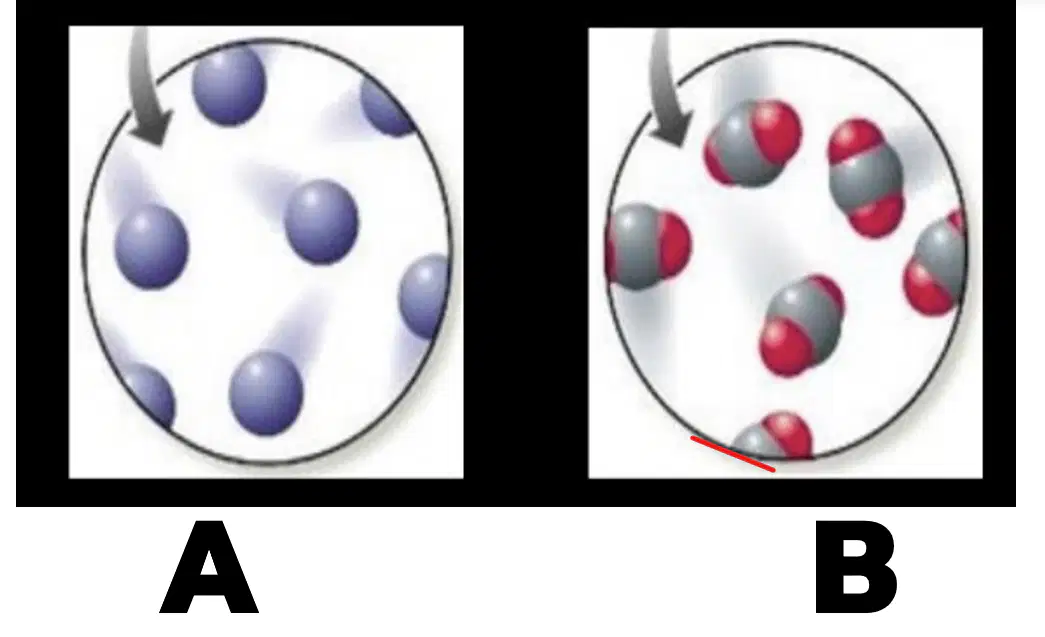
Which molecule is an element?
a)
A
b)
B
c)
A & B
d)
NONE OF THE ABOVE
23.
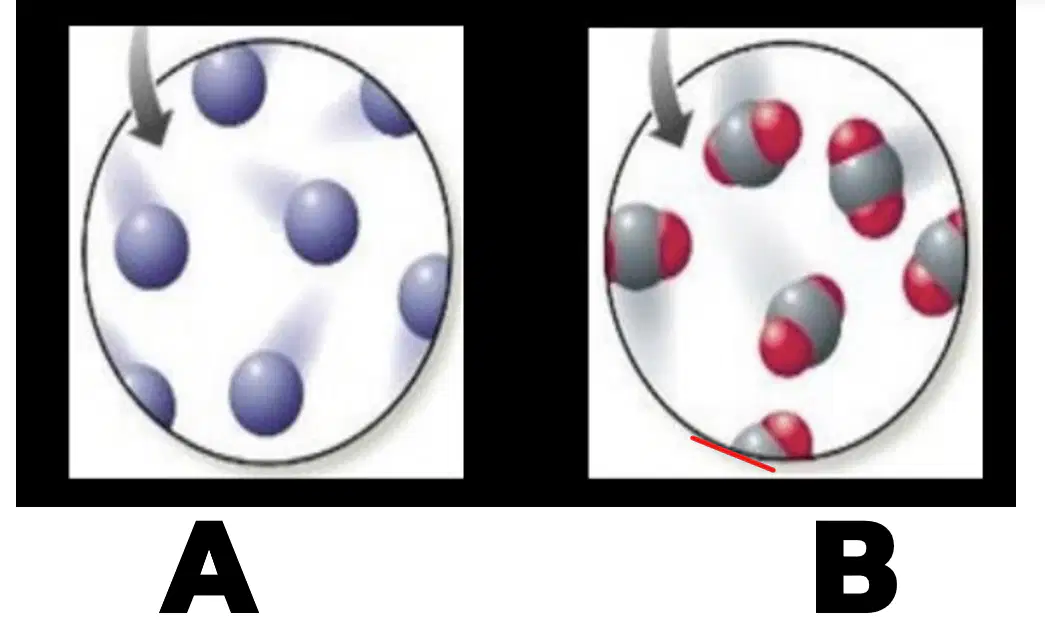
Which molecule is an COMPOUND?
a)
A
b)
B
c)
A & B
d)
NONE OF THE ABOVE
24.
Which of the following best describes a mixture?
a)
A chemically combined substance
b)
A combination of 2 or more element that is used to make a new substance.
c)
A combination of substances where new substances are formed through a chemical reaction.
d)
A combination of substances in which the atoms of the substance do not chemically combine.
25.
Which of the following is NOT example of a heterogeneous mixture?
a)
oil and water
b)
halo-halo
c)
sand and water
d)
air
26.
A type of mixture contains two or more substances that are visibly distinguishable.
a)
homogeneous
b)
heterogeneous
c)
solution
d)
suspension
27.
Which of the following is an example of homogeneous mixtures?
a)
air
b)
soft drink
c)
fruit salad
d)
sandwich
28.
fruit salad
a)
element
b)
compound
c)
homogeneous mixture
d)
heterogeneous mixture
29.
Steel
a)
element
b)
compound
c)
homogeneous mixture
d)
heterogeneous mixture
30.
oxygen
a)
element
b)
compound
c)
homogeneous mixture
d)
heterogeneous mixture
31.
carbon dioxide
a)
element
b)
compound
c)
homogeneous mixture
d)
heterogeneous mixture
32.
air
a)
element
b)
compound
c)
homogeneous mixture
d)
heterogeneous mixture
33.
Which of the given methods of separation is used to separate blood?
a)
hand picking
b)
filtration
c)
distillation
d)
centrifugation
34.
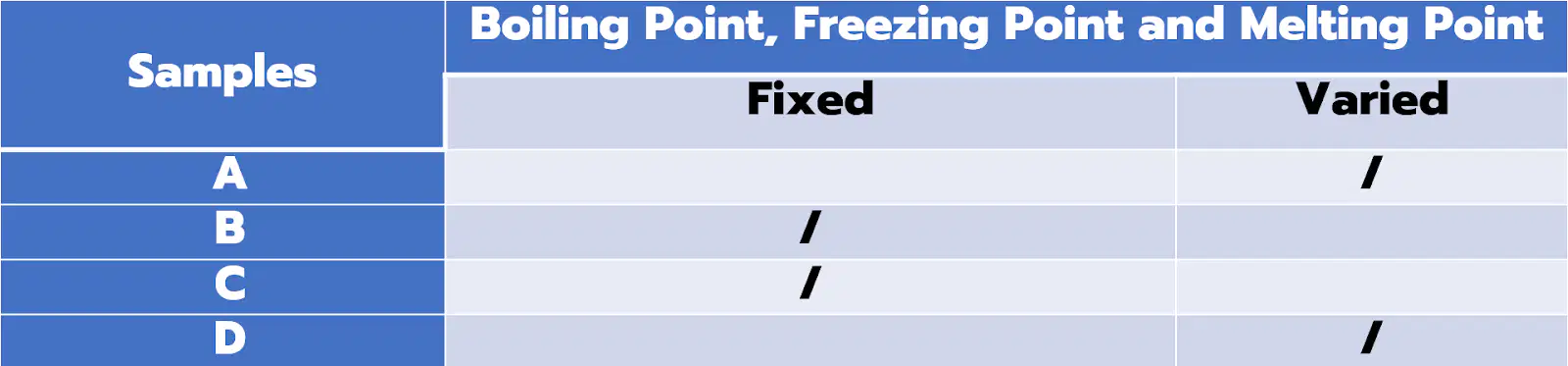
Which of the samples are considered mixtures?
a)
A
b)
B
c)
B and C
d)
A and D
35.
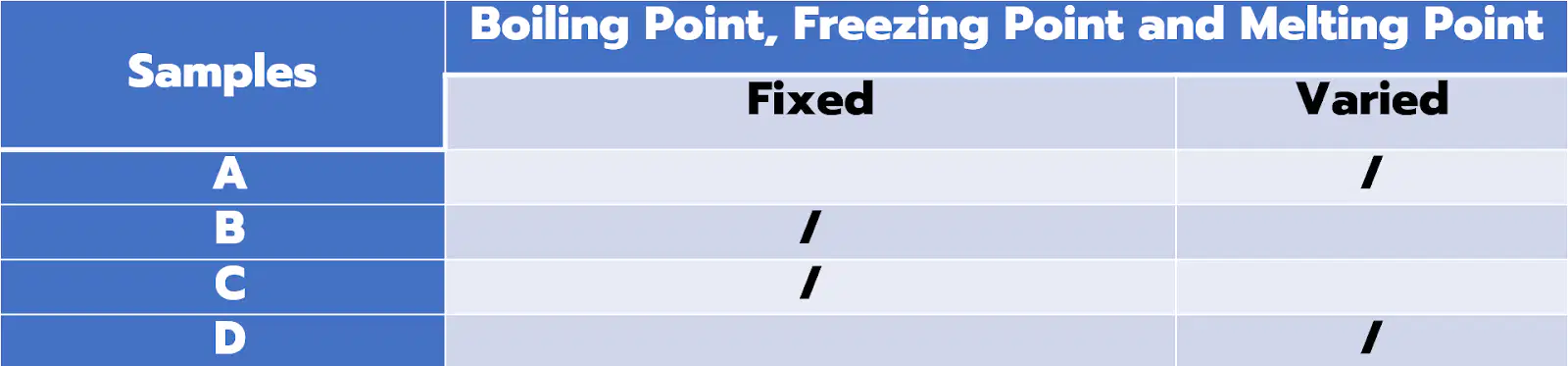
Which of the samples are considered pure substances?
a)
A
b)
B
c)
B and C
d)
A and D
36.
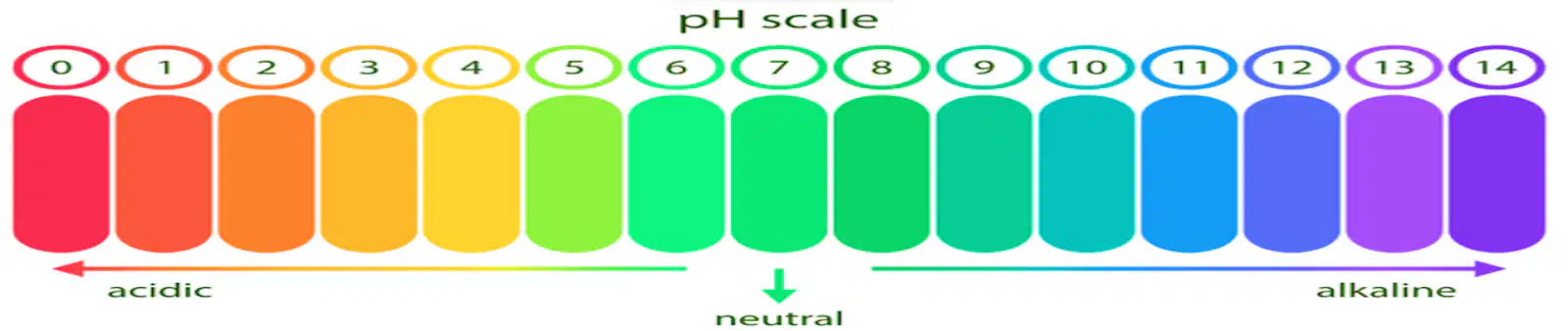
Given the pH number 4 and 2, which pH number is more acidic?
a)
4
b)
2
c)
Both are acidic
d)
none of the choices is acidic
37.
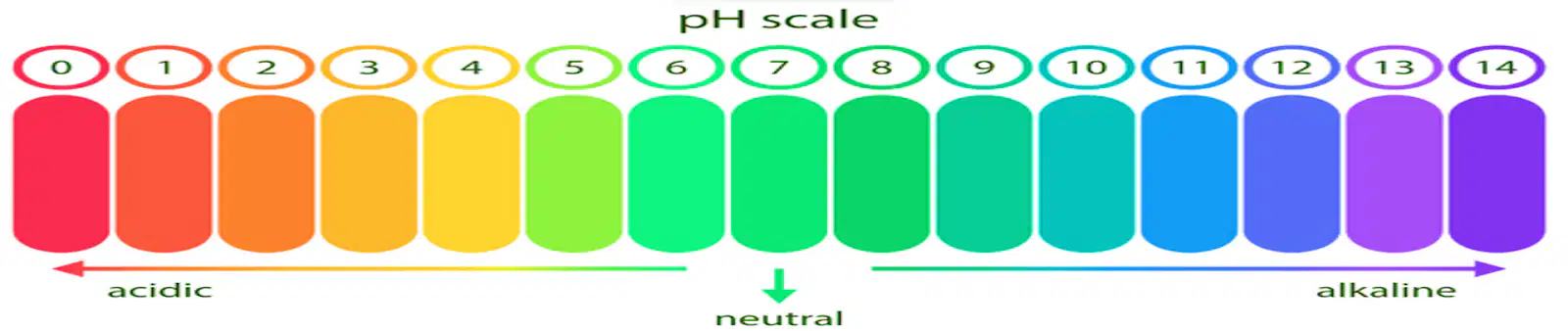
In pH indicator, what number is considered strongly basic?
a)
8
b)
10
c)
12
d)
14
38.
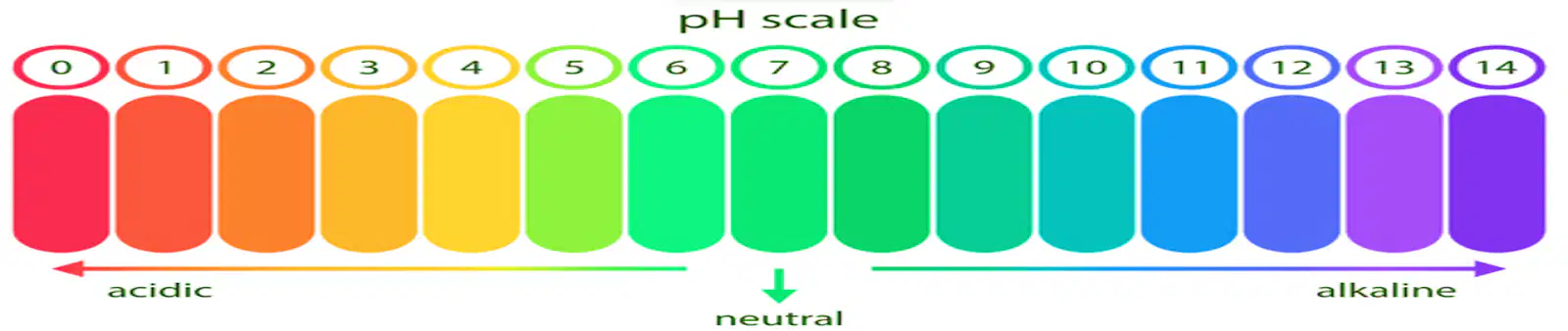
Which pH number is near neutral?
a)
6.9
b)
12.2
c)
2.2
d)
8.5
39.
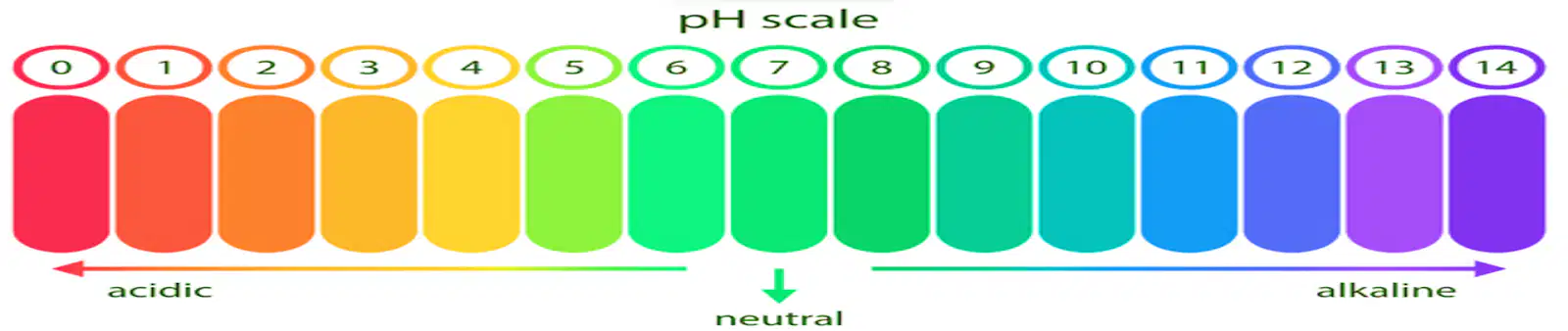
How can you classify pH number 0 in pH scale?
a)
weak acid
b)
strong acid
c)
weak basic
d)
strong basic
40.
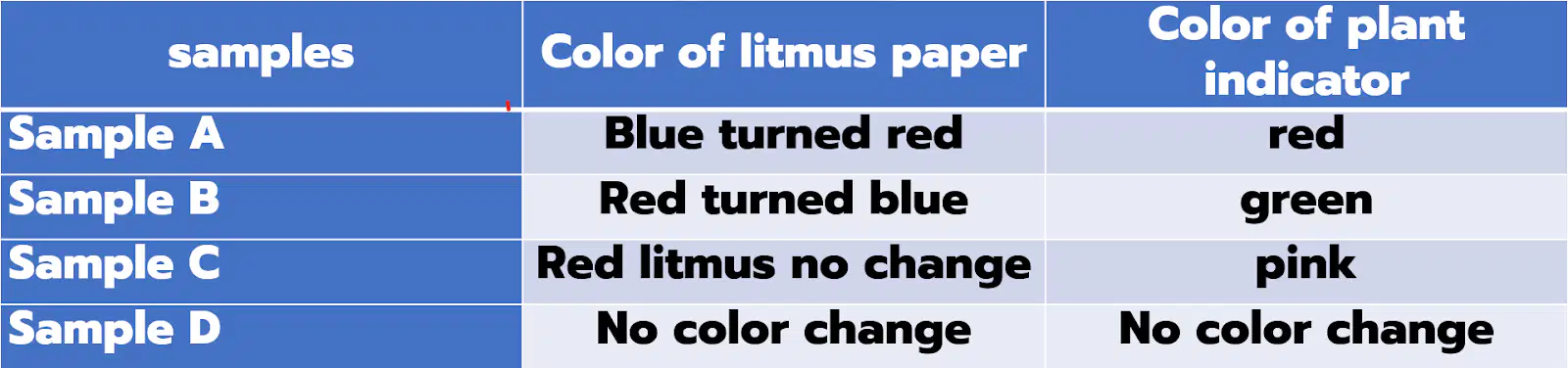
Which of the following samples are considered acids?
a)
D
b)
C
c)
B and C
d)
A and C
41.
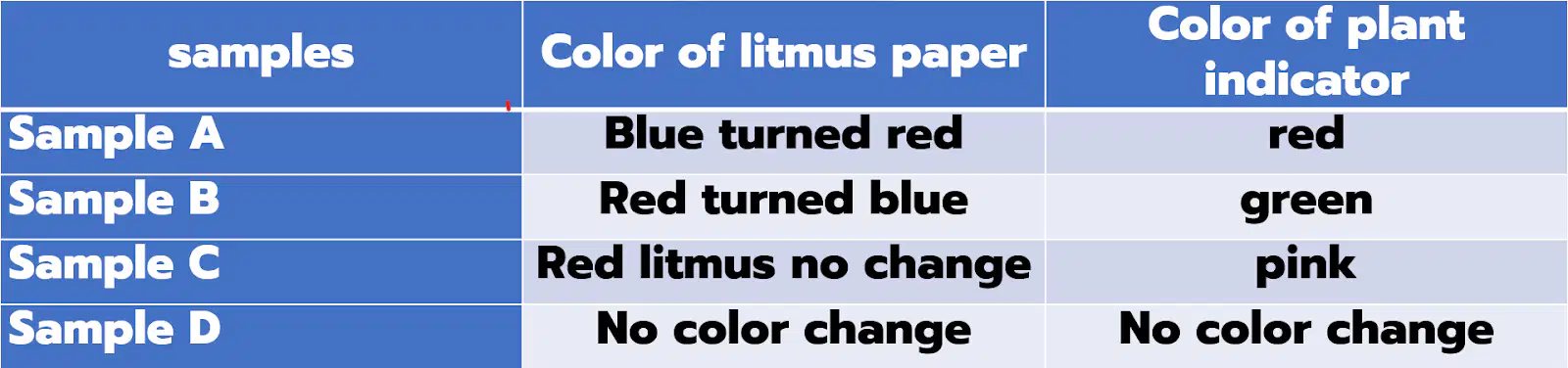
Which of the following samples are considered base?
a)
A
b)
D
c)
B
d)
A and C
42.
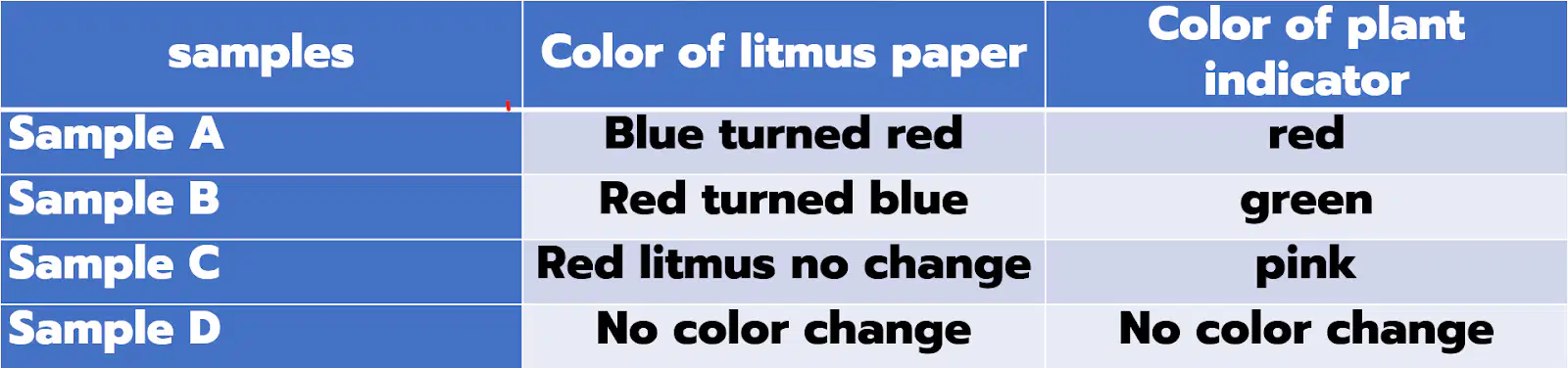
Which is NOT true about sample C?
a)
Red litmus paper did not change because it is an aci
b)
Indicator turned pink which is an indication of acidity.
c)
Sample C is neutral based on the pH level.
d)
Sample C is an acid
43.
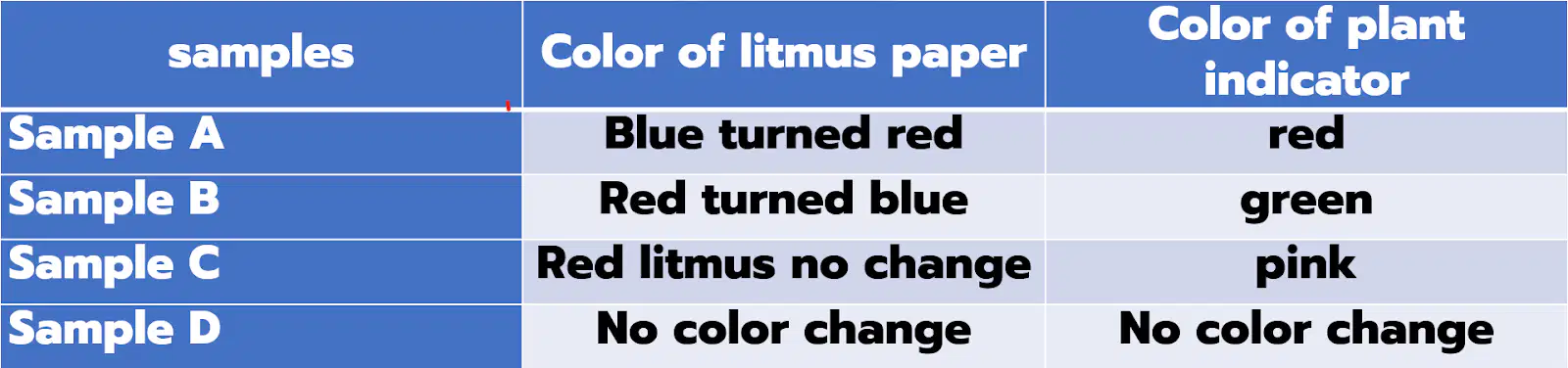
Based on the table how can we classify sample D?
a)
acid
b)
base
c)
neutral
d)
none of the choices
44.
Which of following examples cannot be used to indicate basicity and acidity among compounds?
a)
pH scale
b)
plant indicators
c)
litmus paper
d)
hydrogen peroxide
45.
What color will be formed in plant indicator if the sample is a basic compound?
a)
red
b)
blue
c)
yellow
d)
pink
46.
A sample was tested using a litmus paper showed a red color. What kind of compound is the sample?
a)
acid
b)
basic
c)
neutral
d)
none of the choices
47.
Which example has the highest basicity level?
a)
blood (8.0)
b)
drain cleaner (14.0)
c)
antacids (10.0)
d)
baking soda (9.0)
48.
Which arrangement is correct from strong to weak base?
a)
vinegar, lemon, orange, battery
b)
drain cleaner, antacids, egg whites, blood
c)
blood, ammonia, milk coffee
d)
battery, gastric juice, lemon, coffee
49.
Which of the following describe a base?
a)
Sour in taste.
b)
Used as cleaning material
c)
Have a pH level of less than 7.0
d)
Can destroy fabrics
50.
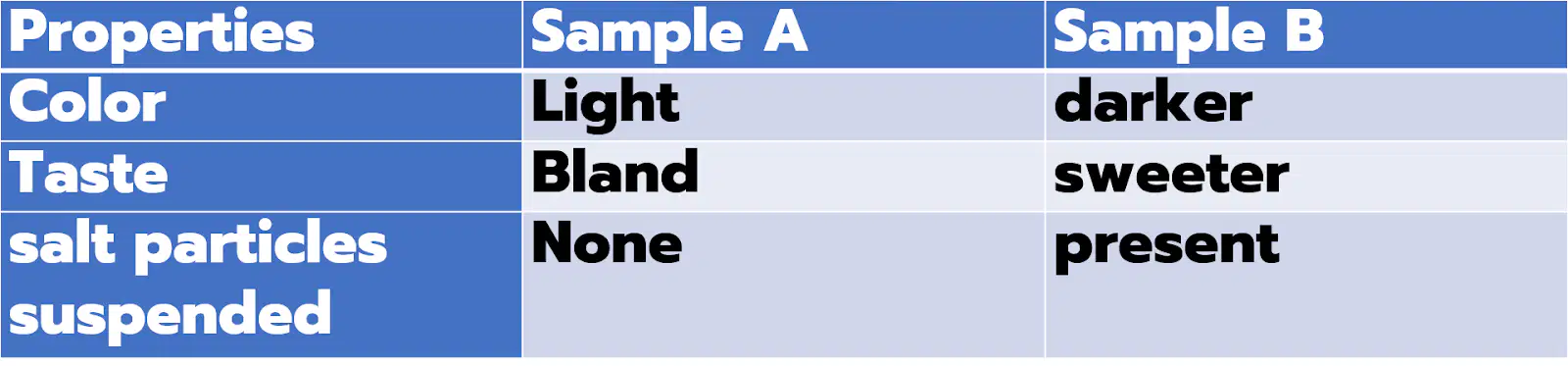
Which sample is a saturated solution? _____
a)
A
b)
B
c)
A & B
d)
NONE OF THE CHOICES
51.
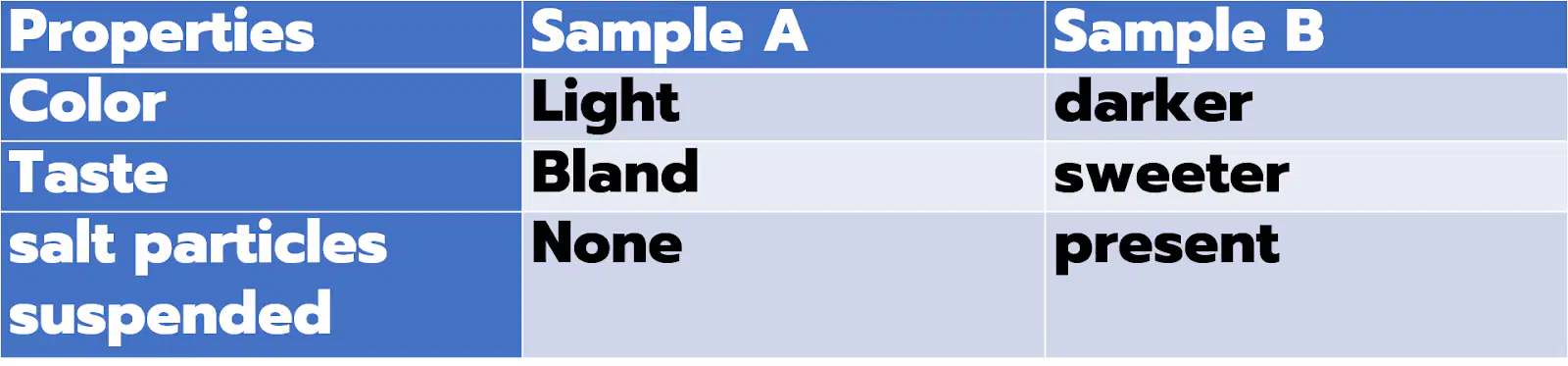
Which sample is a unsaturated solution? _____
a)
A
b)
B
c)
A & B
d)
NONE OF THE CHOICES
52.
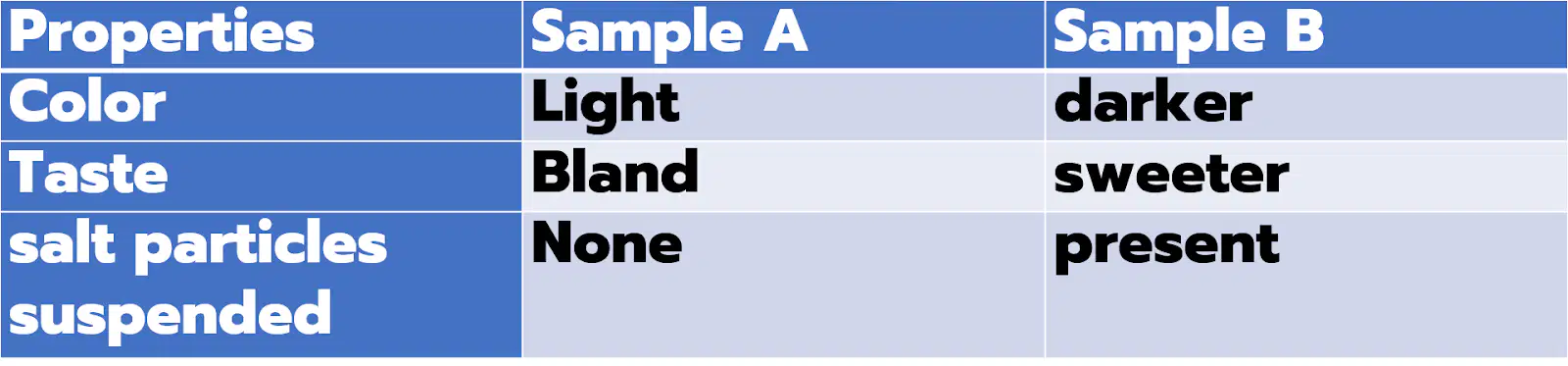
Which sample can still dissolve salt? _______
a)
A
b)
B
c)
A & B
d)
NONE OF THE CHOICES
53.
In describing solubility, which component of solution tells us that the solution is already saturated?
a)
solute
b)
solvent
c)
stirring
d)
scooping
100 %

