
 Worksheets
Cell Structure 1.0
Total questions: 29
Worksheet time: 15mins
What is the function of the cell membrane?
The function of the cell membrane is to provide structural support to the cell.
The function of the cell membrane is to produce energy for the cell.
The function of the cell membrane is to store genetic information in the cell.
The function of the cell membrane is to control the movement of substances in and out of the cell.
Which part of the cell controls all the activities of the cell?
Mitochondria
Cell membrane
Nucleus
Cytoplasm
What is the gel-like substance inside the cell called?
cell membrane
cytoplasm
mitochondria
nucleus
Which organelle is known as the powerhouse of the cell?
chloroplast
mitochondria
nucleus
lysosome
What is the function of the endoplasmic reticulum?
The function of the endoplasmic reticulum is protein synthesis, lipid metabolism, and detoxification.
The function of the endoplasmic reticulum is cell division.
The function of the endoplasmic reticulum is energy production.
The function of the endoplasmic reticulum is waste elimination.
What is the outer boundary of the cell called?
Nucleus
Cell wall
Cell membrane
Cytoplasm
Which organelle contains the genetic material of the cell?
mitochondria
cytoplasm
nucleus
cell membrane
What is the function of the cytoplasm?
The function of the cytoplasm is to store genetic information.
The function of the cytoplasm is to produce energy for the cell.
The function of the cytoplasm is to hold organelles in place and facilitate cellular processes.
The function of the cytoplasm is to protect the cell from external threats.
Which organelle is responsible for protein synthesis?
Ribosome
Lysosome
Mitochondria
Nucleus
What is the function of the mitochondria?
Stores waste products
Regulates body temperature
Transports oxygen
Produces energy
If a cell has a nucleus it must have a:
nuclear membrane
capsid
cell wall
central vacuole
What is a cell in a living organism?
What is a neclues in a cell?
What is cytoplasm?
What is an organelle in a cell?
What is the purpose of DNA in a cell?
Provide energy for the cell
Regulate cell division
Store and transmit genetic information
Synthesize proteins
What is the name of anything that can only be seen under a microscope?
Amoeba
Virus
Bacteria
Microscopic
What is DNA?
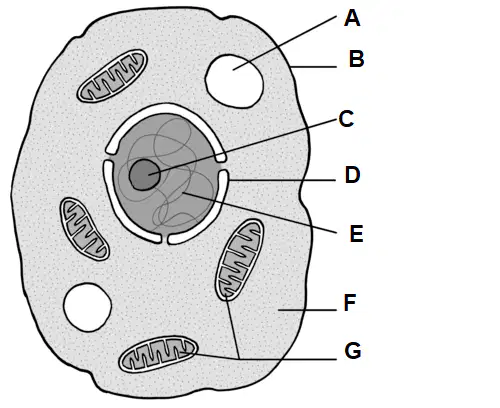
Name the components of a cell represented by A in the diagram.
Vacuole
Name the components of a cell represented by B in the diagram.
Vacuole
Name the components of a cell represented by C in the diagram.
Vacuole
Nucleolus
Name the components of a cell represented by D in the diagram.
Vacuole
Nuclear membrane
Name the components of a cell represented by E in the diagram.
Vacuole
Nuclear membrane
DNA Material
Name the components of a cell represented by F in the diagram.
Cytoplasm
Nuclear membrane
DNA Material
What is the function of a microscope?
What is the function of vacuoles in plant cells?
What is the function of vacuoles in animal cells?
Name the components of a cell represented by G in the diagram.
Cytoplasm
Nuclear membrane
Mitochodria
Where does photosynthesis take place in a plant?

