Wayground logo

Free Printable Worksheets

Font size

S
M
L
XL
Worksheets

Orbital Diagrams and Lewis Dot Structures

Total questions: 26

Worksheet time: 32mins

Name
Class
Date
1.
This is a correct dot diagram for oxygen (O)
a)
true
b)
false
2.
This is the correct dot diagram for sodium (Na)
a)
true
b)
false
3.
This is a correct dot diagram for fluorine (F)
a)
true
b)
false
4.
Which element is pictured?
a)
neon
b)
fluorine
c)
magnesium
d)
argon
5.

There are __ energy levels

a)

1

b)

2

c)

7

d)

8

6.
How many atomic orbitals are there in the p sublevel?
a)
2
b)
3
c)
4
d)
5
7.
Electron arrangement that uses arrows
a)
Electron configuration
b)
Shorthand configuration
c)
Lewis dot structure
d)
Orbital diagram
8.
What does Pauli exclusion principle state ?
a)
states that each electron occupies the lowest energy orbital available
b)
states that a maximum of two electrons can occupy a single atomic orbital, but if only if the electros have opposite spins
c)
states that single electrons electrons with the same spin must occupy each-energy orbital before additional electrons with opposite spins can occupy the same orbitals
9.
What does Hund's rule states ?
a)
states that single electrons electrons with the same spin must occupy each-energy orbital before additional electrons with opposite spins can occupy the same orbitals
b)
states that each electron occupies the lowest energy orbital available
c)
states that a maximum of two electrons can occupy a single atomic orbital, but if only if the electros have opposite spins
10.
What does an atom's electron-dot structure consist of ? 
a)
the elements atomic number and mass number which represents the number of protons and neutrons
b)
the element's symbol, which represents the atomic nuclues and inner-level electrons,surrounded by dots representing all of the atom's valence electrons
11.
What do you start electron configuration with?
a)
1s2
b)
1d10
c)
1f14
d)
1p6
12.
Which of the following is a p block element?
a)
Ca
b)
Ar
c)
Re
d)
Au
13.
This is a correct dot diagram for fluorine (F)
a)
true
b)
false
14.

What are valence electrons?

a)

The innermost electrons

b)

The outermost electrons

15.

What is the octet rule?

a)

Elements can only have 8 electrons in its outermost shell

b)

The elements must form an octopus like structure

16.

Electron dot notation is . . . .

a)

A representation of an element in which only valence electrons of an atom are shown

b)

A representation of how compounds are formed.

17.

Which of the elements in the picture has correct electron dot notation?

a)

1

b)

2

c)

3

d)

4

18.
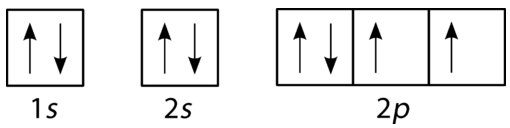
This orbital diagram represents:  
a)
C
b)
B
c)
N
d)
O
19.
This orbital diagram represents:  
a)
C
b)
B
c)
N
d)
O
20.

What is incorrect about this orbital diagram?

a)

Both arrows in the 2p box should be pointing up

b)

There is nothing incorrect with this diagram

c)

There should be 1 electron (arrow) in the first 2p box and one in the 2nd 2p box

d)

All the arrows should be pointing up.

21.

Which rule is being violated in the following orbital diagram?

a)

Hund's

b)

Aufbau's

c)

Pauli's Exclusive

22.
Electrons occupy orbitals of lowest energy first is part of what electron configuration rule?
a)
Hund’s Rule
b)
Aufbau Principle
c)
Pauli Exclusion Principle
23.

Which of the following statements regarding electronic orbitals is/are correct? (you may need to select more than one answer)

a)

Each p-orbital can hold a maximum of six electrons.

b)

The 3p-orbitals have a higher energy level than the 3s-orbital.

c)

The 4s orbital has a higher energy than the 3d orbital.

d)

The 1s-orbital has the same shape and energy as the 2s-orbital.

24.
 The diagram above represents two electrons with 
a)
a. opposite spins.
b)
 b. the same spin.
c)
c. different energies.
d)
d. different energy levels.
25.

What does the 1 in "1s" stand for?

a)

energy level

b)

s orbitals

c)

p orbitals

d)

the number of electrons

26.

Which of the following is the electron configuration for Fluorine

a)
b)
c)
d)