
 Worksheets
Science 9_Biology_1stQ_Reviewer
Total questions: 60
Worksheet time: 33mins
Which are the organs of the respiratory system?
Lungs, heart, and blood.
Rib cage, diaphragm, and lungs.
Nose, lungs, heart, and diaphragm
Lungs, throat, and passageways that lead to lungs
What happens in the diaphragm when we exhale (breathe out)?
The diaphragm relaxes and moves upwards.
The diaphragm contracts and moves upwards.
The diaphragm relaxes and moves downwards.
The diaphragm contracts and moves downwards.
What will happen if the epiglottis does not close the entrance of airways?
The larynx will be blocked with food particles.
The pharynx will have difficulty in swallowing.
The food particles will block the opening of the trachea and a person will have difficulty in breathing.
The food particles will block the bronchioles thus making it difficult to breathe in and breathe out.
What important activity takes place in the lungs?
Food is digested.
Liquid waste is filtered from the blood.
The trachea is exchanged for the larynx.
Oxygen is exchanged for carbon dioxide.
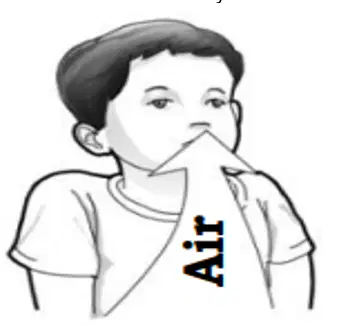
Which is taking place in this figure?
Exhalation; the rib cage is expanding.
Exhalation; the diaphragm is relaxing.
Inhalation; the chest cavity is reduced.
Inhalation; the diaphragm is contracting.
Which statement is true about the human circulatory system?
It makes blood cells.
It transports oxygen and nutrients.
It breaks down food and releases nutrients.
It is the first line of defense against bacteria.
Which blood vessel carries blood away from the heart?
Artery
Blood vessel
Capillary
Vein
Which is NOT a function of the circulatory system?
Deliver oxygen and nutrients to cells.
Break down carbohydrates into glucose.
Transport other materials through body.
Remove carbon dioxide and wastes from cells.
If a rupture occurs in the pulmonary artery, which passageway is affected?
The passageway of blood going to aorta.
The passageway of blood going to lungs.
The passageway of blood going to vena cava.
The passageway of blood going to right atrium.
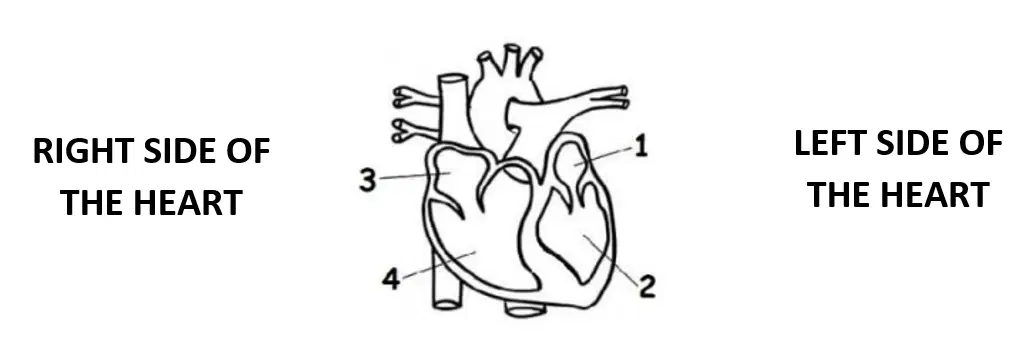
Which path in the figure does the blood flow through the heart as it returns from the head and body?
1→2
2→1
3→4
4→3
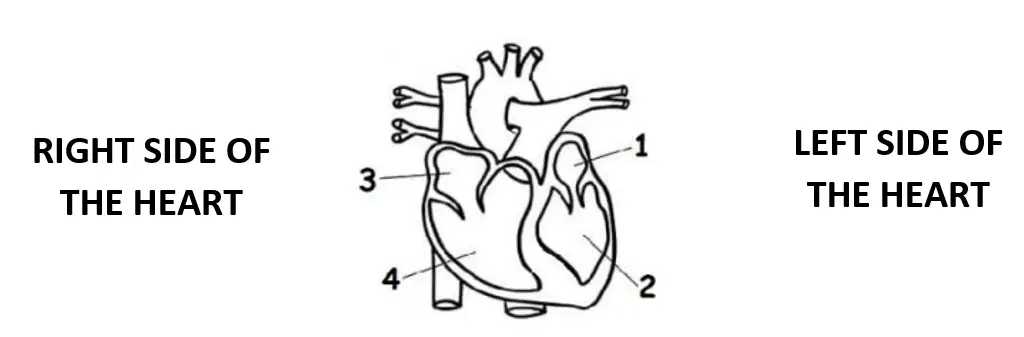
In which chamber does the blood flow while transporting fresh oxygen?
1→2
2→1
3→4
4→3
What type of circulation carries oxygenated blood to the rest of the body excluding the lungs.?
Heart Circulation
Pulmonary Circulation
Coronary Circulation
Systemic Circulation
For the body to maintain homeostasis, the intake of oxygen into the lungs must be followed by which process?
A decrease in blood flow.
An increase in blood pressure.
A decrease in gas exchange.
The exhalation of carbon dioxide.
How do the respiratory and circulatory systems work together?
They supply the body's cells with oxygen.
They are responsible for the movement of the body.
They break down food into energy and eliminate waste.
They send chemical signals throughout the body via hormones.
The circulatory and respiratory systems work together to provide cells with oxygen and nutrients and remove wastes such as carbon dioxide. When the body needs more oxygen, how does the circulatory system respond?
The heart beats faster to match the increase in breathing rate.
More blood is sent to the lungs and less to the rest of the body.
The blood vessels in the arms and legs constrict to conserve oxygen.
Blood moves more slowly through the organs to carry away more wastes.
When one characteristic is more strongly inherited than another characteristic, it is said to be.
Dihybrid
Dominant
Recessive
Monohybrid
Which genotypes consists of two identical genes for a given character?
Dominant
Recessive
Homozygous
Heterozygous
The human sex chromosome for male is ______________________.
XX
YY
XY
XZ
Which of the following is a physical feature or trait of an organism?
Allele
linkage
Genotype
Phenotype
The chromosome number of normal human gametes is ___________________.
12
23
46
Higher for eggs and sperm
Which is NOT an example of incomplete dominance?
A pink flower produced from red and white flowers
A flower that is both red and white produced from red and white flowers
Curly-haired and straight-haired individuals producing wavy-haired offspring
A highly spotted dog and a non-spotted dog producing puppies with a few spots
A man heterozygous for blood type A marries a woman heterozygous for blood type B. What is the chance that their first child will have type O blood?
0%
25%
50%
75%
Which best describes the genetic material a person receives from his or her father?
22 autosomes and an X or Y chromosome
22 haploid cells and an X or Y chromosome
23 diploid cells and an X and Y chromosome
pair of homologous chromosomes and an X and Y chromosome
Which of the following represents an individual who is heterozygous for two genes?
Aabb
AAbb
AaBb
AABb
A couple has a colorblind son, but all their daughters have normal vision. What are the genotypes of this couple?
XX and XY
XX and XCY
XXC and XY
XCXC and XCY
If an organism has two alleles for a gene that are the same and usually masked by another type of allele, the organism is said to be __________?
Heterozygous
Generally defective
Homozygous recessive
Homozygous dominant
Baldness is an example of __________________.
Polygene
X-linked gene
Holandric gene
Sex-influenced trait
What inheritance is most likely involved when both parental phenotypes are expressed in the F1 generation?
Codominance
Multiple alleles
Polygenic inheritance
Incomplete dominance
A polygenic trait is also called _____________________.
X-linked gene
Multiple alleles
Holandric gene
Continuous trait
What information can be obtained from a Punnett square?
Genotype of offspring
Phenotype of offspring
Phenotypic ratio of offspring
All the above information
Which is NOT an example of an endangered species?
Tarsier
Dugong
Maya bird
Monkey-eating eagle
Which do you think is the biggest problem faced by endangered species?
Food
Water
Climate change
Human activities
What is the best example of limiting factors?
waste, animals, and ecosystem
unit area, density, and population
environment, green plants, and land
food, water, and light.
Which could be a probable cause of increase in the population of preys in an environment?
destruction of prey habitats
lower birth rate than death rate of preys
calamities and rampant spread of diseases
increase in the population of their predators
How does habitat degradation cause extinction of species?
It kills acid intolerant species.
It leads to spread of diseases that exterminate species.
It leads to diminishing resources which increases competition among species.
It leads to existence of shallow gene pools that promote massive inbreeding.
What do woolly mammoth, Dodo, and Great Auk have in common?
They are all extinct.
They are all mammals.
They are all threatened species.
They are all endangered species.
Which statements are TRUE?
I. Introducing a new species in an ecosystem affects the food chain.
II. Extinction is a natural process that has occurred since the beginning of time.
III. Human intervention is the most leading cause of animal extinctions in this time.
I and II only
II and III only
I and III only
I, II and III

Refer to the table below: Species composition of two fields.
How will you compare Field A with Field B in terms of every flower species population?
Cattleya have larger population than yellow bell
Yellow bell in Field A is less than in Field B
Gumamela is already extinct in Field A
Field A have more species than Field B
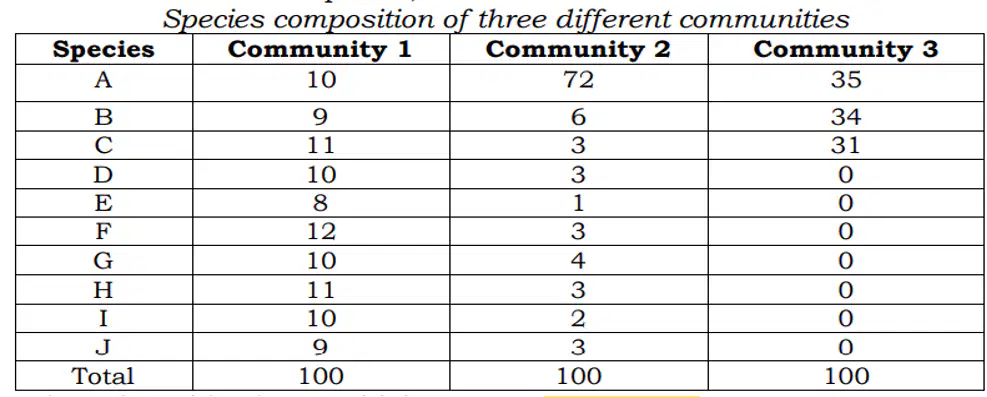
Consider three communities. Each made up of a total of 100 organisms, drawn from combinations of ten species, A to J.
Based on the table above, which statements are correct?
I. Community 3 has higher species richness than community 1 and community 2.
II. Community 2 has the same species richness but has a lower diversity than community 1.
III. Community 1 has the highest diversity because it has the highest species richness and each
species has a similar relative abundance.
I and II only
II and III only
I and III only
I, II and III
Which could you infer about an ecosystem with high species diversity?
Its food webs are relatively simple.
It has a greater number of successful species and a more stable ecosystem.
The change in the environment would probably have quite serious effects on it.
The environment is quite stressful with relatively few ecological niches and only a few organisms are really well adapted to that ecosystem.
Assume two habitats have the same number of species of birds. The first habitat is predominantly one species of bird, with just a few birds of the other species. The second habitat has equal number of all the different bird species found in habitat 1. Will they have the same biodiversity index? If yes, why? If not, which will have the higher biodiversity index, and why?
Yes, because they have equal species richness and species evenness.
Yes, they will have the same biodiversity index because they have the same number of species.
No, habitat 1 has a higher diversity because it is predominantly one species of bird. Diversity index depends on the greatest number of counts of one species of the organisms found in a community.
No, habitat 2 has a higher diversity because, aside from having the same number of species of birds as habitat 1, it also has equal numbers of each species. Species richness and species evenness are both measures of biodiversity.
Which one is the major cause of deforestation?
global warming
muro-ami
illegal logging
overharvesting
When can we say that extinction occurs in species?
when new species evolve.
when species threatened another species
when the last member of that species dies.
when population become larger
How does deforestation, building of dams, conversion of forest to agricultural lands and urban development could cause species to decrease in number which, eventually, could lead to extinction?
They pollute the environment causing species to die.
They cause widespread of diseases which may lead to mass extinction.
They trigger calamities to occur which may cause mass extinction of species.
They destroy the habitat where species live, depriving them the chance to thrive and survive.
Which are considered driving forces of extinction?
climate change
Over hunting
Carbon emissions
All of the above
The following are consequences of water pollution EXCEPT
infectious diseases
oversupply of plant nutrients
accumulation of toxic chemicals
increased dissolved oxygen for marine life
Abiotic factors are non-living things which determine the survival of an organism. Which of the following items is an abiotic factor?
habitat
temperature
food
organism
Where do all water pollutants eventually end up?
rivers
lakes
streams
oceans
Biodiversity can affect the ________ of ecosystems and the _________ of populations.
sustainability; stability
life ; existence
stability ; sustainability
existence ; life
How is the forest ecosystem affected when trees are cut down?
Nutrients are lost in the soil.
Oxygen will no longer be available.
Animals will lose their shelter and food.
There will be available space for building
The environmental conditions that keep a population from increasing in size and help balance ecosystems is called ________.
limiting factor
biotic factor
abiotic factor
environmental factor
What does eutrophication mean?
Forests are cleared to make the land available for other purposes.
People collect, capture, or harvest marine organisms such as coral reefs, fish, sea turtles, and others in a large quantity.
The weakening or death of trees caused by Nitrogen Oxides (NOx) and Sulfur dioxide (SO2) that reacts with water, oxygen, and other chemicals in the atmosphere.
An increase of organic nutrients brought about by the chemicals and garbage thrown into the bodies of water which stimulates the growth of algae and in turn, lessens the available oxygen for other aquatic animals.
Biodiversity is a short term for ____________
biological diversified
biological diversity
biological diverse
bio diversified
Biodiversity and the survival of ecosystems has a direct proportional relationship. This means that if biodiversity will increase, the chance of survival will also _______.
decrease
increase
increase then decreases
cannot be determined
The main source/s of oceanic pollution is/are
oil, ozone, methane.
petroleum, oil, detergent.
detergent, volcanic ashes, oil.
ozone, volcanic ashes, nitric oxide.
Which of the following is the major cause of wildlife depletion?
carbon emissions
deforestation
overfishing
eutrophication
Environments always have both living and _________.
non-living factors
nutrients
biogeochemical cycles
ecosystem
How may conservation be achieved?
by using fine nets
by collecting corals and shells
by using appropriate size of nets
by using cyanide for collecting coral fish
Trees in the forest compete for limited resources like space, sunlight and soil nutrients. Some small plants like grasses and shrubs can't grow well therefore, population decreases. Which limiting factor greatly affects the population of grasses and shrubs in the forest ecosystem?
space
sunlight
temperature
altitude
The ocean is the __________ ecosystem in the world.
shortest
smallest
largest
longest

