
 Worksheets
Colonies Test Review Quizziz
Total questions: 72
Worksheet time: 55mins
The Mayflower Compact helped establish the idea that the __________ create government through direct rule over the people.
people
king
How was the governor selected after South Carolina became a royal colony?
The King appointed the Governor
The people elected their own Royal governor
Colony held an election and everyone was allowed to vote for governor
The Governor was elected by the Lord Proprietors and Elite
What was the economic benefit of South Carolina becoming a royal colony? (Choose 2 answers.)
Colonists were allowed to have a say in Parliament.
The English government increased subsidies for naval stores.
Subsistence farmers were able to afford owning slaves due to loans made by the king.
Merchants were allowed to sell rice directly to foreign countries.
What was the purpose of creating the Commons House of Assembly in the Carolina colony?
It was a legislative house to represent all people of the Thirteen Colonies.
It was a legislative house to represent the common people of the colony.
It was a legislative house to represent the immigrants to the colony.
It was a legislative house to represent only the elite people of the colony.
What was the primary reason the Carolina colonist became unhappy with the Lord Proprietors?
They felt they were paying rent but getting little protection from the Native Americans
They felt the proprietors were too involved in the affairs of the colonists.
They felt that the proprietors were too eager to see slavery prosper.
They felt that the proprietors were against the establishment of religious freedom.
Which social group had greater representation in the legislative assembly in the Carolina colony?
the subsistence farmers
the ministers
the common people
the Lowcountry elite

What is the two regions represent of South Carolina? (HINT: Where did the Royal Governor set up towns to encourage migration?)
Low Country and Back Country
Mountain and Coastal Regions
South South Carolina and Northern South Carolina
Eastern South Carolina and Western South Carolina
Which of the following was a result of the Regulator Movement?
the secession of the Up Country
the establishment of a circuit court system
the creation of the Commons House of Assembly
the end of the headright system
How were Backcountry settlers viewed by the Lowcountry?
The Lowcountry viewed the Backcountry as equals.
The Lowcountry viewed the Backcountry as uncivilized traders and woodsmen.
The Lowcountry viewed the Backcountry as leaders of the colony.
The Lowcountry viewed the Backcountry as representatives of the king.
What did the Royal Governor established to encourage migration?
establish towns in South Carolina's backcountry
establish roads to Columbia from the coastal region of South Carolina
establish communication between towns in the lowcountry and backcountry
establish courts and jails in towns in the backcountry
South Carolina started as a PROPREITARY colony, but eventually changed to a (a)
What was the economy of South Carolina and other Southern Colonies based on?
Ship building
Trading with natives
Harvesting lumber
Plantation systems
What was the economy of South Carolina and other Southern Colonies based on?
Ship building
Trading with natives
Harvesting lumber
Plantation systems
African slaves had knowledge of growing what crop?
sugar
cotton
indigo
rice
Why did African slaves use "call and response" songs on plantations?
The songs praised the master for being kind to the slaves
The songs praised the slaves role in southern society
The songs were used to sustain their work and spirit
The songs were used to pray for good weather and a bountiful harvest
Why did the Gullah language develop along the coast of South Carolina?
It had a large isolated concentration of Africans with little interaction with outsiders
The coast was the only places slaves were located in South Carolina
The auction blocks where slaves were sold was located along the coast
The government did not have money to educate the slaves
Why did South Carolina have fewer free African-Americans than other colonies? (Choose 2 answers)
slaves were valuable and owners were hesitant in freeing them.
owners had to pay a fee to the General Assembly to free their slaves.
owners had to pay for the moving expenses for the slaves they set free.
slaves who were freed had to leave within six months or risk re-enslavement
What led to the importation of more slaves in South Carolina during the late 17th Century?
The growing demand for both rice and indigo
The growing demand of the naval stores
The growing demand for cotton in foreign markets
The growing demand of the fur trade business with the natives
What was the result of the Stono Rebellion?
The slaves were able to make it to Spanish Florida and get their freedom.
The Slave Codes were strengthened to control slave life.
The slave trade was restricted in the colony of South Carolina.
The slaves were able to make it the west and gain land of their own.
Read the quote below.
"...That no person whatsoever shall permit or suffer any slave under his care or management...to go out of the limits of said town...or...to go out of the plantation to which the slave belongs...without a letter superscribed and directed, or a ticket..."
The slave code referenced above controlled which of the following aspects of slavery?
the ability to possess a weapon
the ability to obtain medical attention
the ability to read or write
the ability to travel off the plantation
Trade with what areas helped South Carolina become prosperous? Choose 2 answers.
Barbados
Great Britain
France
Spain
Where were slaves trying to escape to during the Stono Rebellion?
Charleston, South Carolina
St. Augustine, Florida
Jamestown, Virginia
Savannah, Georgia
Provide 3 ways slaves lives were limited with the passage of the Slave Codes. (Choose 3 answers.)
Prohibited slaves from gathering without white supervision.
Prohibited slaves from reading and writing.
Prohibited slaves from being sold to other plantations.
Prohibited slaves from dressing above the condition of slaves.

The Middle Passage was the stage of the triangular trade in which millions of Africans were shipped to North America and the West Indies as part of the Atlantic slave trade. Drag and drop to label the map correctly.
HINT: Where did the Slaves come from and where were they going to?
Middle Passage was between Africa and North America
Middle Passage was between Africa and Europe
Middle Passage was between North America and Europe
How was the governor selected after South Carolina became a royal colony?
The colonists were able to elect their own governor to run the government.
The king appointed the governor to look over the colony in his absence.
The colony held an election that allowed all people of South Carolina to vote.
The governor elected by the Lord Proprietors remained in power of South Carolina's government.
What was the purpose of creating the Commons House of Assembly in the Carolina colony?
It was a legislative house to represent the common people of the colony.
It was a legislative house to represent the immigrants to the colony.
It was a legislative house to represent the elite people of the colony.
It was a legislative house to represent all people in North and South Carolina.
Which of the following is a characteristic of the Backcountry?
subsistence farms
large plantations
rice farms
indigo farms
Use the quote to answer the question. "If we want to keep order, we have to take the law into our own hands..." In colonial South Carolina, the quote represents the views of which of the following individuals?
an indentured servant
a colonial governor
a Lord Proprietor
a Regulator
What was the primary reason the Carolina colonist became unhappy with the Lord Proprietors?
They felt they were paying rent but getting little protection from the proprietors.
They felt the proprietors were too involved in the affairs of the colonists.
They felt that the proprietors were too eager to see slavery prosper.
They felt that the proprietors were against the establishment of religious freedom.
Which social group had greater representation in the legislative assembly in the Carolina colony?
the common people
the elite
the ministers
the subsistence farmers
South Carolina started as a _____________ colony, but eventually changed to a ____________ colony.
proprietary; self-governing
proprietary; royal
royal; proprietary
self-governing; royal
What was the economic benefit of South Carolina becoming a royal colony? (Choose three that apply.)
Colonists were allowed to have a say in Parliament.
The English government increased subsidies for naval stores.
Merchants were allowed to sell all crops to the open market, especially to France.
Merchants were allowed to sell rice directly to foreign countries.
What was the economic benefit of South Carolina becoming a royal colony? (Choose three that apply.)
Colonists were allowed to have a say in Parliament.
The English government increased subsidies for naval stores.
Merchants were allowed to sell all crops to the open market, especially to France.
Merchants were allowed to sell rice directly to foreign countries.
What does being a Royal Colony mean?
Controlled by the King
Ruled by the appointed king
Forced to give half of its agricultural products to the king
Not allowed to trade with other colonies without the kings approval
Which of these best describe a bicameral legislature?
Governing body made of two houses
Government made up of only two leaders
Government that requires four-year terms
Governing body that is unfair to its people

This chart shows changes to the early colonial government in South Carolina. What political trend is evident from this chart?
More and more people were excluded from political participation.
The Lords Proprietors grew more powerful as the colony progressed.
There was an expansion of representation for the average person.
Power was in the hands of a few elites who made all political decisions for the colony.
Which word describes the Regulators in the backcountry of South Carolina?
politicians
slaves
soldiers
vigilantes

Which statement about the shaded areas of this map is correct?
Wealth and power was concentrated in this area in the colony.
Whites outnumbered Africans in this area of the colony.
Fur trading and timber were the basis of the economy in this area of the colony.
Most new immigrants settled in this area of the colony.
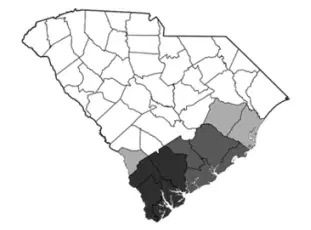
How did people living in the shaded areas of this map make their money?
harvesting timber and pine tar
trading furs and other goods
operating indigo and rice plantations
constructing homes and other buildings
What is a reason the colonies developed some form of self-government?
The king demanded that all colonists be represented in colonial legislatures.
Government representatives in England were too far away to govern the colonies adequately.
Colonists refused to send goods to England unless they were allowed to vote on laws.
The colonists adlped the government structure used by the Native Americans.
2. What were the expectations of English colonists in America?
They expected to be governed by the English king.
They expected the same rights as English citizens.
They expected to denounce their English citizenship.
They expected to be able to choose the leader of Parliament.
9. The Middle Passage refers to
the ocean crossing enslaved Africans endured.
the route taken to reach New York.
a step in climbing the social ladder.
a system of trade between the colonies.
10. Which of these is true about slavery in the colonies?
Laws were written to abolish slavery.
It expanded throughout the colonies.
It was limited to the Southern colonies.
Laws banned the sale of enslaved people.
The three European countries that explored and exploited the New World was
Native American Nations
Spain
France
England
The Spanish settlement in South Carolina was
San Miguel de Gualdape
San James de Rio
San Waccamaw de Rio
San Juan de Gidalgo
The French settlement was called
Charlesfort
Charleston
Charlotte
Columbia
The English settlement in South Carolina was
Charles Town
Charlesfort
Charlotte
Charleston
Spain mainly colonized what areas?
Canada
Antarctica
Florida, southwest North America, Central America, South America
Coastline of North America
Which group had the worst relationship with the Native Americans?
Spanish
English
French

Which nation is identified by the color BLUE?
France
England
Netherlands
Spain
What was the difference between the Massachusetts Bay and South Carolina colonies?
Massachusetts Bay was settled for religious reasons; South Carolina was settled for economic prosperity.
Massachusetts Bay was settled for economic prosperity; South Carolina was settled for religious reasons.
Both Massachusetts Bay and South Carolina were settled for economic prosperity.
Massachusetts Bay was abandoned; South Carolina was thriving.
"Since the natives of that place are utterly strangers to Christianity, whose idolatry, ignorance, or mistake gives us no right to expel or use them ill..."
What freedom is being discussed?
freedom of speech
the right to own slaves
the right to travel freely
freedom of worship
Why did the Puritans escape to New England?
to find gold
to own land
to escape religious persecution
to become friends with the Native Americans
What was the vision of the Lord Proprietors in the colonies?
To keep the wealthy wealthy.
To help the poor.
To make the wealthy and the poor equal.
To give everyone equal opportunity.

Why did the French come to the shaded area of the map?
They were searching for gold.
They wanted to establish trading relationships with the Native populations in the area.
They wanted to convert the Native population to Christianity.
They were escaping from religious persecution in Europe.
The Middle colonies are known as the ...
Wheatville
Slave colonies
New England colonies
Breadbasket
All are Southern cash crops EXCEPT...
wheat
indigo
rice
cotton
What are some examples of New England's economy?
ship building, fishing, and logging
cash crops, plantation systems, indigo
blacksmith, wig makers
fur trading
______________ was a Spanish explorer that traveled through what is now SC looking for gold.
San Miguel de Guadulaupe
Hernan de Soto
Horatio Gonzales
Who were the conquistadors?
plantations
Spanish explorers
boats

