
 Worksheets
Circuits and Ohm's Law
Total questions: 33
Worksheet time: 37mins


How much voltage will Yamiley need to produce a 2 ampere current through a 79 ohm resistor?
158 Volts
0.03 Volts
75 Volts
39.5 V
77 Volts
How much current flows through a 81 ohm light bulb when Morgan connects it with a 120 volt source?
1.48 A
201 A
0.675 A
39 A
177.78 A


Eileen tried each of these setups to make a working circuit.
In which setup would the bulb light?
Setup A
Setup B
Setup C
Setup D

Tasha made this model. In her model the bulb is not lit.
Which of these statements best explains why the bulb is not lit?
The wires are connected to the wrong battery terminals.
The bulb is burned out.
The switch is open.
A wire is missing.

series
parallel
Series
Parallel
Open
Partial

stop the flow of electricity
can still light up
will go out
of the light bulbs burn out also
What is the resistance of a lightbulb that experiences 9 Volts and 3 amps of current?
1/3 ohms
3 ohms
27 ohms
9 ohms
What is the current in a circuit with 6 ohms of resistance and a battery containing 24 Volts?
1/4 A
144 A
4 A
0.4 A
What is the voltage of a circuit with 4 ohms of resistance and 3 amps of current?
12 V
21 V
4/3 V
3/4 V
Match the following
The law that states that resistance in a circuit is equal to voltage divided by current.
Ohm's law
The measurement of how difficult it is for charges to flow through an object; measured in ohms (Ω).
resistance
An electric circuit in which all parts are connected one after another along one path.
series circuit
Match the following
The difference in electrical potential energy per charge between two places in a circuit; measured in volts (V).
voltage
A complete, unbroken path through which electric charges can flow.
electrical circuit
An electric circuit in which different parts of the circuit are on separate branches.
parallel circuit
Which of the following is NOT a main component of a circuit?
conductive wires
a switch
a source of electric energy
a device that runs on electricity
A student creates a circuit with a 12-V battery and a lightbulb with 6 Ohms (Ω) of resistance. What is the current of the circuit?
0.5 A
2.0 A
6.0 A
72 A
Which of the following describes an advantage of parallel circuits?
Each device shares the voltage.
If one device goes out, the others are unaffected.
Adding devices reduces the current.
More voltage is needed to reach an appropriate current.
In a circuit containing a switch, if the switch is turn "on"....
....the circuit is closed
....the circuit is open
....there is no current
....the voltage is increased
Which of the following would result in a circuit with 1.2 amps of current?
a 6-V battery and a 10-Ω resistor
a 1.5-V battery and a 5-Ω resistor
a 3-V battery and a 2.5-Ω resistor
a 4.5-V battery and a 7.5-Ω resistor

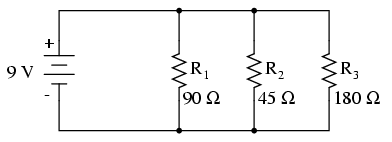
Which of the following is true about the circuit in the picture?
The circuit is an open circuit
If one light bulb goes out, the others will be unaffected
The circuit is a parallel circuit
Adding another battery would increase the brightness of each light bulb
Draw wires between the battery and the light bulbs to create a series circuit


What is the current of the circuit illustrated? (Use appropriate units!)

What are three ways you can increase the current in the circuit pictured?

