
 Worksheets
Unit 2: Matter and Energy Flow in an Ecosystem
Total questions: 40
Worksheet time: 2hrs 0mins
An ecosystem is all living things and their environment?
True
False
What is a food chain?
A community of living things
A bird catching a fish
The order in which living things get food and pass energy
How human, plants, and animals interact
What breaks down dead plants and animals?
Soil
Oceans
Decomposer
Food chains
What are some decomposers that you have seen outside?
Mushrooms
Worms
Maggots
All answer options are correct
Nutrients flow from grass to deer which would the deer be?
Prey
Predator
Consumer
Producer
Nutrients flow from grass to deer which would the grass be?
Prey
Predator
Consumer
Producer
There would be (a) producers in an ecosystem if there is abundance of herbivores.
Plants need soil to grow
True
False
How do plants get food?
The make if from water, air, and the soil.
Plants do not need food.
They make it from animals and rocks
They make it from water, air, and sun
What happens to a plant if it does not receive sunlight?
Plants will GROW
Plants will wilt and die
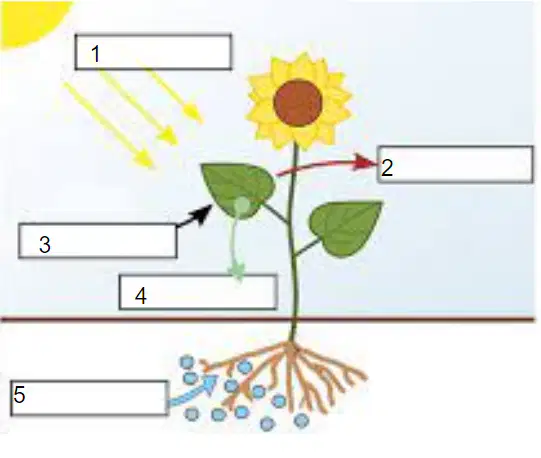
What goes in box 1?
Sunlight
Carbon Dioxide
Oxygen
Sugars (Plant Food)
Water
What goes in box 2?
Sunlight
Carbon Dioxide
Oxygen
Sugars (Plant Food)
Water
What goes in box 3?
Sunlight
Carbon Dioxide
Oxygen
Sugars (Plant Food)
Water
What goes in box 4?
Sunlight
Carbon Dioxide
Oxygen
Sugars (Plant Food)
Water
What goes in box 5?
Sunlight
Carbon Dioxide
Oxygen
Sugars (Plant Food)
Water
What is the ultimate source of energy for all life on Earth?
Plants
Water
Sunlight
Moonlight
If there were no sun, what would live on Earth?
Humans
Plants
Insects
Nothing
If plants suddenly died, do you think humans could still get the energy we need to survive?
Yes
No
Plants get the food they use for energy and growth by-
making it from the sunlight
absorbing it from soil
eating small insects
breaking down bacteria
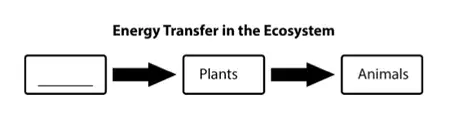
The diagram shows a transfer of energy in the ecosystem. What belongs in the blank in the first box of the diagram? (a)
The process by which plants make food requires water, carbon dioxide and which of the following?
nutrients from the soil
energy from the sun
dead and decaying animals
minerals found in rocks

A diagram showing the transfer of energy between members of an ecosystem is provided. The information in this diagram supports which of the following ideas?
all organisms depend on other organisms
every animal gets energy from another kind of animal
all organisms will be eaten by another organism at some time
the original source of energy for all organisms is the sun
Animals get the energy they need for growth and repair from-
the action of muscles.
protective coloration.
the food they eat.
avoiding predators.
Under which of the following conditions would a plant grow the best? A plant grown with (a)
Which of the following would provide the best evidence that plants require water for growth?
Watering two plants on alternate days over a period of one year and measuring the growth of both plants
Comparing data on the growth rates of plants in habitats that receive lots of rain and plants in drier habitats
Growing 100 plants under identical conditions, but providing water to only 50 of the plants, then measuring the growth of all the plants
Timing how fast different seeds are able to grow in soil and how fast seeds are able to grow in water from several different sources.
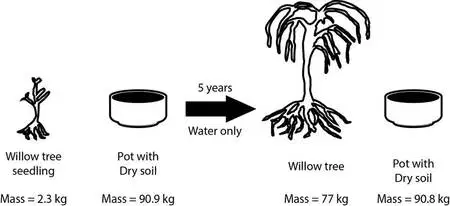
In a famous experiment, a scientist measured the mass of a small willow tree seedling and the mass of a pot of dry soil. The willow tree was planted in the soil, and only water was added as the tree grew. After five years, the mass of the soil and the willow were measured again. What data from this investigation supports the claim that soil does not provide most of the materials a plant needs to grow?
The mass of the dry soil was greater than the tee after it grew.
After the willow tree grew, the soil lost 0.1 kg of mass.
The willow gained mass, but the soil lost almost no mass.
The amount of mass the willow tree gained during the five years was 74.7 kg.
As a plant grows, it gains mass. Which of the following provides the most matter that a plant uses for its growth?
gases in the air
minerals in the soil
salt in the water
The idea that plants do not need soil to grow is supported by which of the following observations?
Plants remain green for several hours after being removed from the soil.
Different types of plants grow better in different types of soil.
Some plants are grown in containers with nothing but water.
When plants die, some of their nutrients are returned to the soil.
The food of almost any type of organism can be traced to -
the Sun.
the ocean.
bacteria.
plants.
Which of the following best explains the primary role of decomposers in ecosystems? Decomposers –
break down dead organisms and recycle materials.
provide an important source of food for many animals.
change matter that is not food into matter that is food.
extract water from soil and release it into the atmosphere.
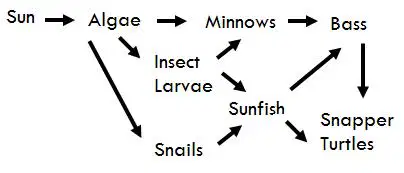
Destiny is given a list of organisms and asked to determine how these organisms interact together. Destiny draws them in a food web diagram, which is provided. Based on her diagram, what is the role of the sunfish in this food web?
to break down waste products made by insect larvae
to provide energy for the bass and snapper turtles
to take in light from the sun and produce food
to consume the algae and other pond plants

A food web diagram is provided. Based on the diagram, which THREE consumers all get their energy directly from the same producer?
squirrel
deer
robin
field mouse
mountain lion
Carbon dioxide gas moves from the atmosphere and into living things as part of what process?
animals eating plants
plants decomposing
plants producing food
animals absorbing waste
Which of the following best describes the role of decomposers in the cycling of matter?
Returning nutrients from dead plants and animals to the soil
Releasing oxygen gas into the atmosphere for animals to breathe
Using energy from the Sun to produce food for plants and animals
Providing a source of food for plants and animals to eat
Liquid water is moved from living things to the environment when animals-
eat
urinate
sleep
breathe
Matter moves directly from plants to animals when plants are eaten by animals. Matter also moves from plants to animals indirectly through -
sunlight
heat
adaptations
air
Which of the following describes a relationship in which one organism depends on another for its needs?
a rabbit burrowing in the ground
a hawk catching and eating a mouse
a frog cooling off in a pond
an oak tree absorbing sunlight for food
Which of the following would be the most likely to cause the rapid disruption of an ecosystem?
the introduction of a new species
a gradual change in temperature
varying rainfall from season to season
one kind of organism preying on another

The table shows the basic needs of a robin. The table shows the basic needs of a robin.
prairie dogs digging tunnels in the ground
beavers building a dam to create a pond
humans clearing forests to build houses
ants building large anthills in a schoolyard

A food web for a prairie ecosystem is provided. In this ecosystem, matter is transferred from -
eagle -> squirrel -> plant seeds
sun -> plant seeds -> plant
mountain lion -> eagle -> snake
prairie grass -> deer -> mountain lion

