
 Worksheets
Test Review !!!!
Total questions: 49
Worksheet time: 25mins
A principle that geologic processes that occurred in the past can be explained by current geologic processes.
Uniformitarianism
Catastrophism
Law of Crosscutting
Law of Superposition
The principle that states that all geologic change occurs suddenly.
Uniformitarianism
Catastrophism
Law of Crosscutting
Law of Superposition
Younger rocks lie above older rocks, if layers are left undisturbed.
Uniformitarianism
Catastrophism
Law of Crosscutting
Law of Superposition
Faults or intrusions are younger than any layer of rock they cut through.
Uniformitarianism
Catastrophism
Law of Crosscutting
Law of Superposition
The trace or remains of an organism that lived long ago, most commonly preserved in sedimentary rock.
Climate
Ice Core
Fossil Record
Fossil
All fossils discovered on Earth.
Geology
Index Fossil
Fossil Record
Fossil
The weather conditions in an area over a long period of time.
Ice Core
Climate
Relative Dating
Fossil Record
A long cylinder of ice obtained from drilling through ice caps or ice sheets; used to study past climates.
Ice Core
Sea Floor Sediments
Tree Rings
Climate
Any method of determining whether an event or object is older or younger than other events or objects.
Absolute Dating
Radiometric Dating
Relative Dating
Prehistoric Dating
Any method of measuring the age of an event or object in years.
Absolute Dating
Radiometric Dating
Relative Dating
Prehistoric Dating
A method of determining the absolute age of an object by comparing the amount of parent isotope vs. daughter isotope and using half-life.
Absolute Dating
Radiometric Dating
Relative Dating
Prehistoric Dating
An ordered arrangement of rock layers that is based on the relative ages of the rocks (older rocks are at the bottom).
Geologic Column
Fossil Record
Law of Superposition
Relative Dating
Isotope that is unstable and decays; also called a parent isotope.
Radioactive Isotope
Radioactive Decay
Daughter Isotope
Index Fossil
The process in which a radioactive isotope tends to break down into a stable isotope of the same element or another element.
Radioactive Isotope
Radioactive Decay
Parent Isotope
Half-Life
Isotope that is unstable and decays; also called a radioactive isotope.
Radioactive Decay
Daughter Isotope
Parent Isotope
Index Fossil
Stable isotope that forms after the parent isotope decays.
Radioactive Decay
Daughter Isotope
Parent Isotope
Radioactive Isotope
The time required for half of a sample of a radioactive isotope to break down by radioactive decay to form a daughter isotope.
Geology
Geologic Time Scale
Half-Life
Radiometric Dating
Fossils that are used to estimate the absolute age of the rock layers in which they are found. These organisms must have lived during a short time span, have unique features, and be common over large areas.
Fossil Record
Index Fossil
Geologic Column
Absolute Dating
The scientific study of the origin, history, and structure of Earth and the processes that shape Earth.
Biology
Geology
Physics
Paleontology
The standard method used to divide Earth's long natural history into manageable intervals of time.
Geologic Time Scale
Radiometric Dating
Geologic Column
Fossil Record
Preserved remains or evidence of ancient living things
Cast
Molds
Fossil
Minerals
Fossil Preservation: Minerals in groundwater fill in the pore spaces of dead organisms
Casts
Trace Fossils
Mineral Replacement
Molds
Principle that in undisturbed rock layers, the oldest rocks are on the bottom
Absolute Age Dating
Fossil Record
Relative Age Dating
Law of Superposition
The numerical age, in years, of a rock or object
Absolute Age Dating
Fossil Record
Relative Age Dating
Law of Superposition
The process by which an unstable element naturally changes into another element that is stable
Absolute Age Dating
Radioactive Decay
Relative Age Dating
Law of Superposition
Geological Timeline: Longest amounts of time, broken into eras
Eons
Eras
Periods
Epochs
Geological Timeline: These are broken into periods
Eons
Eras
Periods
Epochs
Geological Timeline: These are broken into epochs
Eons
Eras
Periods
Epochs
Geological Timeline: These are broken into epochs
Eons
Eras
Periods
Epochs
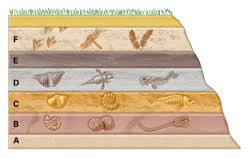
carbonized
The Earth is estimated to be approximately:
4.5 billion years old
4.5 million years old
45 billion years old
45 million years old
Earth's core is made up of:
mostly carbon
nickel and iron
mostly silicon
a mix of all elements
When the Earth was young, it was molten do to high amounts of energy and heat from:
iron forming alloys with nickel
radioactive elements decaying
left over heat from the big bang
left over heat from the supernova explosion
The oldest rocks found on Earth are approximately:
2.8 billion years old
3.3 billion years old
4.2 billion years old
4.2 million years old
Why is it hard to find very old rocks on Earth?
Erosion, volcanic eruptions and other processes destroy rocks
The Earth didn't become solid for billions of years
The oldest rocks were made into the moon during a collision
The oldest rocks were destroyed in a huge collision that killed the dinosaurs
The first particles that formed the Earth were drawn together from:
electrostatic charges
gravitational forces
magnetic forces
universal forces
Once the Earth began to accumulate more mass, which force was responsible for its continued growth?
electrostatic charges
gravitational forces
magnetic forces
universal forces

The moon probably formed when a small planet-sized object rammed into Earth. What evidence supports this theory?
The rocks that formed the moon are exactly the same as the rocks that formed on Earth
The rocks that formed on the moon have very little iron in them
The Earth was larger based on its orbit which changed when the mass of the moon was lost
The rock on the moon contains remnants of life that once lived on Earth
Scientists are able to determine how the Earth formed by (choose all that apply):
radioactive dating of meteorites.
analyzing craters on the Earth and Moon.
studying the size and composition of other planets.
ancient records written on cave walls by early humans
TRUE or FALSE: The Earth is shaped like a perfect sphere.
TRUE
FALSE
In the earliest stages of Earth's development, our planet was made of what?
Cotton Candy
Molten rock
Molten rock with a thin, hard crust
Water
In the second phase of Earth's development, what happens?
The outer layer of molten rock hardens and solidifies.
The Earth freezes over
The Earth is covered with water
Granite starts to form.
A nebula is a
collection of comets.
large cloud of gas and dust.
collection of dwarf planets.
large constellation of stars.
What happens during a supernova?
two nebulas collide
a massive star explodes
a new solar system forms
a sun emits a small burst of energy

