
Font size
 Worksheets
Newtons Laws Final
Total questions: 45
Worksheet time: 47mins


? = mass x acceleration
or
? = m x a
is used to find
1st
Law of Motion
2nd
Law of Motion
3rd
Law of Motion


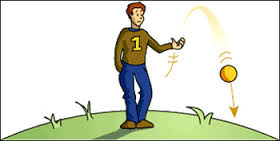


A squirrel sits on the ground and eats a donut. We know the forces on him must be balanced because...
Forces are always balanced
the squirrel is not accelerating
squirrels are projectiles
he's eating a donut

A soccer ball is sitting in the middle of a field. The ball will remain at rest until an outside force like a players foot or the wind acts upon it. Which of Newton's laws is represented by this?
1st
2nd
3rd
Think about pushing a shopping cart and a car. If you apply the same amount of force to both, the shopping cart will travel fast, but the car will hardly move. To move the car yo would need a larger force. Which of Newton's laws is being represented?
1st
2nd
3rd
Sally jumps on her trampoline. She exerts a force on the trampoline and the trampoline exerts an equal but opposite force back on Sally. This represents
Law 1
Law 3
Law 2

Which law explains that it would take more force to push the car than the lawnmower?
1st
2nd
3rd
There is a skateboard rolling and then Billy steps on it and it stops. What Law of motion is this?
3rd
2nd
1st

Which way would a swimmer push to move forward in the water?
To the left
Forward
Backward

The reason a ball bounces up when it hits the ground:
The ball and ground repel each other.
The ball exerts a force on the ground, and the ground exerts a force on the ball.

A person not paying attention while skateboarding hits a rock. The skateboard stops...they don't.
The Law of Inertia (1st law)
The Law of Acceleration (2nd law)
The Law of Conservation of Momentum
Action Reaction Law (3rd law)
What is Force?
Force is ONLY a pull that acts upon a object.
Force is ONLY a push that acts upon an object.
Force is a push and pull that acts upon an object.
What Jedi use.
What is Inertia?
The tendency of an object to keep doing what its doing.
What you use to figure out Net Force.
Issac Newtons middle name.
Basically force but with more steps
What is friction?
Resistance to motion when two objects are in contact with each other
What bananas are made of
the name of Isaac Newtons father
the F in F=MA
What does the M in F=MA stand for
What is Air resistance?
What are newtons used for.
What is newtons 1st law
An object at rest will stay at rest, and an object in motion will stay in motion.
What is Newtons 2nd law
The force acting on an object is equal to the mass of the object multiplied by its acceleration.
What is Newtons 3rd law
What is the formula for calculating momentum?
F = MA
F = MV
P = MV
P = MA
What is the cause of friction?
Friction is caused by the roughness of surfaces in contact.
Friction is caused by the weight of an object.
Friction is caused by the motion of an object.
Friction is caused by the temperature of the environment.
Forces can cause a change in a objects ______
temperature
color
sound
motion

A force that acts on the plane to pull it back to earth.
Yaw
Wings
Tail
Weight
Which of the 3 laws of motion do Airplanes and rockets follow?
1 If an object is not moving, it will not start moving by itself. If an object is moving, it will not stop or change direction unless something pushes it.
2 Objects will move farther and faster when they are pushed harder.
3 When an object is pushed in one direction, there is always a resistance of the same size in the opposite direction.
All of them
A and B only
What is the downward force applied to all objects on Earth?
Mass
Gravity
Thrust
Drag
What Unit do we Measure Force in?
Newtons
Joules
Volts
Lumens
Our rocket had a successful launch!
Not even close
Yes, it soared
It was somewhat successful
It could have been better

A rocket will remain on the launch pad until an unbalanced force is exerted on the rocket, propelling it upward.
True
False

The amount of force exerted on the rocket depends on how much air is pumped inside the rocket.
True
False

A rocket with more mass (click all that apply)
has more inertia than a rocket with less mass.
requires more force to move than a rocket with less mass.
was more difficult to move than less massive rockets.
is more stubborn than less massive rockets.

A rocket with less mass, will experience
slightly more gravitational force.
slightly less gravitational force.
no gravitational force.

If we increase the amount of force applied to the rocket, it would accelerate
more.
less.
the same amount.

When the rocket launches, the water inside the rocket applies a force downward to the launchpad, and the the launchpad applies a force upward to the...
air
grass
rocket
string

We can assume that the rockets with the least mass,
flew the highest
flew the lowest
applied the most force to the ground
had the most air resistance

