
 Worksheets
CBA #2 Review
Total questions: 82
Worksheet time: 3hrs 11mins
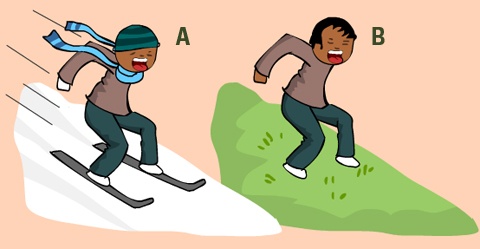
Why is it harder for the boy in Image B to get down the hill?
Motion
Friction
Work
Displacement

A student designs an experiment to test the force of a spring using a spring launcher and four spheres with the same diameter but with different masses. What question is being asked in this investigation?
How does the mass of the ball affect the force needed?
How does the diameter of the ball affect the force needed?
How does the color of the ball affect the force needed?
How does the height of launch affect the mass?

The diagrams show two trials of an experiment in which a spring scale was used to measure force. What is the difference between the two trials?
The mass
The surface of the table
The angle of incline
The type of book used

Students design an experiment to determine how much force is needed to move blocks of wood of different masses across a lab table. What is the question the students are trying to answer?
How much force is needed to move the block?
How does the mass affect the force needed?
How does the surface affect the force needed?
How does the type of wood affect the force needed?

Students design an experiment to determine how much force is needed to move blocks of wood of different masses across a lab table. What is the variable that should change this investigation?
Spring Scale
Surface of the table
Mass of wood block
Speed the block is moved

Some students attach a balloon to a straw and then they tape the straw to the top of a toy car. The students inflate the balloon and release the car. The car travels 40 centimeters across the floor. What should the students do to determine whether the force of the air from a balloon is enough to push the car 40 centimeters across the the same floor in repeated trials?
Test the car several times using an identical balloon filled with different amounts of air.
Test the car several times using different-sized balloons filled with the same amount of air.
Test the car several times using an identical balloon filled with the same amount of air.
Test the car several times using different-sized balloons with different amounts of air.

A student designs an experiment to test the effect of the width of a piece of elastic's ability to stretch. The student selects four pieces of elastic with different widths but the same length. The student then attaches blocks with different masses to the pieces of elastic. The results of the student's experiment are shown above. What should the student do to improve this experiment?
Use blocks of equal mass on the four pieces of elastic
Use blocks with enough mass to cause the four pieces of elastic to break
Use more than four pieces of elastic and four blocks
Use four pieces of elastic with different lengths but the same width

How does the light behave differently when it enters the prism?
The ray of light becomes shorter when it strikes the glass.
The ray of light straightens as it strikes the glass.
The ray of light bends as it strikes the glass.
The ray of light transforms to heat when it strikes the glass.
Light travels in waves. Which of the following statements about light waves is NOT true?
They change direction when they are reflected or refracted.
They travel in straight lines
They can come from natural or artificial sources.
They can travel through any substance.
Andres wants to determine if he can consistently hit a baseball out of the park when he swings the bat as hard as he can. What should Andres do to determine whether he can consistently hit a baseball out of the park?
Hit different types of balls, many times, with varying amounts of force.
Hit the same ball, a few times, with varying amounts of force.
Hit the same ball, many times, with same amount of force.
Hit different types of balls, a few times, with the same amount of force.

Water flows through turbines in dams like the one shown. The flowing water makes the turbines spin.
Light energy
Thermal energy
Sound enegy
Mechanical energy
A force of attraction to objects with steel or iron
friction
force
magnetism
gravity
A force that happens when rubbing objects together
magnetism
force
gravity
friction
Light travels in a ___________ line
reflected
retracted
straight
zig zag
electricity flows in a ______________ circuit
closed
open
smooth
loud
All of these are types of energy except
mechanical
light
flexible
electrical
When salt dissolves in water it is called
salty
soluble
evaporation
precipitation
Which of these is an insulator?
metal spoon
cotton ball
paper clip
ball of foil
Which is a conductor?
rubber
foam
plastic
steel

Pull the spring scale a longer distance.
Cover the table top with a carpet square.
Repeat the same steps using a heavier mass.
Attach a smaller block to the spring scale.

A
B
C
D

Surface A
Surface B
Surface C
Surface D


A student builds a circuit made up of a battery, two light bulbs, and a switch. What will the student most likely observe in this circuit?
Light bulb 1 and light bulb 2 will both be on
Light bulb 1 will be off, but light bulb 2 will be on
Light bulb 1 and light bulb 2 will both be off
Light bulb 1 will be on, but light bulb 2 will be off

The diagram shows a series circuit with three lit bulbs. How many of the bulbs will remain lit if the wire is cut a the point shown by the arrow?
0
1
2
3


Why does the following circuit not work?
The light bulb is broken
The switch is closed
The wood block is an insulator
The battery is dead

The circuit does not work, what could you do to allow the circuit to work?
Add another light
Add another battery
Open the switch
Remove the wood block and connect the wires

Which lights would turn on if your closed switches 1 and 2?
red, blue, and white
red and white
red and blue
blue, white, yellow

In order to produce ONLY LIGHT energy, which switch(es) would you need to close?
switch 1 and switch 2
switch 1, 2, and 3
switch 2 and switch 3
switch 1 and 3

bending or breaking of light as it passes from one medium to another (from air to water)
refraction
absoption
reflection
lens

Electrical Energy is transformed to _____ Energy.
Mechanical
Electrical
Thermal
Light

This shows energy changing from
_______ to _______.
Sound to wind
Thermal to heat
Mechanical to Electrical
Electrical to Mechanical


The bouncing of light off an object
basketball
refraction
reflection
echo

What happens to light passing through a hand lens that makes the image of the penny appear larger? The light is-

Observe the image. After reflecting off of the mirror, which object will the light
coming from the laser most likely strike next?
marble
apple
laser
rock
The arrows in the diagrams below represent light. Which diagram best shows how a
glass mirror would reflect light?


Which experiment listed below will best determine how friction affects the speed of a rolling object?
Roll 3 objects of various sizes across the floor
Roll 3 objects of equal size from various heights across the floor
Roll 3 objects of equal size across 3 different types of surfaces
Roll 3 objects of equal size from equal heights across the floor
Pull the spring scale a longer distance.
Cover the table top with a carpet square.
Repeat the same steps using a heavier mass.
Attach a smaller block to the spring scale.

Students use a spring scale to pull different types of shoes across a wood table and record the amount of force required. Which question is this experimental investigation most likely trying to answer?
A. How much do the different types of shoes weigh?
B. How does the type of shoe affect the amount of force required to pull it?
C. How does a spring scale work?
D. How much force is required to pull the high heel shoe?

energy of movement (motion)
light
sound
electrical
mechanical

energy produced by the flow of electrons (electricity)
sound
energy
electrical
thermal

Electrical Energy is transformed to _____ Energy.
solar
thermal
light
chemical

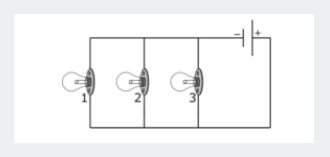
A student builds a circuit made up of a battery, two light bulbs, and a switch. What will the student most likely observe in this circuit?
Light bulb 1 and light bulb 2 will both be on
Light bulb 1 will be off, but light bulb 2 will be on
Light bulb 1 and light bulb 2 will both be off
Light bulb 1 will be on, but light bulb 2 will be off

Students constructed a circuit using different-colored lightbulbs. What will happen if Switch 3 is closed and the other switches are left open?
Only the white bulb will operate
None of the bulbs will operate
Only the white and yellow bulbs will operate
Only the red and blue bulbs will operate
Which object shows an energy transformation from electrical to mechanical?


The breaking down of rocks and other materials on the Earth's surface.
Weathering
Erosion
Deposition
Exfoliation
The process by which rock and soil are moved from one place to another is called-
Chemical weatherin
Erosion
Mechanical weathering
Deosition

The erosion in this picture is from __.
wind
water
glaciers
chemicals

The reason there is an arch in this rock is because __.
the water wore away soft rock first
a glacier rubbed against that part
there were tree roots growing there that broke the rock away
the water can't reach the rest of the rocks

This enormous valley was likely caused by __.
water
glacier
wind
chemicals

What landform is shown in the image above?
River Delta
Sea Arch
Moraine
Canyon

What landform is shown in the image above?
Sea Arch
Canyon
Mountain
Island

What landform is shown in the image above?
Canyon
River Delta
Sea Arch
Island

What landform is shown in the image above?
River Delta
Mountain
Canyon
Island

Which landform is shown above?
Mountain
Sand Dune
Island
Moraine
Landform formed from deposition by water from a river
Delta
Canyon
V shaped valley
Landform
Landform formed from weathering and erosion by a glacier/ice
V shaped valley
U shaped valley
Erosion
Sand dune
Which formation process do most sedimentary rocks follow?
cementation, compaction, deposition, erosion
erosion, compaction, cementation, deposition
erosion, deposition, compaction, cementation


Which layer is the oldest?
siltstone
conglomerate
limestone
mudstone

Sand in the sediment melts and turns into rock.
The weight of the water compacts the sediment into rock.
Changing water temperatures turn sand in the sediment into rock.
Pollution caused by humans turns the sediment into rock.

The process by which rocks are broken down
Weathering
Deposition
Erosion
Sedimentation

The process in which sediment settles out (drops to the bottom) of the water or wind that is carrying it
Weathering
Erosion
Sedimentation
Deposition
How does sediment build up?
day by day
row by row
layer by layer
slice by slice


The picture shows rock layers next to a road. Layer 3 most likely formed in which of these environments?
Desert
Forest
Ocean
Tundra

What is the correct order of the rock layers from oldest to youngest?
A, B, C, D, E, F
F, E, C, D, B, A
F, E, D, C, B, A
A, B, C, E, D, F

The diagram represents the layers found inside a rocky cliff. The rock layers contain fossils. Which of the following layers of rock is most likely the youngest?
The layer containing trilobites
The layer containing aphibians
The layer containing mammals
The layer containing fishes

Which one shows the steps in order to form a Sedimentary Rock?
Weathering, Erosion, Deposition, Cementation, Compaction
Weathering, Erosion, Compation, Cementation
Weathering, Erosion, Deposition, Compaction, Cementation
Weathering, Deposition, Erosion, Compation, & Cementation
Which diagram models the process of compaction leading to the formation of sedimentary rock?


Which list contains only processes that must occur in order for fossil fuels to form?
Formation of faults, burial, glacial formation
Organism growth, burial, volcanic activity
Organism growth, burial, compaction
Erosion, burial, earthquakes

Where was natural gas and oil formed?
bottom of rivers
bottom of lakes
bottom of swamps
bottom of oceans


This landform is formed by
water erosion
weathering
deposition of sediments
glaciers

