
 Worksheets
Nervous System
Total questions: 78
Worksheet time: 1hrs 9mins

What is the function of the nervous system?
to control and coordinate body functions and systems.
to protect the body from harm.
to identify pain and begin healing.
to break down food.
The basic unit of structure and function in the nervous system is a nerve cell. Nerve cells are also called-
Osteocytes
Dendrites
Neurons
Spinal Cords

brain stem
cerebrum
what controls your involuntary muscles (digestion, heart, breathing)?
cerebrum

cerebrum
cerebellum
brain stem

brain stem
cerebrum

What is the number 1 pointing to?
Spinal Cord
Brain Stem
Cerebellum
Cerebrum

What is the number 3 pointing to?
brain stem
cerebrum
cerebellum
spinal cord
What is the number 2 pointing to?
brain stem
cerebrum
cerebellum
spinal cord

cerebrum
The nervous system_________
receives information about what is going on in your body as well as what is going on around you.
tells your body how to react to the information it receives.
helps your body maintain homeostasis.
all of the above.
Reflex actions are important because
They provide a quick, involuntary response
They prevent injury
They are essential to the survival of organisms
All of the above
The nervous system is broken into 2 major parts, the
Central Nervous System
Pedestrian Nervous System
Peripheral Nervous System
Whole Nervous System
The nervous system includes sensory organs (eyes, ears, skin)
True
False
The left side of your brain controls the _______ side of your body.
Right
Left
Front
Back
When you smash your finger, it takes your brain a ________ time to process the pain signal and tell your hand to move.
long
very long
Short
very short
When your get scared, your nervous system goes into
walk and talk mode
fight or flight mode
sit and lounge mode
chill mode
What is the largest part of the brain?
Brain stem
Cerebellum
Cerebrum
Dura mater
What do the motor neurons do?
carry messages from the brain and spinal cord to muscles and glands
carry impulses from skin and sends to organs the to spinal cord and brain
carry impulses from sensory neurons to motor neurons
store messages
Symptoms include: Double vision, Balance problems, caused by immune system eating away at protective nerve covering
Multiple Sclerosis
Concussion
Meningitis
Encephalitis


Dopamine and Serotonin are examples of _______________
Axon
Neurotransmitters
Somatic Nerves
Autonomic Nerves
Neurotransmitters are ______________ that travel across the ______________ to another cell.
electrical signals; receptors
electrical signals; synapse
chemicals; receptors
chemicals; synapse
The branch like figures that receive impulses & conducts them to the cell body
Dendrite
Axon
Cell Body
Myelin Sheath
The two parts of the Peripheral Nervous System
Brain and Spinal Cord
Somatic and Autonomic
Systematic and Brain
Spinal cord and Autonomic
The ____________ is part of the peripheral nervous system and controls our senses.
Systemic
Autonomic
Somatic
Autonomous

What is number 3 pointing at on the neuron?
Dendrite
Axon
Myelin Sheath
Soma


What part of the brain deals with the thalamus and hypothalamus?
Brain Stem
Cerebellum
diencephalan
cerebrum
The part of the PNS that controls involuntary actions
autonomic nervous system
somatic nervous system
organic nervous system
reflexive nervous system

Which part of the brain controls your blood pressure and heart rate?
brain stem
cerebrum
cerebellum
adrenal gland
Which statement best describes a reflex arc?
Slow response that you have to think about
Rapid response to protect body from harm

Where would the nerve impulse start in this reflex arc?
A
C
D
E

_____ neurons carry messages away from the central nervous system and out to muscles or glands. The RED neuron in diagram.
sensory
motor
inter
central
Which way does an impulse travel
From dendrite to axon and out axon terminal
From axon to axon and out dendrite terminal
From axon to dendrite and out axon terminal
From cell body to dendrite and out axon terminal
__________ carry messages between sensory neurons and motor neurons.
Active Neurons
Interneurons
Refraction Neurons
Flower Neurons
The section of the peripheral nervous system that controls voluntary actions.
Somatic Nervous System
Central Nervous System
Peripheral Nervous System
All of the above
The part of the peripheral nervous system that controls involuntary actions.
The somatic nervous system
The immune system
Autonomic nervous system
The digestive system
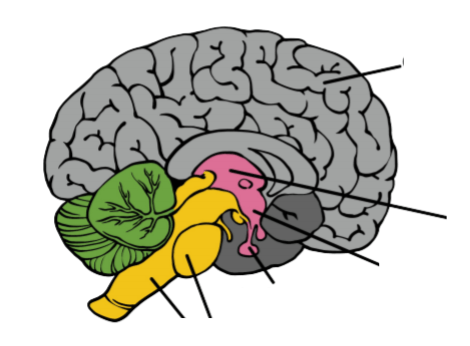
What structure is grey in this picture?
Cerebrum
Cerebellum
Brain Stem
What part of the brain deals with the thalamus and hypothalamus?
Brain Stem
Cerebellum
diencephalan
cerebrum

Letter C represents the
Cerebrum
Cerebellum
Medula

Which lobe of the cerebral cortex is responsible for interpreting visual sensory information?
Temporal
Parietal
Occipital
Frontal
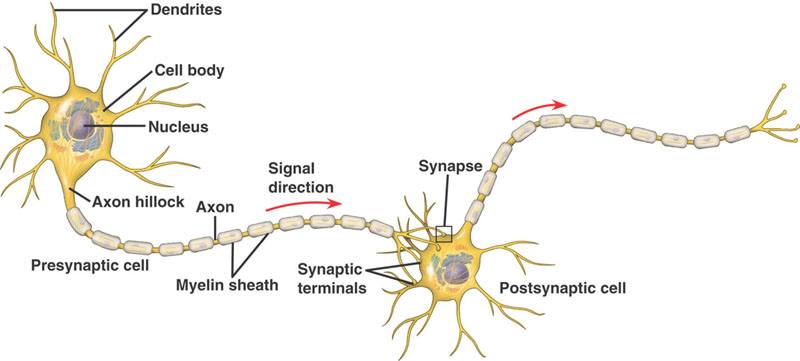

Which of the three types of functional neurons are sensory nerves?
Afferent
Efferent
Interneurons
Which of the three types of functional neurons are motor neurons?
afferent
efferent
interneurons
Which nerve is sensory and controls your ability to smell?
olfactory (I)
trochlear (IV)
vagus (X)
optic (II)
Which nerve is sensory & motor and responsible for facial sensation and chewing?
trigeminal (V)
olfactory (I)
vagus (X)
oculomotor (III)
Which nerve is motor and responsible for tongue movement?
hypoglossal (XII)
facial (VII)
olfactory (I)
trigeminal (V)
Which nerve is motor & sensory and responsible for heart rate & respiration rate and organ sensation & taste?
vagus (X)
optic (II)
facial (VII)
hypoglossal (XII)
Which nerve is sensory & motor and responsible for facial sensation and chewing?
trigeminal (V)
olfactory (I)
vagus (X)
oculomotor (III)


Which part of the brain is highlighted?
Cerebellum
Cerebrum
Brain Stem
Diencephalon

Which part of the brain is highlighted?
Cerebrum
Cerebellum
Diencephalon
Brain Stem

The ____ relays messages from the sense organs, to the area of the brain that processes that information.
thalamus
amygdala
cerebellum
pons

