
 Worksheets
Imperialism Quizizz
Total questions: 101
Worksheet time: 3hrs 45mins
What does the term imperialism refer to?
A policy of giving away a country’s power to another nation as a gift
A policy of extending a country’s power and influence through diplomacy or military force
A policy of trading goods between two states or nations
A policy in which the government debates over paying someone to purchase another country
Hostility towards Spain increased as Americans were persuaded by _____________, which is a style of newspaper reporting that emphasizes sensational news.
Muckraking
Yellow Fever
Yellow Journalism
Wall Street Journal
Leading up to the Spanish-American War, the sudden explosion of the _____________ off of the coast of Cuba led Americans to believe that _______________ was to blame, despite there being no concrete evidence.
U.S.S. Maine; Cuba
U.S.S. Alabama; Spain
U.S.S. Maine; Spain
U.S.S. Maryland; France
The _______________ was a volunteer regiment that served during the Spanish-American War and was organized by future president ______________ .
Rough Riders; Franklin Delano Roosevelt
Tuskegee Airmen; Theodore Roosevelt
Progressive Party; William Taft
Rough Riders; Theodore Roosevelt
In 1901, the __________________ made Cuba a legal protectorate of the United States.
20th Amendment
16th Amendment
Platt Amendment
Elastic Clause
The ________________ was an extension of the Monroe Doctrine and enabled the United States to intervene in Latin American countries struggling with unstable conditions.
Yellow Journalism
Great White Fleet
Rough Riders
Roosevelt Corollary
An _________________ for trade allowed the United States and other nations to trade “openly” with the Chinese and other countries.
Closed Door Policy
Open Door Policy
Roosevelt Corollary
American Expansionist
After attempts were abandoned by the French, the United States attempted to purchase the rights to complete the building of the ______________ in order to connect the Atlantic and Pacific Oceans.
Roosevelt Corollary
Panama Canal
Hay-Bunau-Varilla Canal
Philippine Canal
The term ________________ refers to the idea that through financial investment in foreign nations, the United States would develop a scope of influence that would provide both stability and economic opportunity.
Roosevelt Corollary
Dollar diplomacy
Open Door Policy
Interventionist
Which U.S. President is associated with "Big Stick Diplomacy"?
Grover Cleveland
William McKinley
Teddy Roosevelt
Woodrow Wilson

As a result of the Spanish- American War, the US became a political power in
The Hawaiian Islands
Puerto Rico, Guam, and the Philippines
Samoa
Panama


The belief that the United States was destined to control the continent from the Atlantic to the Pacific is best described as _________________.
Protestant Reformation
Gilded Age
Manifest Destiny
The Crusades
Which of the following terms best describes the pride and commitment to one’s nation?
Socialism
Social Darwinism
Nationalism
Jingoism
The _______________ was a foreign policy statement issued in 1823 stating that the U.S. would oppose any intervention by European nations to control nations in the Western Hemisphere.
Monroe Doctrine
Articles of Confederation
Mayflower Compact
Treaty of Paris
Prior to the Spanish-American War, William R. Hearst published a letter known as the _______________ written by the Spanish minister to the U.S. which was insulting to President McKinley.
McKinley Letter
de Lome letter
Hearst Letter
Pulitzer Memoirs
The most well-known battle of the Spanish-American War took place in Cuba at _____________.
San Juan Hill
The Alamo
Gettysburg
Havana Harbor
The first military action of the Spanish-American War took place in 1898 in the Philippines at the _____________________.
Battle of Horseshoe Bend
Battle of Manila Bay
Battle of San Juan Hill
Battle of Antietam
The ___________________ was signed in 1898, ending the Spanish-American War and rewarding the United States with the islands of Guam, Puerto Rico, and the Philippines.
Treaty of Paris
Treaty of Versailles
Treaty of Velasco
Treaty of Guadalupe Hidalgo
The ________________ was an extension of the Monroe Doctrine and enabled the United States to intervene in Latin American countries struggling with unstable conditions.
Yellow Journalism
Great White Fleet
Rough Riders
Roosevelt Corollary
The United States negotiated the __________________ with the newly independent government of Panama to purchase the land to build the Panama Canal.
Treaty of Paris
Treaty of Versailles
Hay-Bunau-Varilla Treaty
Treaty of Manila Bay
The term ________________ refers to the idea that through financial investment in foreign nations, the United States would develop a scope of influence that would provide both stability and economic opportunity.
Roosevelt Corollary
Dollar diplomacy
Open Door Policy
Interventionist
In what year did the United States begin its rise as a world power?
1898
1941
1914
1929
What territories did the United States acquire as a result of the Spanish-American War in 1898?
Hawaii & Puerto Rico
Puerto Rico, Guam, &
the Philippines
Japan, Puerto Rico & Guam
Puerto Rico, Hawaii & the Philippines
The American victory in this war helped establish the U.S. as an imperial power.
Vietnam War
WWII
Spanish American War
WWI
What were some economic effects of the Spanish-American War?
Increased economic success
New inovations
Industrialization & Urbanization
natural resources & new markets for trade

What passage way, built by T. Roosevelt, made shipping and transportation more efficient between the Atlantic & Pacific Oceans?
Panama Canal
Big Stick Policy
National Park Service
Open Door Policy

This person advocated for oversea expansion and the development of a large navy.
FDR
Alfred T. Mahan
Sandford B. Dole
Teddy Roosevelt

This individual pushed for the annexation of Hawaii.
FDR
Alferd T. Mahan
Sandford B. Dole
Teddy Roosevelt

This president pushed for increasing the size of the navy and the building of the Panama Canal.
Sandford B. Dole
FDR
Ronald Reagan
Theodore Roosevelt

What is the type of sensational reporting where writers exaggerated or even invented stories?
muckraking
yellow journalism
journalism
reporting

Why did the United States acquire Hawaii?
The US wanted volcanoes
To use the islands as a naval base, and for its sugar
to create a naval base during World War II
to assist Queen Liliuokalani take control of the islands

What was a result of headlines like the one above?
World War I begin
The Spanish-American War
The US entered World War I
The Union defeated the Confederacy
What were the two main locations of fighting during the Spanish-American War?
Alaska and Hawaii
Puerto Rico and Guam
Cuba and the Philippines
Spain and the United States
After the Spanish American War, the U.S. Directly controlled all of the following territories EXCEPT
The Philippines
Guam
Puerto Rico
Cuba
Which policy gave US the right to be the "policemen of the Western Hemisphere"
Roosevelt Corollary
Good Neighbor Policy
Open Door Policy
Marshall Plan

Why did Theodore Roosevelt help support a revolt against Columbia?
Columbia refused to comply with trade agreements
He wanted to establish a naval base in Columbia
He wanted to establish a colony in Columbia
He wanted to build the Panama Canal

President Theodore Roosevelt said “Speak softly and carry a big stick.” His big stick was a reference to
a. joining military alliances to carry out foreign policy goals
using the navy to accomplish foreign policy goals
a. using the national forests to stimulate building projects
a. supporting woman suffrage to expand civil rights
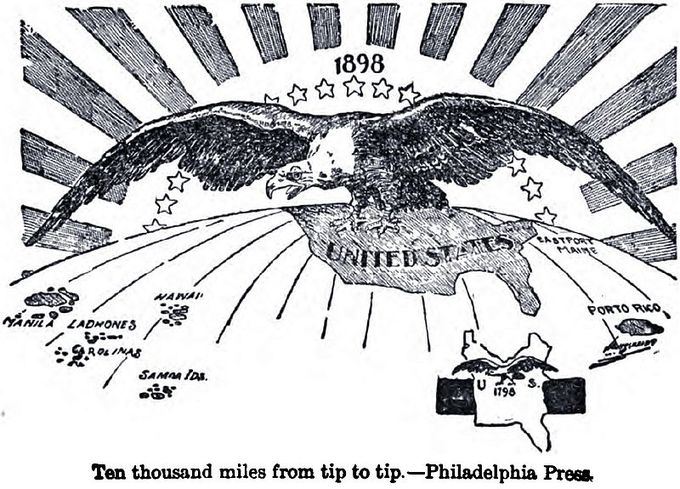
This image is a representation of...
US Exploration
US Diplomacy
US War Relations
US Imperialism
Before 1898, most American had opposed imperialism. Why did imperialism suddenly become more popular in the US by the end of the century?
Americans felt it was against the principles of democracy to rule over others.
Americans wanted to sell goods to new markets and buy raw materials for new industries.
Americans wanted to rule others because America had once been a British colony.
Americans feared imperialism would bring the United States into conflict with other powers.
Why is the Spanish American War of 1898 often considered a major turning point in US history?
It revealed the US had become a world power.
It marked the first American victory over a European country.
It demonstrated the need for better communications in wartime.
It showed American support for European economic interests in East Asia.
Social Darwinism and the ideas expressed in the "White Man's Burden" were used by Europeans to justify their policies of
pacifism
communism
isolationism
imperialism
Which of the following was NOT a reason for US Imperialism?
Raw materials
Power
Social Darwinism
To spread disease
Imperialism made the United States more powerful.
True
False
Imperialism helped supply businesses with raw materials during the Industrialization period in America.
True
False
annexation means:
adding on to a country
giving up land or territory
moving to a new country
moving from city to city
This document warned the Eastern Hemisphere to stay out of the Western Hemisphere
Marbury v. Madison
Monroe Doctrine
Platt Amendment
Foraker Act
What is the "White Man's Burden"?
A belief in "cultural superiority"
A philosophy related to Manifest Destiny
Taft's foreign policy approach
A belief in white privilege
Which of the following was NOT a motivating factor of imperialism?
Establish naval bases around the world
Expand to new world markets
Slavery
Spread American influence & democracy
__________warned against the establishment of any additional European colonies in Latin America.
Roosevelt Corollary
Monroe Doctrine
Woodrow Wilson
William H. Taft
Which president said “speak softly and carry a big stick; you will go far.” The U.S. Navy is the “big stick” he is referring to.
Woodrow Wilson
William H. Taft
Teddy Roosevelt
__________used a combination of gifts and threats to convince Japan to enter into trade relations with the United States.
Commodore Matthew Perry
Lieutenant David Schwimmer
General Matt LeBlanc
This gave every country equal access to trade with China.
Boxer Rebellion
Open Door Policy
Modernization
Sphere of Influence
The explosion on the USS Maine started...
WWI
WWII
Spanish American War
Mexican American War
Which of the following was not an advantage of owning Hawaii, Guam, and the Philippines?
they served as places to stop and refuel
they made it easier to trade with Southeast Asia
they served as a source of more workers for the large number of factories in the US
they served as a military advantage in defending the US
Which of the following reasons for imperialism was based on the spread of Anglo-Saxon culture?
The desire to compete with European empires
White Man's Burden
The need for more natural resources
The need for more markets
Where did the US encourage a revolt in Central America and why?
Colombia; to take control of oil fields
Panama; to build a canal connecting the Atlantic and Pacific Oceans
Bolivia; to elminate the rebel Simon Bolivar
Mexico; to catch "Pancho" Villa
What was the significance of building a canal in Panama?
it would take territory away from the Spanish empire
it would allow easier economic and military access to and from the Atlantic and Pacific Oceans
it would make it easier for the US to invade countries in South America
it would allow the US to control worldwide trade
The Roosevelt Corollary was related to what prior foreign policy?
Monroe Doctrine
Big Stick Policy
Dollar Diplomacy
Moral Diplomacy
What group did not benefit from Seward's purchase?
the Russian government
native tribes in the purchased territory
the US
Russians living in the purchased territory
Hawaii was taken over by business men lead by...
Sandford B. Dole
Theodore Roosevelt
Grover Cleveland
the Queen of Hawaii
Which amendment stated that the US would not annex Cuba?
Teller Amendment
Platt Amendment
21st Amendment
17th Amendment
Which president refused to annex Hawaii?
Cleveland
T. Roosevelt
Taft
McKinley
Which territory was promised independence after the Spanish American War but was actually denied independence?
Guam
Philippines
Cuba
Puerto Rico
Why did the United States "need" territories like the Philippines and Hawaii?
they acted as refueling stations for ships
they had once belonged to the United States
to rid the Americas of European powers
so that those countries did not imperialize the US
What often happens to areas that are colonized?
the economy suffers and are the people are not treated as equals
they become wealthy with the abundance of new opportunities that are presented
they are often deported to another country
they are executed
This is the belief in regards to imperialism that it must be done so as to lead "backwards" people towards the light of democracy...
White Man's Burden
Open Door Policy
Self-determination
Sphere of Influence
Fake news is the modern term for what during the 1890s?
yellow journalism
red journalism
false advertising
negative journalism
Which of the following is not a territory that the US acquired through war?
Alaska
Puerto Rico
Guam
Philippines
What role did the media(yellow journalism) play in the Spanish American War?
shaped public opinion to go to war
only covered facts of the events of the war
play no role in the war whatsoever
shaped public opinion to give the president war powers to declare war on Cuba
Which president built on the Monroe Doctrine's limitations on colonization in the Western Hemisphere?
T. Roosevelt
Taft
Wilson
Seward
How did the US gain the rights to build the Panama Canal?
the US helped Panama achieve independence from Colombia
a treaty with Colombia whom controlled Panama
the US purchased the land from Panama for 7.2 million dollars
the US helped Colombia put down a rebellion in Panama

The white man's burden is illustrated in this picture. What was the white man's burden?
the belief that imperialism was necessary to civilize people of color around the world
the white man's struggle to control the Philippines
The title of a poem written by Edgar Allan Poe
The endless journey of trying to improve American foreign policy
The Kingdom of Hawaii was annexed by the US for what reason?
Great locations for tropical resorts.
The local residents needed help to prevent the spread of poverty & disease.
The location was strategically valuable to both military & business leaders
Local rulers wanted financial aid to rebuild after a natural disaster.
Teddy Roosevelt's idea that if diplomacy fails with a nation, we will use our military to get our way
Big Stick Diplomacy
Dollar Diplomacy
Latin American Policy
Missionary Diplomacy
Which territory was NOT acquired as a result of our victory in the Spanish-American War, 1898?
Guam
Puerto Rico
Philippines
Hawaii
Dollar Diplomacy: How did this help America?
The US intervened in Latin America and helped US businesses.
The US intervened in Asia and increased the sugar trade.
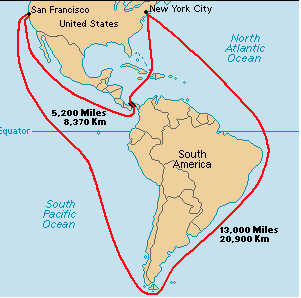
Why was the building of the Panama canal so important?
It reduced the spread of communism in Latin American countries.
It resulted in the signing of the North American Free Trade Agreement.
It reduced travel times between the Pacific & Atlantic Oceans (+ for trade)
Created tension between the US & Latin American countries over immigration

In the late 1800s, the US government wanted control of the areas labeled on this map in order to increase opportunities for
cultural exchange
foreign trade
national self-determination
technological growth
As a result of the Spanish- American War, the US became a political power in
The Hawaiian Islands
Puerto Rico, Guam, and the Philippines
Samoa
Panama
Theodore Roosevelt once said "We Have Become A Great Nation.." When did he say this?
1898: After the Spanish American War
1920s The Jazz Age
1776 Declaration of Independence
When was the Spanish American War?
2022
1898
1776

