
 Worksheets
Mixture, solutions, and electrolytes
Total questions: 28
Worksheet time: 26mins

Identify the substance in box B.
element
compund
mixture

Identify the substance in box D.
element
compound
mixture
Identify the substance in box B.
element
compund
mixture
Identify the substance in box D.
element
compound
mixture

Identify the substance in box Y.
element
compound
mixture

Identify the substance in box W.
element
compound
mixture

Identify this substance.
element
compound
mixture

Identify this substance.
element
compound
mixture

Identify this substance.
element
compound
mixture

Identify the substance.
element
compound
mixture

What type of mixture is this
heteregenous
homogeneous

What type of mixture is this
heterogenous
homogeneous

What type of mixture is this
Hetergeneous
homogenous

Which contains only elements?
A
B
C
D

Which contains a pure substance? (Choose all)
A
B
C
D
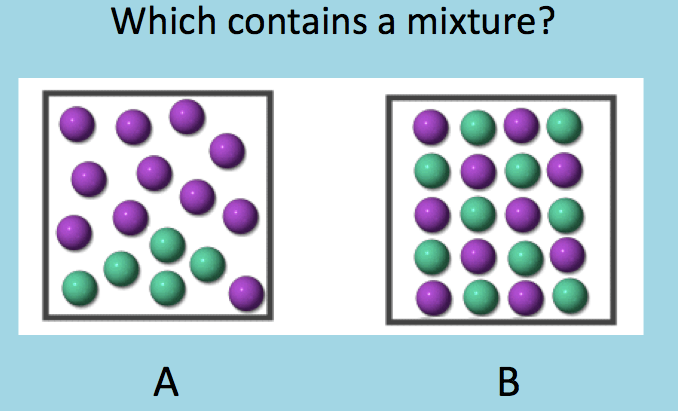
Which contains a mixture? (Choose all)
A
B

Which contains a solution? (Choose all)
A
B
None are solutions

Which contains only elements (no compounds)? (Choose all)
A
B
C

Which is a heterogeneous mixture? (Choose all)
1
2
3
4

Two substances have been combined physically and appear the same throughout is called a.........
A homogeneous mixture
A heterogeneous mixture
An element
A compound
Salt water (NaCl & H2O) is an example of an
element
compound
mixture
Solutions that conduct a current are called ____________ and are made from ___________ compounds.
electrolytes; ionic
nonelectrolytes; ionic
electrolytes; molecular
electrolytes; covalent
Which of the following is NOT a solution?
the air you breathe
carbonated soda
nail polish mixed with acetone
milk

Which of the following best summarizes the figure below?
HX is the only electrolyte
Both HX and HZ are electrolytes, but HY is not.
Only HY is an electrolyte
All the solutions shown are electrolytes.

What would the substance be classified as?
nonelectrolyte, no dissociation
nonelectrolyte, complete dissociation
strong electrolyte, complete dissociation
weak electrolyte, partial dissociation

What would the substance be classified as?
nonelectrolyte, no dissociation
nonelectrolyte, partial dissociation
strong electrolyte, complete dissociation
weak electrolyte, partial dissociation

What would the substance be classified as?
strong electrolyte, no dissociation
nonelectrolyte, complete dissociation
strong electrolyte, complete dissociation
weak electrolyte, partial dissociation

