Wayground logo

Free Printable Worksheets

Font size

S
M
L
XL
Worksheets

chemistry unit 1

Total questions: 24

Worksheet time: 11mins

Name
Class
Date
1.

All matter has mass and _____________________________.

a)

takes up space

b)

is dirty

c)

takes a long time to measure

2.

Which form of matter has its own shape and volume?

a)

liquid

b)

solid

c)

gas

3.

What form of matter has no definite shape or volume?

a)

liquid

b)

solid

c)

gas

4.

What form of matter takes the shape of its container and has volume?

a)

liquid

b)

solid

c)

gas

5.

What is an example of a solid?

a)

oxygen

b)

ocean

c)

lego

6.

What is an example of a liquid?

a)

ocean

b)

carbon dioxide

c)

computer

7.

How can you change a liquid to a solid?

a)

freeze it

b)

melt it

c)

boil it

8.

How can you change a solid to a liquid?

a)

freeze it

b)

melt it

c)

boil it

9.

When liquid evaporates, it is changing from a liquid to a __________.

a)

solid

b)

gas

c)

plasma

10.

What will happen if you leave a shallow dish of water on a windowsill for a week?

a)

the water will evaporate

b)

the water will boil

c)

the water will freeze

11.

Bt adding heat to a pot of water on the stove you change the water from a liquid to a gas. This process is called ___________________________.

a)

melting

b)

freezing

c)

boiling

12.

To melt something (change it from a solid to a liquid), you have to ___________ heat.

a)

remove

b)

add

13.

In order for a liquid to freeze (turn to a solid), you have to ________________heat.

a)

add

b)

remove

c)

apply

14.

Change of state

a)

When a material returns to its previous shape after the force that caused the change has been removed.

b)

Reversible changes between solid, liquid and gas.

c)

When the material or subtance can be returned to its previous state, and no new material or substance is produced.s

d)

When substances interact and produce a new substance.

15.

What are the characteristics of liquids?

a)
Definite volume but no definite shape, ability to flow, takes the shape of its container
b)
Definite volume but no definite shape, inability to flow, does not take the shape of its container
c)
No volume and no shape, inability to flow, does not take the shape of its container
d)
Definite volume and definite shape, inability to flow
16.

What are the characteristics of gases?

a)
Low density, compressibility, and ability to expand to fill their container
b)
Low density, incompressibility, and inability to expand
c)
Medium density, incompressibility, and ability to contract
d)
High density, incompressibility, and inability to expand
17.

When the temperature of matter increases the particles ...

a)
speed up and move farther apart
b)
speed up and move closer together
c)
slow down and move farther apart
d)
slow down and move closer together
18.
What two types of measurements make up DENSITY? 
a)
Mass and Volume
b)
Temperature and Mass
c)
Grams and Centimeters
d)
Volume and Weight
19.
Look at this image.  Which object has the LOWEST density in water? How? 
a)
The Ping Pong Ball because it floats to the top 
b)
The bolt because it has sunk to the bottom
c)
The soda cap because it is not just full of air like the Ping Pong ball
20.
Jack has a rock. The rock has a mass of 14g and a volume of 2cm3. What is the density of the rock?
a)
7 mL
b)
7 g/cm3
c)
28 g/cm3
d)
1/7 g/cm3
21.
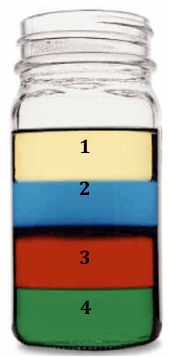
Why do the liquids form different layers?
a)
They have different densities.  
b)
They have different masses.  
c)
They have different volumes.  
d)
They are different temperatures.  
22.
What units can be used to express density?
a)
g/mL
b)
grams
c)
millimeters
d)
milliliters
23.
An object should float in a liquid if it is 
a)
Denser than the liquid 
b)
Less dense than the liquid
c)
Lighter than metal
d)
 Shaped like a ball 
24.
Put the liquids in order from most dense to least dense?
a)
4, 3, 2, 1
b)
1, 2, 3, 4
c)
3, 4, 2, 1, 
d)
4, 3, 1, 2