
 Worksheets
Mitosis / Meiosis / Binary Fission Quiz
Total questions: 35
Worksheet time: 18mins
Name
Class
Date
1.
Name
4 lines
2.
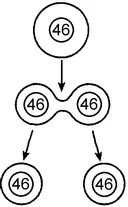
The image shows a diagram of a cellular process. Which process is BEST illustrated by this diagram?
a)
tissue repair by mitosis
b)
tissue repair by meiosis
c)
sexual reproduction through mitosis
d)
asexual reproduction through meiosis
3.
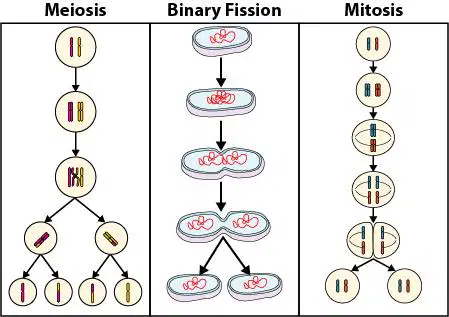
Three models of cellular reproduction are shown below.
Which explanation about cellular reproduction is best supported by the models?
a)
Mitosis and meiosis both produce diploid and haploid gametes during cellular replication.
b)
Binary fission and mitosis both produce daughter cells that are identical to the parent cells.
c)
Meiosis and binary fission both include the process of crossing over during cellular replication.
d)
Meiosis and mitosis both produce daughter cells with fewer chromosomes than the parent cells.
4.
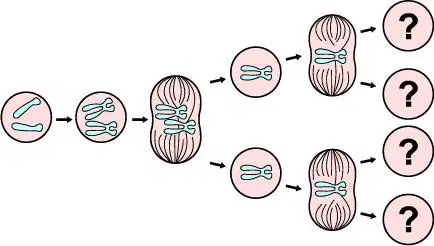
A student creates a model of the two-step process of meiosis.
Which choice could be used to correctly complete the model?
a)
Option 1
b)
Option 2
c)
Option 3
d)
Option 4
5.
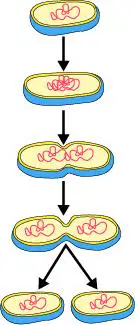
Bacteria can reproduce asexually using the process of binary fission. A model of this process is shown.
Using the model, which TWO statements describe how binary fission maintains genetic continuity?
a)
The nucleus divides in two before the separation.
b)
The daughter cells are identical to the parent cell.
c)
Genetic information is recombined during replication.
d)
The chromosome from the parent cell is completely copied.
e)
Each daughter cell has half of the parent cell's genetic information.
6.
Which of the following correctly defines a gamete?
a)
a sex cell that contains half of the chromosomes of a regular cell
b)
a collection of cells that join during fertilization to form a zygote
c)
a cell that contains double chromosomes in preparation for mitosis
d)
a mutation that occurs in a sex cell and is passed to offspring
7.
Meiotic cell division has two steps called Meiosis I and Meiosis II. Which of the following is correct about each step?
a)
At the end of Meiosis I one diploid cell has become two haploid cells, and at the end of Meiosis II two haploid cells have become four haploid cells.
b)
At the end of Meiosis I one diploid cell has remained one diploid cell, and at the end of Meiosis II one diploid cell has become two haploid cells.
c)
At the end of Meiosis I one haploid cell has become two diploid cells, and at the end of Meiosis II two diploid cells have become four haploid cells.
d)
At the end of Meiosis I one haploid cell has remained one haploid cell, and at the end of Meiosis II one haploid cell have become two diploid cells.
8.
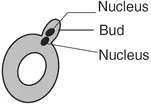
The diagram represents a yeast cell that is in the process of budding.
Which statement describes the most likely outcome of this process?
a)
The bud will divide and create two sex cells.
b)
The bud will develop into a fertilized egg cell.
c)
The two cells that are formed will have varied DNA.
d)
The two cells that are formed will have identical DNA.
9.
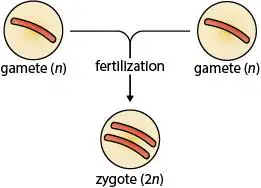
The graphic shows the process of fertilization.
Which statement BEST explains how this process affects genetic continuity?
a)
Through mitosis, the zygote receives a complete set of chromosomes from each parent.
b)
Through mitosis, the zygote receives half of the needed chromosomes from each parent.
c)
Through meiosis, the zygote receives half of the needed chromosomes from each parent.
d)
Through meiosis, the zygote receives a complete set of chromosomes from each parent.
10.
Which of the following processes produces genetic diversity?
a)
Binary fission
b)
Meiosis
c)
Mitosis
d)
Cloning
11.
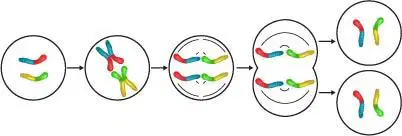
A student uses gummy worms to model the process of mitosis. The model is shown below.
Using the model, which statement correctly explains how mitosis preserves genetic continuity?
a)
The daughter cells receive chromosomes that are recombined from the parent cells.
b)
The daughter cells receive chromosomes that are identical to the parent cell.
c)
Each daughter cell receives half of its chromosomes from each of the parent cells.
d)
Each daughter cell receives twice as many chromosomes as the parent cell.
12.
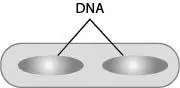
Bacteria reproduce through binary fission. The diagram shows a bacterial cell preparing to reproduce. Which diagram shows the outcome of binary fission?
a)
Option 1
b)
Option 2
c)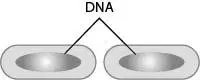
Option 3
d)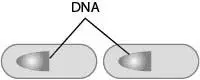
Option 4
13.
A chicken has some cells that contain 78 chromosomes and other cells that contain 39 chromosomes. Which process is responsible for creating the cells with the larger number of chromosomes?
a)
gamete production
b)
cell differentiation
c)
mitosis
d)
meiosis
14.
The process of mitosis can produce what kind of cells?
a)
sex cells
b)
gametes
c)
skin cells
d)
homologous pairs of cells
15.
In meiosis, what results from a diploid parent cell?
a)
1 diploid daughter cell
b)
2 diploid daughter cells
c)
2 haploid daughter cells
d)
4 haploid daughter cells
16.
Which type of cell results from meiosis, but not mitosis?
a)
diploid cell
b)
haploid cell
c)
2n daughter cell
d)
body cell
17.
During which phase of mitosis do chromosomes line up in the middle of the cell?
a)
prophase
b)
telophase
c)
metaphase
d)
anaphase
18.
By what process does a prokaryotic cell reproduce?
a)
mitosis
b)
meiosis
c)
binary fission
d)
spontaneous generation
19.
Which cellular process allows some animals to regrow lost limbs?
a)
meiosis
b)
reproduction
c)
differentiation
d)
mitosis
20.

The table below describes cell division in rows X and Y.
Which of the following correctly identifies the type(s) of cell division described in rows X and Y?
a)
Row X and Y describe mitosis.
b)
Row X and Y describe meiosis.
c)
Row X describes meiosis, while row Y describes mitosis.
d)
Row X describes mitosis, while row Y describes meiosis.
21.
The type of cell division that is responsible for the production of egg and sperm cells is
a)
meiosis.
b)
mitosis.
c)
budding.
d)
binary fission.
22.
Which diagram represents a plant cell close to the final stage of mitosis?
a)
Option 1
b)
Option 2
c)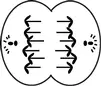
Option 3
d)
Option 4
23.
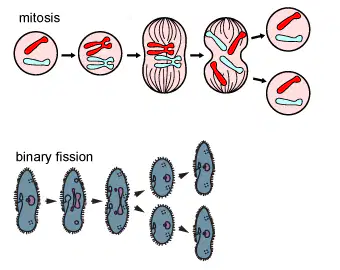
The diagram shows two models of the cellular division process.
Which of the following describes how both of these cellular division processes maintain genetic continuity?
a)
Both processes create cells with half the genetic material of the parent cells.
b)
Both processes create cells with twice the genetic material of the parent cells.
c)
Both processes involve the replication and division of identical genetic material.
d)
Both process involve the recombination and division of new genetic material.
24.
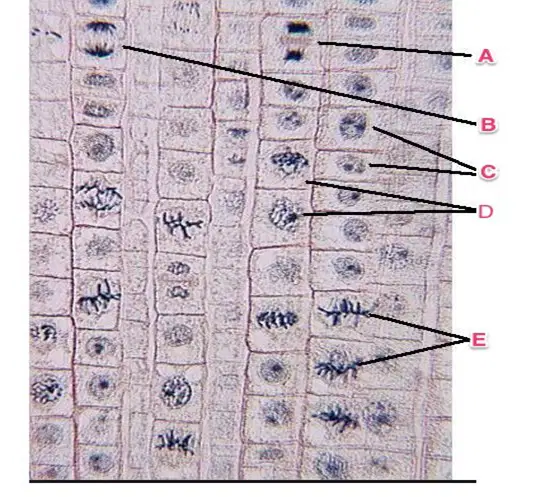
What phase of mitosis is this cell undergoing at point E?
a)
prophase
b)
metaphase
c)
anaphase
d)
telophase
25.
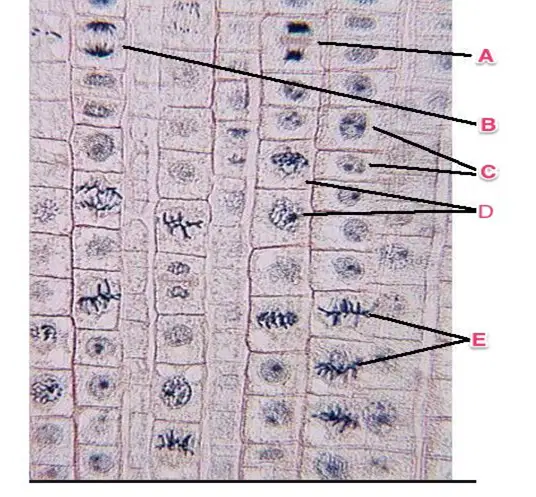
What phase of mitosis is this cell undergoing at point B?
a)
prophase
b)
metaphase
c)
anaphase
d)
telophase
26.
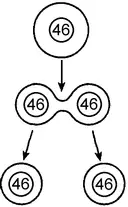
The image shows a diagram of a cellular process. Which process is BEST illustrated by this diagram?
a)
tissue repair by mitosis
b)
tissue repair by meiosis
c)
sexual reproduction through mitosis
d)
asexual reproduction through meiosis
27.
Which of the following correctly defines a gamete?
a)
a sex cell that contains half of the chromosomes of a regular cell
b)
a collection of cells that join during fertilization to form a zygote
c)
a cell that contains double chromosomes in preparation for mitosis
d)
a mutation that occurs in a sex cell and is passed to offspring
28.
Which of the following processes produces genetic diversity?
a)
Binary fission
b)
Meiosis
c)
Mitosis
d)
Cloning
29.
Choose the answer choice that correctly pairs the type of reproduction with the correct process(es).
a)
sexual reproduction; mitosis and budding
b)
asexual reproduction; mitosis and meiosis
c)
sexual reproduction; meiosis
d)
asexual reproduction; meiosis
30.
Which of the following could be used to describe the end result of meiosis? Select 3.
a)
genetically unique cells
b)
haploid cells
c)
four daughter cells are produced
d)
genetically identical cells
e)
diploid cells
31.
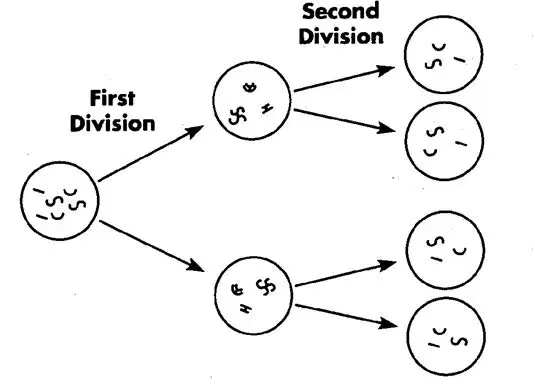
Refer to the diagram. The process shown is _________
a)
mitosis.
b)
chromosomal mutation.
c)
dominance.
d)
meiosis.
32.
Meiotic cell division has two steps called Meiosis I and Meiosis II. Which of the following is correct about each step?
a)
At the end of Meiosis I one diploid cell has become two haploid cells, and at the end of Meiosis II two haploid cells have become four haploid cells.
b)
At the end of Meiosis I one diploid cell has remained one diploid cell, and at the end of Meiosis II one diploid cell has become two haploid cells.
c)
At the end of Meiosis I one haploid cell has become two diploid cells, and at the end of Meiosis II two diploid cells have become four haploid cells.
d)
At the end of Meiosis I one haploid cell has remained one haploid cell, and at the end of Meiosis II one haploid cell have become two diploid cells.
33.

The table below describes cell division in rows X and Y. Which of the following correctly identifies the type(s) of cell division described in rows X and Y?
a)
Row X and Y describe mitosis.
b)
Row X and Y describe meiosis.
c)
Row X describes meiosis, while row Y describes mitosis.
d)
Row X describes mitosis, while row Y describes meiosis.
34.
Which cellular process allows some animals to regrow lost limbs?
a)
meiosis
b)
reproduction
c)
differentiation
d)
mitosis
35.
Which diagram best represents mitotic cell division?
a)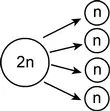
Option 1
b)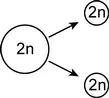
Option 2
c)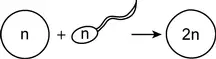
Option 3
d)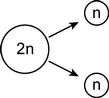
Option 4
100 %

