
 Worksheets
Imperialism/www1 Review
Total questions: 60
Worksheet time: 41mins
US entered war to gain control of Puerto Rico, Guam, Cuba, and the Philippines in this war...
Rico War
Spanish American War
War on terrorism
Island war
The explosion on the USS Maine started...
WWI
WWII
Spanish American War
Mexican American War
This person believed that the strength of a nation lies in the power of their Navy...
Theodore Roosevelt
Woodrow Wilson
Henry Cabot Lodge
Alfred Thayer Mahan
Choose all reasons for US imperialism...
the end of the frontier in the US
desire to compete against European empires
the need for more workers in the industrial age
the need for new markets and more natural resources
Which foreign policy allowed for multiple nations to trade with China?
Open Door Policy
Dollar Diplomacy
Moral Diplomacy
Big Stick Policy
What was the significance of building a canal in Panama?
it would take territory away from the Spanish empire
it would allow easier economic and military access to and from the Atlantic and Pacific Oceans
it would make it easier for the US to invade countries in South America
it would allow the US to control worldwide trade
The Roosevelt Corollary was related to what prior foreign policy?
Monroe Doctrine
Big Stick Policy
Dollar Diplomacy
Moral Diplomacy
Hawaii was taken over by business men lead by...
Sandford B. Dole
Theodore Roosevelt
Grover Cleveland
the Queen of Hawaii
Which territory was promised independence after the Spanish American War but was actually denied independence?
Guam
Philippines
Cuba
Puerto Rico

What is the type of sensational reporting where writers exaggerated or even invented stories?
muckraking
yellow journalism
journalism
reporting
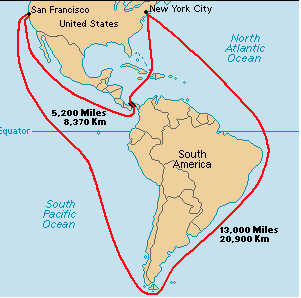
After the Spanish American War, the U.S. Directly controlled all of the following territories EXCEPT
The Philippines
Guam
Puerto Rico
Cuba

Why did Theodore Roosevelt help support a revolt against Columbia?
Columbia refused to comply with trade agreements
He wanted to establish a naval base in Columbia
He wanted to establish a colony in Columbia
He wanted to build the Panama Canal
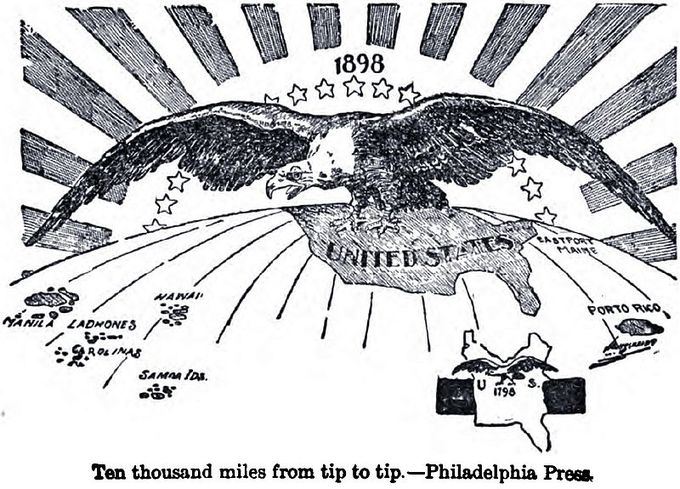
This image is a representation of...
US Exploration
US Diplomacy
US War Relations
US Imperialism
In what year did the United States begin its rise as a world power?
1898
1941
1914
1929

What is "annexation"?
When a country takes control of new territory.
When a country frees territory that it controls.
When a country frees another group of people from imperialist rule.
When a country rebels against it's imperial rulers.

Imperialism is __________.
when a powerful nation uses its resources to help a weaker nation
when a weaker nation invites a powerful nation to help it industrialize
when a powerful nation takes control of the economy and government of a weaker nation
when weak nations join together to fight a strong nation
What country had to admit guilt for WWI according to the Treaty of Versailles?
Germany
Russia
Austria-Hungary
Italy
What is a method of citizens loaning money to the government to pay for war?
propaganda
sussex pledge
espionage
war bonds
What is the name for information designed to influence opinion?
yellow journalism
media
muckraking
propaganda
Which of the following countries was not one of the Allies?
Germany
Great Britain
USA
France
What does the term imperialism refer to?
A policy of giving away a country’s power to another nation as a gift
A policy of extending a country’s power and influence through diplomacy or military force
A policy of trading goods between two states or nations
A policy in which the government debates over paying someone to purchase another country
The _______________ was a foreign policy statement issued in 1823 stating that the U.S. would oppose any intervention by European nations to control nations in the Western Hemisphere.
Monroe Doctrine
Articles of Confederation
Mayflower Compact
Treaty of Paris
Hostility towards Spain increased as Americans were persuaded by _____________, which is a style of newspaper reporting that emphasizes sensational news.
Muckraking
Yellow Fever
Yellow Journalism
Wall Street Journal
Leading up to the Spanish-American War, the sudden explosion of the _____________ off of the coast of Cuba led Americans to believe that _______________ was to blame, despite there being no concrete evidence.
U.S.S. Maine; Cuba
U.S.S. Alabama; Spain
U.S.S. Maine; Spain
U.S.S. Maryland; France
The _______________ was a volunteer regiment that served during the Spanish-American War and was organized by future president ______________ .
Rough Riders; Franklin Delano Roosevelt
Tuskegee Airmen; Theodore Roosevelt
Progressive Party; William Taft
Rough Riders; Theodore Roosevelt
In 1901, the __________________ made Cuba a legal protectorate of the United States.
20th Amendment
16th Amendment
Platt Amendment
Elastic Clause
The ________________ was an extension of the Monroe Doctrine and enabled the United States to intervene in Latin American countries struggling with unstable conditions.
Yellow Journalism
Great White Fleet
Rough Riders
Roosevelt Corollary
An _________________ for trade allowed the United States and other nations to trade “openly” with the Chinese and other countries.
Closed Door Policy
Open Door Policy
Roosevelt Corollary
American Expansionist
After attempts were abandoned by the French, the United States attempted to purchase the rights to complete the building of the ______________ in order to connect the Atlantic and Pacific Oceans.
Roosevelt Corollary
Panama Canal
Hay-Bunau-Varilla Canal
Philippine Canal
The term ________________ refers to the idea that through financial investment in foreign nations, the United States would develop a scope of influence that would provide both stability and economic opportunity.
Roosevelt Corollary
Dollar diplomacy
Open Door Policy
Interventionist
Which U.S. President is associated with "Big Stick Diplomacy"?
Grover Cleveland
William McKinley
Teddy Roosevelt
Woodrow Wilson

As a result of the Spanish- American War, the US became a political power in
The Hawaiian Islands
Puerto Rico, Guam, and the Philippines
Samoa
Panama


Who led the Progressive Movement?
Farmers from the Midwest who needed more workers.
The wealthy who wanted to help the poor.
The middle class city dwellers who were educated.
Poor immigrants who demanded help.
A major goal of the Progressive movement was to
stimulate the economy.
support government control of factory production.
encourage immigration from southern and eastern Europe.
correct the economic and social abuses of industrial society.
Jacob Riis is most important for
finding a method to mass-produce steel.
exposing the terrible conditions in the slums of New York.
developing a new process to speed up production in factories.
being the driving force behind the transcontinental railroad.
The goals of muckraking journalists were to
advertise the economic benefits of industrialization.
describe and illustrate the problems within American society.
encourage European immigration through advertising in European newspapers.
attract rural residents to move into the urban centers.
During the Progressive Era, new amendments were added to the U.S. Constitution. Which amendment number created a national income tax?
14th
15th
16th
17th
During the Progressive Era, new amendments were added to the U.S. Constitution. Which amendment number allowed citizens to directly elect senators?
14th
15th
16th
17th

Which muckraking journalist took this picture?
Lewis Hine
Woodrow Wilson
Jacob Riis
Theodore Roosevelt

Which muckraking journalist took this picture?
Lewis Hine
Woodrow Wilson
Jacob Riis
Theodore Roosevelt
In 1906, the United States Congress passed the Meat Inspection Act which allowed government officials to inspect meat sold in interstate trade. What type of reform was this law?
Grassroots
State
National
International
The NAACP was created to
promote the rights of African Americans.
organize ethnic enclaves in large urban centers.
direct immigrants to helpful services such as locating factory jobs.
promote settlement of the American Midwest away from large urban centers.

