
 Worksheets
European Geography Test Review
Total questions: 36
Worksheet time: 18mins

Which of these are countries in central Europe?
France, United Kingdom, Spain
Belgium, Italy, Ukraine
Germany, Austria, Switzerland
Poland, Romania, Sweden
Poland, Hungary, and the Czech Republic are countries in -
Northern Europe.
Eastern Europe.
Low Countries
Central Europe.

Which of these European countries border the Mediterranean Sea?
France, Netherlands, Norway
Portugal, France, Austria
Denmark, Finland, Lithuania
Spain, Italy, Greece

This city is the primate or leading city of the United Kingdom, and home to a number of famous buildings such as Westminster Abbey.
London
Vienna
Athens
Budapest
Which of the following best describe the continent of Europe?
a continent consisting mostly of large islands
a huge isthmus connecting the continents of Asia and Africa
a giant peninsula of smaller peninsulas.
a part of a large landmass called Europia
Hot, dry summers and mild, moist winters are characteristic of -
prevailing westerlies.
a large landmass.
the North Atlantic drift.
a Mediterranean climate.
How have people in the Netherlands interacted with their environment?
by reclaiming land once covered by the sea
by damaging the land through heavy mining
by polluting the coastline
by cultivating forests
Which of the following statements is NOT true of Europe's rivers?
Europe has very few navigable rivers.
The rivers of Europe are important for trade and hydroelectric power.
The rivers of Europe are connected by a series of canals.
Europe is having to deal with massive amounts of pollution in its rivers.
Which of these is not a large settled island in Europe?
Sicily
Iceland
Ireland
Madagascar
Major mountain regions in Europe include the -
Urals and Alps
Pyrenees and Atlas.
Alps and Pyrenees.
Zagros and Taurus
The climate of Europe is moderated by –
the annual melting of polar ice.
burning of forests and peat bogs.
southerly winds from the Sahara Desert.
the North Atlantic Current.
The second-longest river in Europe, it runs through central and eastern Europe, passes four national capitals, and empties into the Black Sea.
Seine
Danube
Thames
Rhine
The Strait of Gibraltar controls access to the
Baltic
Mediterranean
Black
North
The Chunnel connects which two countries?
Britain and Ireland
Britain and Spain
Britain and Norway
Britain and France
Which of the following is NOT a problem for Europe's forests?
planting seedlings
air pollution
acid rain
deforestation
After WWII, the majority of countries in Eastern Europe became _____
monarchies
democratic
communist
socialist
Members of the European Union began sharing a unit of currency on January 1, 1999.
European Union
European Free Trade Association
European Monetary Union
European Currency Union
Changes occurred in Eastern Europe in the late 1980s and early 1990s when the region -
changed from an industrial to an agricultural society.
moved away from communism toward independence.
experienced land reforms.
strengthened its ties with the Soviet Union.
Farming in Europe is characterized by -
meager soils and low yields.
a total lack of grazing animals.
advanced techniques and high yields.
planting and harvesting by hand.
One source of economic development in mountainous regions of Europe is –
manufacturing
tourism
textiles
farming
Rivers and canals in Europe are
closed for human use due to pollution
largely abandoned in favor of highways
dry and unusable in the summer
important transprotation links
Many economies in Europe are characterized by -
concentration on a single natural resource.
heavy reliance on cash crops.
significant government involvement.
very low participation in global trade.
Where do most people in Western Europe live?
near the mountains
in rural areas
in urban areas
in small towns
Europe is known as the birthplace of the Industrial Revolution because it-
was able to turn coal mining into a big business.
used water power to run spinning machines.
had an abundant supply of raw materials.
produced and traded more manufactured goods than any other area.
All of the following are challenges faced by Europe today except –
environmental pollution.
ethnic tensions.
terrorism.
high birth rates.
Europe is home to Western culture derived from the civilizations of —
Scandinavia and Ethiopia.
Mecca and Jerusalem.
Spain and Egypt.
Greece and Rome.
Which of these was not a method which spread European culture throughout the world?
exploration
isolationism
imperialism
colonization
What is true of modern Europe?
There are many ethnic groups with different languages and religions.
People have abandoned ethnic identities to minimize conflicts.
The division between communism and capitalism created two large ethnicities.
People have blended into a unified culture.
Conflicts in Europe often occur due to -
financial panics.
poor crop yields.
ethnic divisions.
scarcity of water resources.
Many countries in Europe are now members of what military alliance?
OPEC
NATO
ASEAN
NAFTA

This structure was built nearly 2,500 years ago in Greece. It is the -
Parthenon
Big Ben
Arc de Triomphe
St. Peter's Basilica

These famous buildings are found in what European country?
Italy
Poland
Sweden
Romania
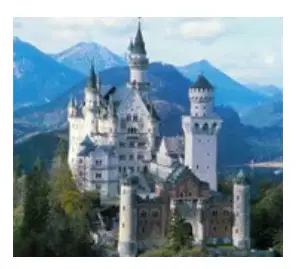
Neuschwanstein Castle was built by King Ludwig II in the late 1800s in the southenr part of what is now-
France
Germany
Austria
Italy
The Eiffel Tower, Arc de Trikomphe, Louvre, and Notre Dame cathedral are famous buildings in what city in France?
Paris
Marseille
Rome
Avignon
Inhabited for thousands of years, this city was once the center of a major empire and is not the capital of Italy.
Paris
Kiev
Rome
Vienna
A consolidation of two sister cities on the Danube River, this city is the capital of Hungary
Kiev
Budapest
Berlin
Rome

