
 Worksheets
7.3 Three Branches
Total questions: 18
Worksheet time: 9mins
At the Constitutional Convention, state delegates decided NOT to—
change the Articles of Confederation
break away from Great Britain
sign the Articles of Confederation
allow any westward expansion
What was the only branch of government provided for in the Articles
of Confederation?
Judicial
Executive
Amendment
Legislative
Who was elected president of the Constitutional Convention?
Ben Franklin
John Adams
George Washington
Thomas Jefferson
What did the Great Compromise decide?
How many years legislative representatives could serve in government
How many votes each state had in the Senate and House of Representatives
Who would be the first president of the United States
The rights that would be established in the Bill of Rights
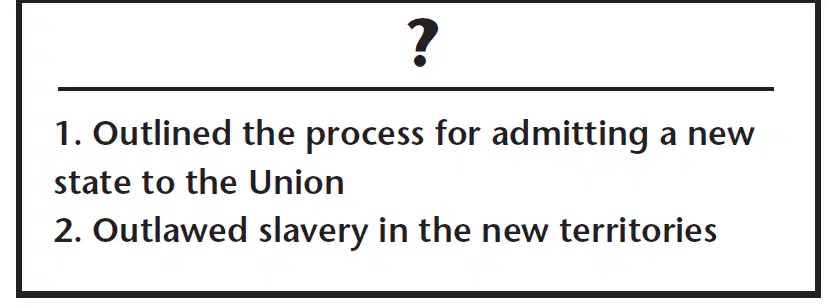
What title should be given to these outcomes of the Articles of Confederation?
The Northwest Ordinance
Ratification Process
Monroe Doctrine
Westward Expansion
Who is known as the Father of the Constitution?
James Madison
George Washington
John Adams
Thomas Jefferson
What are the three weaknesses of the Articles of Confederation?
gave each state one vote
gave Congress no power to tax
no common currency or money
provided the government with too much power
The first constitution of the United States was
Declaration of Independence
Articles of Confederation
Virginia Declaration of Rights
Bill of Rights
What was the main reason the delegates decided to draft a new constitution?
The Bill of Rights did not clearly outline the civil liberties of individuals.
The citizens of each state did not agree with the Northwest Ordinance.
The Articles of Confederation was too weak to sustain the new nation.
The states demanded a national military for defense against European nations.
Where did the state delegates meet to decide to write a new constitution?
Boston
Philadelphia
Washington DC
New York City
What issues did the delegates debate at the Constitutional Convention?
Term length of legislative representatives and how much power to allot the national government
How large and small states should be represented in government and the size limit of
new and future states
How much power to give to the national government and how large and small states
should be represented
How much power should be given to the executive branch and the official boundary
lines of the United States
The U.S. Constitution established a federal system of government
based on power being shared between—
national and state governments
city and state governments
American and European governments
local and federal governments
How many states had to vote in favor of the Constitution in order for
it to become law?
all 13
1 out of 13
9 out of 13
7 out of 13
The Constitution was signed at the end of the convention. What process
happened next in order for the document to become law?
Ratification
Admittance
Amending
Confirmation

