
 Worksheets
Geological Time Scale Quiz
Total questions: 14
Worksheet time: 7mins
Name
Class
Date
1.
Multiselect: Read the question and check the TWO answer choices that are correct.
Ronald is learning the difference between absolute and relative dating to determine the age of a rock.
Which statements in this list refer to relative dating? Choose TWO correct answers.
a)
This is also called radiometric dating.
b)
It is like saying you are younger than your mother.
c)
Relies on the property of half-life, which is the predictable time for an element to decay.
d)
Disturbances in the rock layers make this type of dating difficult.
e)
This uses the decay of radioactive elements to find the age.
2.
Which of the following eras are the longest in the geologic time scale?
a)
Precambrian Time
b)
Paleozoic Era
c)
Mesozoic Era
d)
Cenozoic Era
3.
Which of the following time periods are the oldest in the geologic time scale?
a)
Paleozoic Era
b)
Mesozoic Era
c)
Precambrian Time
d)
Cenozoic Era
4.

Which rock layer is the newest?
a)
A
b)
B
c)
C
d)
D
5.
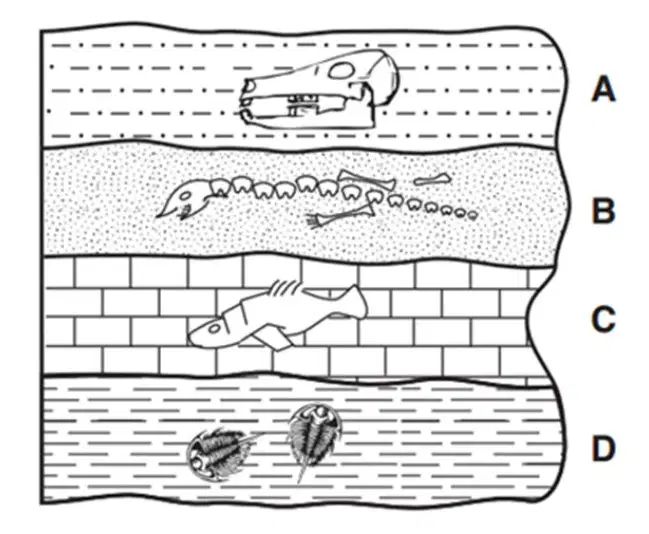
Which fossil is older than the fish fossil?
a)
A
b)
B
c)
C
d)
D
6.
A major event that happened during Precambrian Time was
a)
Periods of ice ages
b)
The first life appeared on Earth (one-celled animals, bacteria, jellyfish).
c)
Mass extinction
7.
A major event that happened during the Paleozoic (early life) Era was
a)
Planet Earth formed.
b)
Formation of the supercontinent, Pangaea
c)
Complex life: dinosaurs, small mammals, birds, conifers, and flowering plants
8.
A major event that happened during the Mesozoic (middle life) Era was
a)
Complex life: dinosaurs, small mammals, birds, conifers, and flowering plants
b)
Development of large mammals including human beings
c)
Planet Earth formed.
9.
A major event that happened during the Cenozoic (late life) Era was
a)
Development of large mammals including human beings
b)
Formation of the supercontinent, Pangaea
c)
Mass extinction
10.
remains of an organism that lived in the past
a)
absolute dating
b)
relative dating
c)
fossils
d)
half-life
11.
the end of a group of organisms
a)
mass extinction
b)
fossils
c)
relative dating
12.
finding out how old one rock is compared to another rock
a)
absolute dating
b)
relative dating
c)
half-life
13.
finding out how old a rock is in actual years
a)
absolute dating
b)
relative dating
c)
mass extinction
14.
the rate of atom decay
a)
absolute dating
b)
fossils
c)
half-life
100 %

