
 Worksheets
Potential & Kinetic Energy Quiz Review
Total questions: 18
Worksheet time: 10mins
Name
Class
Date
1.
True or False: Energy cannot be created or destroyed.
a)
True
b)
False
2.
What is potential energy?
a)
The stored energy due to its position or condition.
b)
The energy that an object has due to its motion.
c)
The energy an object has due to its existence.
d)
The energy an object has due to its volume.
3.
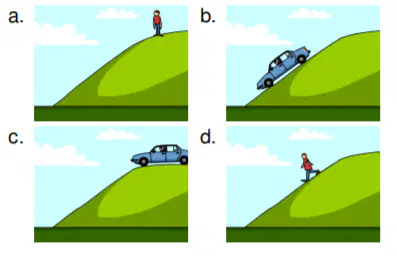
Which of these has the most potential energy?
a)
A
b)
B
c)
C
d)
D
4.
What is kinetic energy?
a)
The stored energy of an object due to its position or conditon.
b)
The energy that an object has due to its motion.
c)
The energy an object has due to its existence.
d)
The energy an object has due to its volume
5.

Which passenger has the most potential energy?
a)
A
b)
B
c)
C
d)
D
6.
Which of the following has the most kinetic energy?
a)
A car traveling at 80 kph.
b)
A tractor-trailer traveling at 80 kph.
c)
A cheetah running at 80 kph.
d)
A motorcycle traveling at 80 kph.
7.
When does an object have no kinetic energy?
a)
When it's at rest.
b)
When it's moving very slowly.
c)
When the only force that's acting on it's gravity.
d)
When it has no electrical charge
8.
When is potential energy transformed into kinetic energy?
a)
When an object at rest is lifted to a higher elevation.
b)
When an object at rest remains at rest.
c)
When an object at rest is put into motion.
d)
When an object in motion is stopped and out at rest.
9.
The slower an object moves, the ______________ kinetic energy it has.
a)
Same
b)
More
c)
Less
d)
None of the above
10.
Why do objects at high elevations have more potential energy than objects at low elevations?
a)
Because the thinner air at higher elevations means objects have a greater potential to move very fast.
b)
Because objects at high elevations are closer to the sun, which is the source of all energy on earth.
c)
Because objects at high elevations tend to move slower than objects at low elevations.
d)
Because gravity gives objects at high elevations the potential to fall much further.
11.

Which letter has the most kinetic energy?
a)
X
b)
Z
c)
Y
d)
There is no kinetic energy
12.
The amount of kinetic energy an object has depends on both its:
a)
Mass and weight
b)
Color and smell
c)
Speed and height
d)
Mass and speed
13.
During an energy transfer, which of the following is true about an object that is gaining kinetic energy?
a)
The object is motionless.
b)
The object has potential to move.
c)
The object is losing momentum.
d)
The object is losing potential energy.
14.

Which statement best summarizes the transformation of energy in the image?
a)
Potential energy is transformed into kinetic energy
b)
Kinetic energy is transformed into kinetic energy
c)
Gravitational potential energy is transformed into electric potential energy
d)
Electric potential energy is transformed into magnetic potential energy
15.

This graph shows different points on the path of a ball rolling down and then up a hill. Which point has the most potential energy?
a)
Point A
b)
Point B
c)
Point C
d)
Point D
16.

What kind of energy is in a rock at the edge of a cliff?
a)
Potential
b)
Kinetic
c)
Both potential and kinetic energy
d)
none of the above
17.
On a roller coaster, where is maximum kinetic energy?
a)
At the bottom of a big hill
b)
When going around a corner
c)
When going upside down
d)
At the top of a big hill
18.

Which statement accurately describes the skater’s energy as they go up the ramp?
a)
As the skater moves up the ramp, their total energy decreases
b)
As the skater’s speed increases, their potential energy remains the same
c)
As the skater’s kinetic energy decreases, their potential energy increases
d)
As the skater’s kinetic energy increases, their downward speed decreases
100 %

