
 Worksheets
Girl Can't Dance
Total questions: 19
Worksheet time: 38mins
Name
Class
Date
1.
Why was Theo eager to get to school on Monday? ("Eager" means “feeling a strong and impatient desire to do something.”)
a)
A. He was excited for P.E. first period.
b)
B. He couldn’t wait to see everyone’s reaction to his YouTube video.
c)
C. He was grounded and ready to get out of the house.
d)
D. He wanted to talk to his friends about the new Jackson Jax album.
2.
While talking about the Gary Larry Show, Emma says that Jackson Jax “sauntered to the microphone.” What does the word "sauntered" reveal about Jackson Jax?
a)
A. He is nervous about performing.
b)
B. He has grown tired of being a celebrity.
c)
C. He has swagger and confidence—he’s extremely comfortable in the spotlight.
d)
D. He is dancing his way to the microphone.
3.
Which lines support the idea that fame changes Emma? (Choose TWO.)
a)
A. “Being as uncoordinated as I am, I hate P.E., and I think it’s fair to say that P.E. hates me.”
b)
B. “‘Who’s Andy Warhol?’ I asked. ‘Does he do karaoke?’”
c)
C. “I exhaled loudly, then scrawled a giant ‘E’ on the paper.”
d)
D. “I put my sunglasses back on. Aubree just didn’t get me.”
4.
Which detail would be LEAST important to include in a summary of the story?
a)
A. Emma’s twin brother secretly recorded a video of her and posted it on YouTube.
b)
B. “Girl Can’t Dance” went viral and made Emma a celebrity.
c)
C. There were 15,000 people at the Jackson Jax concert that Emma and Aubree attended.
d)
D. Emma comes to realize that her friendship with Aubree is more important than fame.
5.
Consider the poem “Fame Is a Bee.” Which literary device does poet Emily Dickinson use?
a)
A. simile: a comparison of two unlike things using like or as
b)
B. hyperbole: extreme exaggeration; a statement not meant to be taken literally
c)
C. metaphor: a comparison of two unlike things to show a particular quality or aspect of one of those things
d)
D. allusion: a statement that refers to something without mentioning it directly
6.
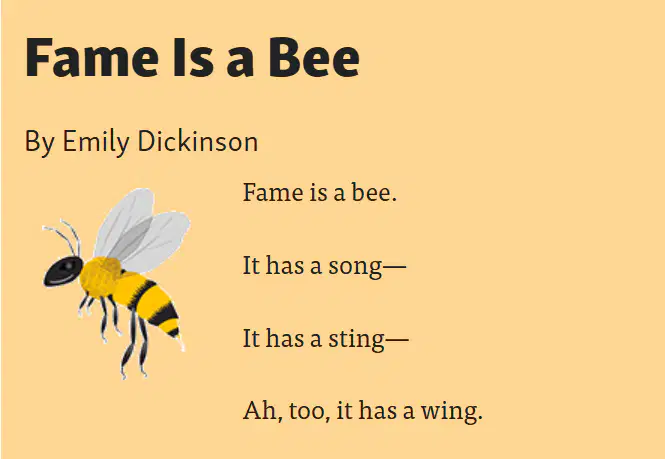
Which is a big idea of the poem?
a)
A. There are both positive and negative things about being famous.
b)
B. Fame happens by accident.
c)
C. Fame makes you rich.
d)
D. Friendship is more important than fame.
7.
Consider the first line of the story: "At first sight of me, I guarantee you'd want my autograph."
What can you infer about the narrator?
a)
The narrator is famous an a bit stuck up assuming that the reader would be impressed by her.
b)
The narrator has many friends, but no one likes her.
c)
The narrator has great handwriting, so the reader would want her autograph.
d)
The narrator is not liked by anyone.
8.
After "Girl Can't Dance" had received lmore than 500,000 hits, Emma says: "Then the strangest think happened. Some kids at school started being nice to me."
Why are some kids being nice to Emma all of a sudden?
a)
She was always popular.
b)
She was famous now.
c)
They thought she was such a good dancer and singer.
d)
The had always wanted to be her friend but were shy.
9.
Consider what Emma says in the final lines of the story: "I tossed my sunglasses in the trash and headed back to Aubree. I had something to tell her."
What is Emma going to tell Aubree?
a)
Emma will tell her that she still doesn't want to be her friend.
b)
Emma will tell Aubree she is sorry and she was wrong to treat her poorly.
c)
Emma will tell Aubree that she didn't have time for her.
d)
Emma will tell Aubree that she passed her test.
10.
The main or central character that is usually involved in a conflict or struggle with the antagonist.
a)
protagonist
b)
minor character
c)
plot
d)
flashback
e)
foreshadowing
11.
The sequence of events in a story.
a)
plot
b)
minor character
c)
protagonist
d)
flashback
e)
foreshadowing
12.
The opponent or enemy of the main character, or protagonist.
a)
antagonist
b)
minor character
c)
plot
d)
protagonist
e)
flashback
13.
A struggle between opposing forces. May be external or internal.
a)
conflict
b)
minor character
c)
plot
d)
dynamic character
e)
flashback
14.
A character who does not play a large role in a story.
a)
minor character
b)
major character
c)
flashback
d)
protagonist
e)
plot
15.
A main or important character who plays a large role in the story.
a)
major character
b)
minor character
c)
foreshadowing
d)
dialogue
e)
flashback
16.
Clue or hints about something that is going to happen later in the story.
a)
foreshadowing
b)
plot
c)
fiction
d)
flashback
e)
dialogue
17.
A scene in a story that occurred before the present time that the story is taking place.
a)
flashback
b)
dialogue
c)
fiction
d)
dynamic character
e)
conflict
18.
A character who undergoes a significant internal change over the course of a story.
a)
dynamic character
b)
conflict
c)
simile
d)
climax
e)
symbol
19.
The conversation between characters in a work of literature.
a)
dialogue
b)
climax
c)
antagonist
d)
setting
e)
simile
100 %

