
 Worksheets
resistance in circuits year 10
Total questions: 27
Worksheet time: 1hrs 9mins
Four unequal resistors are connected in series with each other. Which one of the following statements is correct about this combination?
The equivalent resistance is equal to that of any one of the resistors.
The equivalent resistance is equal to average of the four resistances.
The equivalent resistance is less than that of the smallest resistor.
The equivalent resistance is less than that of the largest resistor.
The equivalent resistance is more than the largest resistance.
Four unequal resistors are connected in a parallel with each other. Which one of the following statements is correct about this combination?
The equivalent resistance is less than that of the smallest resistor.
The equivalent resistance is equal to the average of the four resistances.
The equivalent resistance is midway between the largest and smallest resistance.
The equivalent resistance is more than the largest resistance.
None of the other choices is correct.
Draw a circuit with a battery connected to four resistors, R1, R2, R3, and R4, as follows. Resistors R1 and R2 are connected in parallel with each other, resistors R3 and R4 are connected in parallel with each other, and both parallel sets of resistors are connected in series with each other across the battery.


When unequal resistors are connected in parallel in a circuit,
the same current always runs through each resistor.
the potential drop is always the same across each resistor.
the largest resistance has the largest current through it.
the power generated in each resistor is the same.
When unequal resistors are connected in series across an ideal battery,
the same power is dissipated in each one.
the potential difference across each is the same.
the current flowing in each is the same.
the equivalent resistance of the circuit is less than that of the smallest resistor.
the equivalent resistance of the circuit is equal to the average of all the resistances.

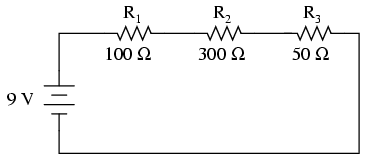
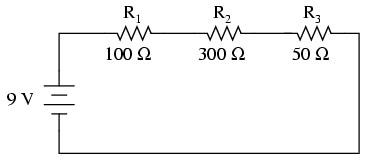
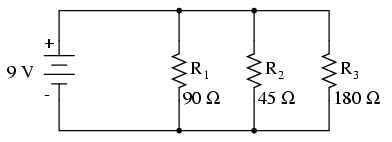


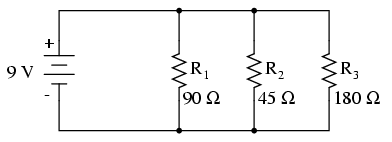
In a __________ all components are connected end-to-end
Ohmic Conductor
Series Circuit
Non-Ohmic Conductors
Parallel Circuit
________ describes the relationship between current, voltage, and resistance.
Coulumb's Law
Ohm's Law
Gauss Law
Pascal's Law
The total resistance in this circuit is
100 Ω
450 Ω
400 Ω
30 Ω

The potential difference across the 300 Ω resistor is
6 V
9 V
2 V
30 V

What is the total resistance across this circuit?
3 kΩ
10 kΩ
13 kΩ
18 kΩ
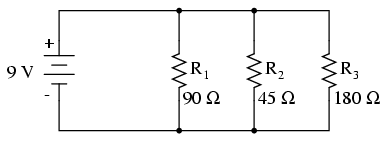
The current going through the 45 Ω resistor is
0.05 A
0.2 A
0.1 A
5 A

The total current going through the battery of this circuit is
0.35 A
0.0286 A
0 A
9 A
If short circuit occurs in one room of a house and it goes dark, but all the other rooms stay lit, it is because...
all of the fuses have blown.
the short circuit has only blown one fuse and the rest of the house is still lit because it is in series.
the short circuit has only blown one fuse and the rest of the house is still lit because it is in parallel.
the short circuit has not blown any of the fuses.


In the circuit shown above, what is the value of the potential difference between points X and Y?
1 V
2 V
3 V
4 V

