Wayground logo

Free Printable Worksheets

Font size

S
M
L
XL
Worksheets

Microscope

Total questions: 49

Worksheet time: 2hrs 31mins

Name
Class
Date
1.
What is the total magnification of a microscope with two lenses when one lens has a magnification of 10x, and the other lens has a magnification of 30x?
a)
15x
b)
30x
c)
40x
d)
300x
2.
When you focus on a new specimen, always begin with
a)
low power and coarse adjustment.
b)
low power and fine adjustment
c)
high power and coarse adjustment
d)
high power and fine adjustment
3.
If your teacher asks you to move a microscope to table, how do you carry it?
a)
by the body tube and the eyepiece
b)
with one hand
c)
one hand on the arm and the other under the base
d)
with one hand on the base and the other on the eyepiece.
4.
Which part of the microscope controls the amount of light available?
a)
coarse adjustment knob
b)
diaphragm
c)
objective lens
d)
revolving nosepiece
5.
Which part lets you turn up the power of magnification, such increasing from 40x to 100x?
a)
coarse adjustment knob
b)
diaphragm
c)
field-of-view
d)
revolving nosepiece
6.
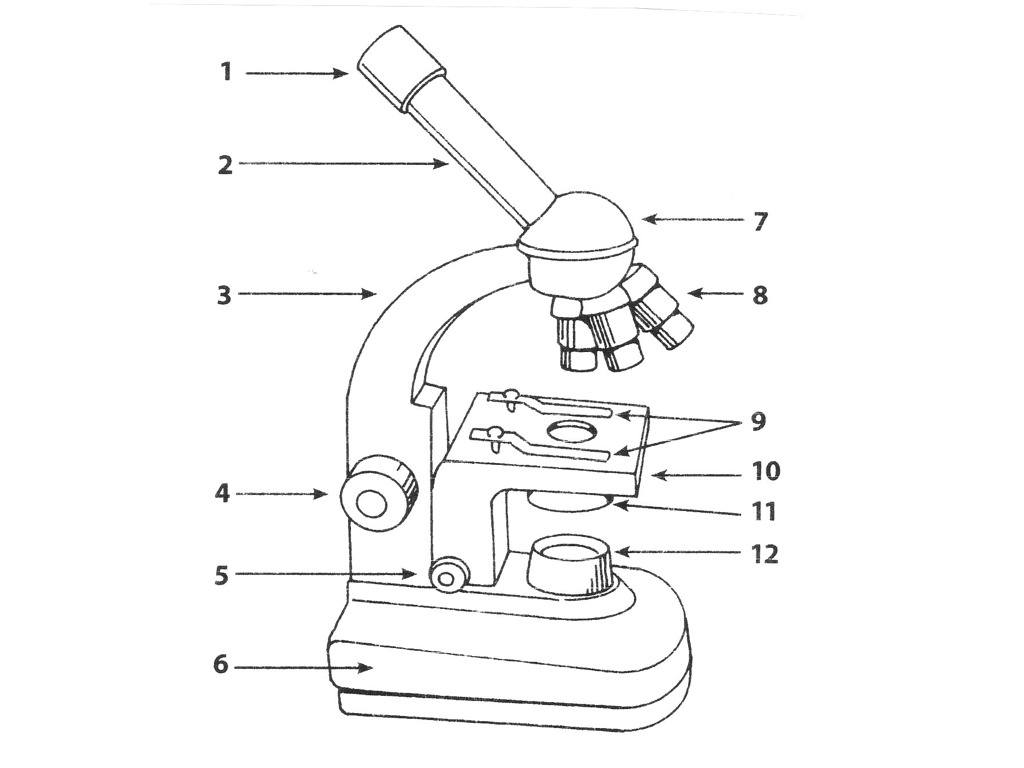
What is part 1?
a)
eye piece
b)
body tube
c)
arm
d)
coarse adjust
7.
What part is 3?
a)
eye piece
b)
base
c)
arm 
d)
coarse adjust
8.
If the eyepiece of your scope has a power of 10, and the selected objective lens has a power of 20,what is the total magnification?
a)
20x
b)
30x
c)
200x
d)
2000x
9.
What part is 5?
a)
coarse adjustment
b)
fine adjustment
c)
diaphragm
d)
stage
10.
What is part 6?
a)
arm 
b)
base
c)
body tube
d)
illuminator
11.
What is number 3?
a)
Course Adjustment Knob
b)
Fine Adjustment Knob
c)
Diaphragm
d)
Eyepiece
12.
What is number 4?
a)
Course Adjustment Knob
b)
Fine Adjustment Knob
c)
Diaphragm
d)
Eyepiece
13.
What is number 5?
a)
Course Adjustment Knob
b)
Fine Adjustment Knob
c)
Diaphragm
d)
Eyepiece
14.
What is number 6?
a)
Course Adjustment Knob
b)
Fine Adjustment Knob
c)
Diaphragm
d)
Eyepiece
15.
What is number 8?
a)
On/Off Switch
b)
Nosepiece
c)
Light
d)
Objective Lens
16.
What is number 9?
a)
On/Off Switch
b)
Nosepiece
c)
Light
d)
Objective Lens
17.
What is number 11?
a)
Aperture
b)
Stage
c)
Stage Clips
d)
Stand
18.
The part of the microscope that you look through. Usually contains a 10x lense.
a)
Eyepiece
b)
Nosepiece
c)
Telescope
d)
Magnifier
19.

What does it mean to make the object appear larger than it actually is?

a)

magnification

b)

resolution

20.

What does it mean to make the object become clearer, sharper, or more in focus?

a)

magnification

b)

resolution

21.
Who looked at cork and named the cell?
a)
Robert Hooke
b)
Van Leeuwenhoek
c)
Robert Brown
d)
Francesco Redi
22.

This early cell theory scientist looked in a microscope and discovered "animalcules" in the gunk from his teeth and pond water.

a)

Schleiden

b)

Leeowenhoek

c)

Hooke

d)

Virchow

e)

Schwann

23.

To focus a specimen, it is best to start with which objective:

a)

high power

b)

low power

c)

scanning

d)

ocular

24.

A microscope has a 4x ocular lens and a 10x objective, what is this microscope's total magnification?

a)

4x

b)

14x

c)

40x

d)

400x

25.
If you move the slide left while viewing, in which direction will it appear to move?
a)
right 
b)
left
c)
up 
d)
down
26.

The greater the ___________________, the smaller the field you are actually viewing.

a)

detail

b)

objective

c)

magnification

d)

body

27.
A microscope is an instrument that.
a)
makes faraway objects look closer.
b)
makes small objects appear larger.
c)
decreases the size of small objects.
d)
increases the size of small objects.
28.
If you move the slide left while viewing, in which direction will it appear to move?
a)
right 
b)
left
c)
up 
d)
down
29.

Moves stage up and down for focusing; locates the specimen

a)

Fine Focus Knob

b)

Large Focus Knob

c)

Course Focus Knob

d)

Small Focus Knob

30.
Lets light pass through an object and then through two or more lenses
a)
Binocular Microscope
b)
Compound Microscope
c)
Electron Microscope
d)
Simple Microscope
31.

uses one lens to magnify an image.

a)

simple light microscope

b)

compound microscope

c)

electron microscope

d)

SEM

32.

Using a microscope, _____ observed and named cells.

a)

Leeuwenhoek

b)

Aristotle

c)

Hooke

d)

Linneaus

33.
What is number 1?
a)
Base
b)
Arm
c)
Stage
d)
Neck
34.
What is number 2?
a)
Base
b)
Arm
c)
Stage
d)
Neck
35.
What is number 3?
a)
Course Adjustment Knob
b)
Fine Adjustment Knob
c)
Diaphragm
d)
Eyepiece
36.
What is number 4?
a)
Course Adjustment Knob
b)
Fine Adjustment Knob
c)
Diaphragm
d)
Eyepiece
37.
What is number 5?
a)
Course Adjustment Knob
b)
Fine Adjustment Knob
c)
Diaphragm
d)
Eyepiece
38.
What is number 6?
a)
Course Adjustment Knob
b)
Fine Adjustment Knob
c)
Diaphragm
d)
Eyepiece
39.
What is number 7?
a)
On/Off Switch
b)
Nosepiece
c)
Light
d)
Objective Lens
40.
What is number 8?
a)
On/Off Switch
b)
Nosepiece
c)
Light
d)
Objective Lens
41.
What is number 9?
a)
On/Off Switch
b)
Nosepiece
c)
Light
d)
Objective Lens
42.
What is number 10?
a)
On/Off Switch
b)
Nosepiece
c)
Light
d)
Objective Lens
43.
What is number 11?
a)
Aperture
b)
Stage
c)
Stage Clips
d)
Stand
44.
What is number 12?
a)
Aperture
b)
Stage
c)
Stage Clips
d)
Stand
45.
Which pieces raise and lower the stage or objective lense?
a)
Diaphragm and Light
b)
Aperture and Diaphragm
c)
Fine and Course Adjustment Knobs
d)
Eyepiece and Arm
46.
Which piece does NOT primarily support the microscope?
a)
Arm
b)
Nosepiece
c)
Base
47.
Which piece is a wheel that allows the user to control the amount of light let through the slide?
a)
Stage
b)
Diaphragm
c)
Light
d)
Fine Adjustment Knob
48.
The part of the microscope that you look through. Usually contains a 10x lense.
a)
Eyepiece
b)
Nosepiece
c)
Telescope
d)
Magnifier
49.
Piece used in combination with the eyepiece. Provides a range of magnifications from 4x to 40x.
a)
Eyepiece
b)
Microscope
c)
Objective Lens
d)
Nosepiece