
Font size
 Worksheets
revision Q1
Total questions: 220
Worksheet time: 4hrs 29mins

A_______ is a push or pull on a specific object.
motion
force
friction
gravity

_________ is a force that can slow objects down as they rub together.
friction
balanced force
unbalanced force
gravity
a change in position
position
magnet
speed
motion
a push or a pull
magnet
speed
force
motion
Forces can change the motion of object.
True
False
What does the word "contact" mean?
to touch
to move
to write
to read

What type of contact force is in this photo?
Tension Force
Spring Force
Frictional Force
Spring Force
Air Resistance Force

What type of contact force is in this photo?
Tension Force
Spring Force
Frictional Force
Spring Force
Air Resistance Force

The force between the two people through the rope is
Contact (Tension Force)
Non-contact Pull
Contact ( Friction)
Non-contact Push
Friction is a
Contact Force
Myth
Non-contact Force

Which type of force do you see in the picture?
Push
Pull
Throw
Gravity pulls you down to the earth.
True
False

A push moves things _______ .
Close to you
Away from you

What happens when you PULL a ball?
It moves away
It moves closer
Which of the following forces can push (repel) and pull (attract)?
Magnetic Force
Electric Force
Gravitational Force
Both Magnetic and Electric Force.
Gravity means:
being buried in a grave
the force that pulls us toward Earth
small crushed rocks

The picture is an example of a
pull
push
shove
dig

The picture is an example of a
push
pull
target
track

When I throw a ball up into the air, it falls because of
magnetism
thermal energy
solar energy
gravity
A non-contact force is between
two objects that aren't touching
two objects that are touching
the ground and wheels
you and me
Electricity is an example of
Contact force
Non-contact Force
Electricity is not a force
After rubbing a balloon to your head, it sticks to the wall.
Electrical
Gravitational
Magnetic
Involves positive and negative particles.
Electrical
Gravitational
Magnetic
The moon is pulled towards Earth and never flies away.
Electrical
Gravity
Magnetic
Gravity acts as non-contact force, pulling down on objects towards Earth.
True
False

Explain the predicted motion of two children on a seesaw.
Back and forth
Up and down
Side to side

Explain the predicted motion of swing.
Back and forth
Side to side
Up and down
Two objects with same electrical charges will
attract each other
even out in the end
repel each other
cause a spark


If two objects push each other away they __________ from each other.
attract
repel
static
force

A positively charged object and a negatively charged object will ___________ when close together.
force
attract
repel
conductor
A force that is caused by two surfaces rubbing together:
Friction
Force
Push
Pull
The _________ of magnetism is applied when a magnet pulls a paperclip toward it.
force
distance
two objects with opposite charges will move towards each other
attract
repel (repulsion)
conduct
two objects with the same charge will move away from each other
attraction
repel (repulsion)
conduct
Magnetic Force is an example of ____________ force.
contact
non-contact
balanced
unbalanced

Contact Force
Non contact Force

What is going to happen?
They will repel
They will attract
NOTHING
Magnetism can...
only attracts objects
only repels objects
attracts or repel objects
When an object or a person moves another by touching it, it´s a...
Contact force
Non-contact force

Magnets __________________________ iron and steel to them
repel
strength
glue
attract
In a magnet the opposite poles will ___________.
attract
repel
Which of these is attracted to a magnet?
iron nail
copper coin
piece of paper
notebook


A contact force is from
touching objects
far apart objects
not touching object
always a pull
A non-contact force is between
two objects that aren't touching
two objects that are touching
the ground and wheels
you and me

The three examples pictured are of
Non-contact Forces
Contact Forces

The force between the phone and the mount is a
contact force
non-contact force

Gravity is a
Contact Force
Myth
Non-contact Force
Friction is a
Contact Force
Myth
Non-contact Force
Magnetic Force is an example of ____________ force.
contact
non-contact
balanced
unbalanced
______________ is a force that always acts in the direction opposite of motion.
applied
friction
gravity
normal
Electricity is an example of
Contact force
Non-contact Force
Electricity is not a force
Air resistance is an example of
Contact force
Non-contact Force
Air resistance is not a force
Friction is an example of
Contact force
Non-contact Force
Friction is not a force
Gravity is an example of
a contact force
a non-contact force
gravity is not a force

Patterns of motion happen when the same motion repeats over and over.
true
false

Omar is on a playground and need to walk by students on swings. Omar can predict when it will be safe to go by. He knows the swing moves in a pattern:
spinning
back and forth
zigzag
up and down
What two things do you need to find speed (select both)
distance
time
velocity
direction
What two things do you need to find speed (select both)
distance
time
velocity
direction
The measuring unit of speed is .....
m/sec2
m/s or km/h
newtons
gm/kg
You walk 10 meters to science class in 20 seconds. Your speed is
2 m/s
0.5 m/s
200 m/s
5 m/s


What is motion?
A change in position.
A change in force.

When your position changes, you're in ____________.
motion
force

Which of these are examples of motion?
Turning around
Moving side to side
Traveling
All of them

When a moving object makes the same pattern again and again.
motion
pattern of motion
outcome
friction
Motion can be ________________.
straight
circular
up and down
all of the above
Something that happens in a regular or repeated way is a
Pattern
Observation
Prediction
Weight
When you tell that something will happen in the future, you are making
a motion
an observation
a prediction
a mass
the position of one object in relation to another object
graph
pattern
relative position
data
Pattern of motion will NEVER change.
True
False
Position is what?
place or location
south
north
hands on a clock

Predict the motion of the pendulum
round and round
downward
back and forth
up and down
What is a pattern of motion?
A motion that is random
A motion that repeats
Any typr of regular force
Something that happens in a regular or repeated way is a
Pattern
Observation
Prediction
Weight
When you tell that something will happen in the future, you are making
a motion
an observation
a prediction
a mass
The change in location of an object is called
observation
weight
mass
motion
A swing is an example of ___________ motion.
line
weak
strong
back and forth

Choose the direction of the moving object that you see in the picture.


Microwave turntable is an example of ________.
motion in a circle
motion in a line
a prediction

Which pattern of motion does a pinwheel have?
left and right
in a line
in a circle
Which picture doesn’t show motion?


What is position?
Movement
Place where something is
the way an object’s faces.
motion
direction
position
the position of an object compared to the position of another object.
relative motion
relative position
position
the motion of an object compared to another object.
relative motion
relative position
motion
............... is how far something travels.
speed
distance
motion

the pattern in motion is
back and forth
straight line
round and round

pattern in motion is
back and forth
straight line
up and down

pattern in motion is
up and down
straight line
back and forth

pattern in motion is
up and down
back and forth
sraight line

pattern in motion
up and down
back and forth
straight line

wasp moves
back and forth
straight line
without pattern
If you drop a ball it will
stop
roll
bounce
In strong wind, the wind chime will move
slowly
quickly
In mild wind, the wind chime will move
slowly
quickly
The rabbit changes its position faster, a rabbit’s speed is
fast
slow
sto
A turtle changes its position slowly, a turtle’s speed is
fast
slow
motion
relative means
next to
compared to
The unit of speed is ...............
m / s
km / h
both are correct

Identify the force.
pull
push
Force can move and stop the object.
True
False

What is a force?
pull and push
things
people

The man is ..... the box.
pulling
pushing
Balanced forces show
an object moving
an object not moving
Unbalanced forces show
an object moving
an object not moving
Which force is contact?
friction force
gravity
If the forces are acting in the SAME DIRECTION, how do you find the net force
add
subtract
divide
multiply
Which force is non contact ?
friction force
gravity

forces that act in the same direction are ................together
added
multiplied
Forces that act in the same direction are added together to be......................
stronger
weaker
nothing
When a force acts on an object without changing its motion, it will be...............
balanced
unbalanced

Describe the forces in the picture
balanced because no one is moving
unbalanced because one side is winning
Gravity and magnetism are ...
contact forces
non-contact forces
Gravity and magnetism are ...
contact forces
non-contact forces
Force that is opposite but not equal
Balanced
Unbalanced
Force that is opposite and equal
Balanced
Unbalanced
the pull between Earth and other objects, which acts even without touching
force
repel
gravity
magnetic force

The forces are ___
balanced
unbalanced

The following picture depicts
unbalanced forces
balanced forces
uncontrolled forces
controlled forces
Which description best describes "net force"?
strong force acting on an object
no force acting on an object
balanced forces acting on an object
total of all forces acting on an object
Friction can slow down an object in motion
true
false

How will this object move?
It won't move.
It will move to the right.
It will move to the left.
It will move up.

How will this object move?
It won't move.
It will move to the left.
It will move in both directions.
It will move to the right.

What is the net force?
30 N left
25 N right
55 N right
5 N left

What is the net force?
1000 N upward
500 N right
40 N right
0 N

These forces are ______________
Balanced Force
Unbalanced Force

What Is the Net Force?
0 N
10 N right
10 N left
What are the balanced forces?
forces that are not equal in size and are opposite in direction
forces that are equal in size and opposite in direction.
What are the unbalanced forces?
forces that are equal in size and opposite in direction.
forces that are not equal in size and are opposite in direction
It is the sum of all the forces acting on an object.
Net force
Gravity
Friction
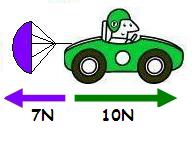
What is the net force?
3 N
3 N, right
17 N, right
3 N, left

Natural magnet
can turn on and turn off by electric current.
is not made magnetic by people.
is made magnetic by people.
they repel
Electromagnet
can turn on and turn off by electric current.
is not made magnetic by people.
is made magnetic by people.
they repel

What is a Magnetic pole?
is the space where the force of a magnet acts.
attract
Is the point where the magnetic force is strongest.
repel

What is a Magnetic FIELD?
is the space where the force of a magnet acts.
attract
Is the point where the magnetic force is strongest.
repel
How do the magnetic poles interact?
opposite pole repel and like pole attract
opposite pole attract and like pole repel

How do poles interact?
They repel
They attract

what about the poles?
They repel
They attract

What make Earth a large magnet?
because it has a north pole and south pole
because it´s big
becasue they have charges.
Which poles attract each other?
north and north
south and south
north and south
What items will a magnet attract?
Beach ball, glass jar
nails, paper clips
book, lunch box
golf ball, glue

What will happen when these magnets are brought close together?
They will attract each other.
They will repel each other.
Which part of the Magnet is Strongest?
The Center
The Sides
The Poles
A magnet cannot not move which of the following objects?
a paper clip
a nail
a toothpick
a staple
Which metal can be attracted to magnets?
Copper
Aluminum
Iron
Gold
Which poles repel or push apart each other?
north and south
south and north
south and south
Which poles attract each other?
north and north
south and south
north and south
The AREA around a magnet where you feel a pulling force.
Gravity
Magnetic Field
Friction

Name the magnet.
Button magnet
Cylinder magnet
Bar magnet
Ring magnet
Magnets can be found in paper
true
false
Magnets can be found in refrigerator
true
false
How many poles are there in a magnet?
3
1
4
None of them

How many poles does a magnet have?
1
2
3
4
What are the poles of a magnet?
north and south
east and west
north and west
west and south

What do two opposites pole of a magnet do when placed close together?
attract
repel
When like (the same) poles are placed together they _______.
repel
attract
Which is NOT true about magnets?
They have a north and south pole
They have a magnetic field
They come in different shapes and sizes
They are made of wood
Metals that easily transfer electricity are called
resistors.
magnets
insulators
conductors

How are electromagnets different from magnets?
magnets have a North and South pole
you can turn an electromagnet on/off
magnets are more powerful

Surrounding every magnet is a __________ __________.
another magnet
electrical current
magnetic field

What is a permanent magnet?
Can be turned off
Can not be turned off
Can turned on and off
What are the components of the electromagnet?
copper wire, iron nail, and a wooden stick
copper wire, iron nail
copper wire, iron nail, and a battery
Copper wire, paper and a battery
What type of magnet that can turned on and off?
electromagnet
permanent magnet
electricity
battery
Magnets on refrigerator cannot be turned off. Which type of magnets they belong?
electromagnets
battery
permanent magnets
copper wire
What are the components of the electromagnets?
battery, wire and bulb
battery , copper wire and paper clips
battery, copper wire and iron nail
battery, wire and aluminum
How can we control an electromagnet?
By turning the electricity on and off.
By turning the kinetic energy on and off.

What would happen if you took one end of the wire off the battery?
The nail will be a magnet.
The nail would no longer be a magnet
Nothing will happened.
The nail will heats up.

Which part of the electromagnets turned into a magnet when electricity flows through a coiled wire?
Battery
Copper wire
Iron Nail
Bulb
Which steps will you take to build an electromagnet?
First, wrap the wire around a nail. Next, attach the ends of the wire to a battery to make an electric circuit.
First, attach the ends of the wire to a battery to make an electric circuit. Next wrap the wire around a nail.

Which part of the electromagnet produces a magnetic field?
Battery
Coiled copper wire
Bulb
Iron nail
When matter has an overall positive charge or a negative charge, we say that it has an
electric charge
positive charge
negative charge

the negative charges in the blue circle will .......the positive charges in the red circle
repel
attract
nothing happens

The object in the picture is............
Negatively charged
positively charged
Neutral
when the number of the negative charges and positive charges are the same ,the object is ..........
Negatively charged
positively charged
Neutral

What will happen between the charges in the picture?
Repulsion
Attraction
Nothing happens
in a............electrical charges can move easily
insulator
conductor
nothing
in an...........electrical charges cannot move easily
conductor
insulator
nothing

The matters in the picture are...........
insulators
conductors
Neutral

insulators
conductors
both
Electric force is a ............force
Contact
non contact force
both
When two objects push away from each other, they ______.
electric charge
neutral
repel
attracts
The push or pull of charged object on each other is an ______.
electric forces
neutral
repel
attracts
______ is the transfer of particles that have an electric charge between objects that are not touching.
conductor
insulator
static discharge
attracts
This is an example of POSITIVE charge


This is an example of NEGATIVE charge
This is an example of NEUTRAL charge

complete the statement: Opposite charges _____
attract
repel
are neutral
they can move easily

complete the statement: Like charges _____
attract
repel
are neutral
they can move easily
Electric charges can be _________ or ___________.
in or out
north or south
left or right
positive or negative
__________ charges attract each other.
like
opposite
none
all
Electric forces can be found in nature.
true
false
Electric forces between objects that are closer are _________.
stronger
weaker
negative
positive
When an object has more positive particles than negative particles, it has _______________________.
a positive charge
a negative charge
no electric charge; it is neutral
When an object has more negative particles than positive particles, it has ______________________.
a positive charge
a negative charge
no electric charge; it is neutral
When an object has 5000 negative particles and 5000 positive particles, it has _______________________.
a positive charge
a negative charge
no electric charge; it is neutral

