
 Worksheets
Alchemy Quiz 05
Total questions: 10
Worksheet time: 6mins
How many elements are in NaHCO3?
3
4
6
12
If a copper compound is in solution, how would we designate that after the compound formula?
(s)
(l)
(g)
(aq)
Which of the following is false about atoms, elements and compounds?
Different kinds of atoms can combine to make one kind of element.
Compounds are made of more than one kind of element.
Elements and compounds are both made of atoms.
An element is always made of only one kind of atom.
Which statement is NOT a description of a chemical reaction?
A liquid is heated on a Bunsen burner and its temperature rises.
A solid is dropped into a beaker of liquid and an explosion occurs.
Two liquids are mixed in a beaker and a solid forms at the bottom of the beaker.
A solid is dropped into a beaker of liquid and a gas is released.
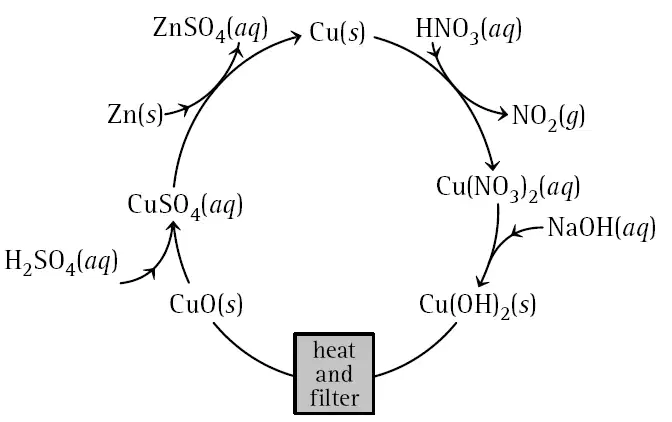
The copper cycle is a demonstration of what principle of chemistry?
Most elements are metallic solids.
Metals are excellent conductors.
Elements exist as gases, liquids, or solids.
Mass is conserved in chemical reactions.
Which of the following is evidence of a chemical change?
change in shape
change in size
change in odor
change in state or phase
Which of the following statements about chemical changes is false?
Chemical changes can be reversed by physical changes.
Chemical changes form new substances that have different properties.
Chemical changes can be detected.
Compounds can be broken down through chemical changes.
Which of the following statements about physical changes is false?
Dissolving is a physical change.
Changes of state (e.g., melting, boiling, etc.) are physical changes.
Physical changes are often easily reversible.
Physical changes can produce new substances.
In the following chemical equation, which are the reactants? Check all that apply.
Fe(s) + CuSO4(aq) --> FeSO4(aq) + Cu(s)
Fe(s)
CuSO4(aq)
FeSO4(aq)
Cu(s)
In the following chemical equation, which are the products? Check all that apply.
Fe(s) + CuSO4(aq) --> FeSO4(aq) + Cu(s)
Fe(s)
CuSO4(aq)
FeSO4(aq)
Cu(s)

