
 Worksheets
ELS Mega Reviewer
Total questions: 257
Worksheet time: 4hrs 48mins
Which doomsday scenario for our Universe predicts a cold dark death, as a consequence of the second law of thermodynamics?
The big chill/The heat death
The big crunch.
The big bounce.
The big bang.
Which doomsday hypothesis could be described as a reverse big bang, resulting in a hot dense end to our Universe?
The big crunch.
The big bang.
The big chill.
The big bounce.
Which of the following ideas make up the Big Bang Theory?
The Universe is currently expanding.
The Universe was once hot and dense.
The Universe has a finite size.
The Universe is unbounded.
Which description is considered most accurate regarding what actually happened during the Big Bang?
Two galaxies collided causing an immense explosion as stars crashed into one another
All of what would become the universe was concentrated in a single small point, or singularity, which rapidly expanded into what is now stars, planets, galaxies, matter, and energy.
All matter emerged from a massive black hole at the center of the universe.
Parts of the sun were ripped off by massive internal explosions and were thrown into space where they cooled to become other things, like plants, comets, and other galaxies.
If something that makes light is moving away from you, it spreads the wavelengths of light out. This application of the Doppler effect is known as ___.
blue shift
green shift
red shift
black shift
Most distant galaxies show a red shift. This is considered evidence that the universe is ___.
getting cooler
expanding
condensing into a small point
swirling around
Observations of space indicate that most matter in the universe is ___.
hydrogen, helium, and dark matter
gold and plutonium
oxygen and water vapor
carbon
Cosmic Microwave Background Radiation is a form of _________.
Matter
Energy
Visible Light
Water
As galaxies move away from our galaxy
a shift on the electromagnetic spectrum is noticed. This phenomena is
called _____________.
redshift
blueshift
How does Cosmic Microwave Background Radiation support the Big Bang Theory?
Microwaves are found everywhere in the universe.
Microwaves occurred at the time of the Big Bang
Microwaves are useful in our everyday lives
The Big Bang Theory explains the formation of the...
Earth
Sun
Universe
Solar System
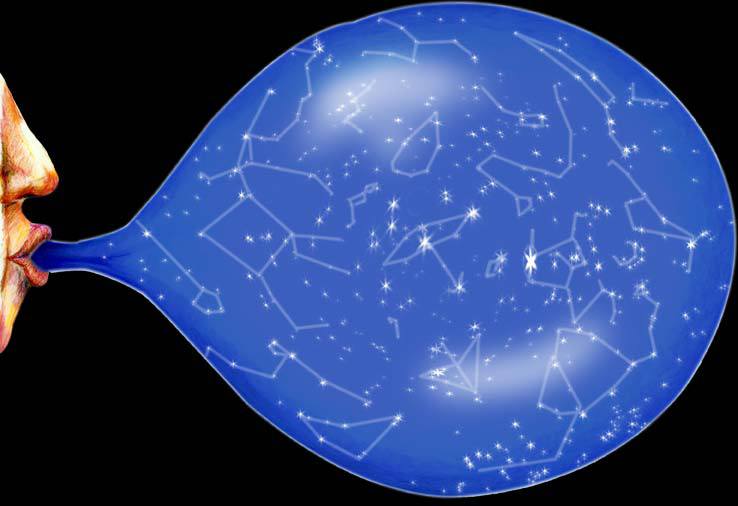

What happens during nuclear fusion in the sun?
oxygen nuclei combine to form helium
Helium nuclei combine to form oxygen
helium nuclei combine to form hydrogen
hydrogen nuclei combine to form helium
Why does the sun appear bigger than all other stars?
It is the biggest star in the universe.
It is Earth's closest star.
All other stars are much smaller than our star.
The sun is the only star we can see.
In comparison to other stars in the sky, the Sun appears brighter because it is ...
hotter
larger
older
closer
Which stars are cooler?
red
blue
yellow
Which characteristics describe a star? Choose all that apply.
Made of gas
Made of rock
Give off heat and light
Close to our planet
Far from our planet
The outermost layer of the sun, which can only be seen during a solar eclipse, is the ...
Hot zone
Chromosphere
Corona
Phtosphere
Which layer of the atmosphere has meteors?
troposphere
stratosphere
mesosphere
thermosphere
Which layer of the atmosphere contains the ionosphere?
troposphere
stratosphere
mesosphere
thermosphere
Which layer of the atmosphere has weather?
troposphere
stratosphere
mesosphere
thermosphere
Which layer of the atmosphere contains the ozone?
troposphere
stratosphere
mesosphere
thermosphere
Temperature increases with height in the ______ due to solar radiation.
troposphere
stratosphere
mesosphere
thermosphere
Temperature increases with height in the ______ due to the ozone trapping heat.
troposphere
stratosphere
mesosphere
thermosphere
Temperature decreases with height in the ______ because there is nothing but thin air.
troposphere
stratosphere
mesosphere
thermosphere
Temperature decreases with height in the ______ because the heat from the surface rises and cools.
troposphere
stratosphere
mesosphere
thermosphere
Which is not a factor that influences daily weather?
heat
air pressure
elevation
moisture
What is the term for the day to day conditions of the atmosphere?
weather
climate
hurrican
global wind
Which prevailing wind can be found between 30 and 60 degrees latitude?
trade winds
horse winds
eaterlies
westerlies
Which prevailing wind can be found between 60 and 90 degrees latitude?
trade winds
horse winds
eaterlies
westerlies
Which prevailing wind can be found between 0 and 30 degrees latitude?
trade winds
horse winds
eaterlies
westerlies
Which gas makes up the largest portion of air?
oxygen
nitrogen
carbon dioxide
methane
What do you call the part of the atmosphere where molecules escape into space?
doldrums
ionosphere
exosphere
dead zone
Ray of sunlight hitting the equator directly results in:
fires
cold weather
a low pressure system
a high pressure system
What protects the earth from harmful UV rays from the sun?
clouds
ionosphere
nitrogen gases
the ozone

Which type of cloud is this?
cirrus
stratus
cumulus

Which type of cloud is this?
cirrus
stratus
cumulus

Which type of cloud is this?
cirrus
stratus
cumulus


Areas near the sea are cooler in summer and warmer in winter.
True
False
What causes changes in seasons?
The earth spinning
The earth tilting on its axis
The earth revolving around the sun
The earth's elliptical orbit

In New York State there is a greater chance of precipitation falling as snow in January than in March, because in January the Northern Hemisphere is tilted:
toward the Sun, and temperatures are warmer
toward the Sun, and temperatures are colder
away from the Sun, and temperatures are warmer
away from the Sun, and temperatures are colder


A small, very intense cyclonic storm with exceedingly high winds, most often produced along cold fronts in conjunction with severe thunderstorms
hurricane
tornado
air mass
cold front

Lines of latitude are also known as:
parallels
perpendiculars
longitude
rungs
Lines of latitude run in which direction?
east and west
north and south
Lines of latitude measure _______ and __________ from the equator?
east and west
north and south

Lines of longitude run in which direction?
east and west
north and south
Lines of longitude measure ________ and ___________ from the Prime Meridian
east and west
north and south
The areas between the equator and 30 degrees North/South is known is also known as _________ AND ____________.
low latitudes
high latitudes
tropical climate zone
temperate climate zone
arctic climate zone
The areas between the 30 and 60 degrees North/South is known is also known as _________ AND ____________.
middle latitudes
high latitudes
tropical climate zone
temperate climate zone
arctic climate zone
The areas between the 60 and 90 degrees North/South is known is also known as _________ AND ____________.
middle latitudes
high latitudes
tropical climate zone
temperate climate zone
arctic climate zone

The climatic effect shown in this photo where one side of the mountains receives less precipitation is known as:
rainshadow
monsoon
rain cycle
wind convection
Which theory proposes that the universe originated from a singularity and underwent rapid expansion?
Steady State Theory
String Theory
Cyclic Universe Theory
Big Bang Theory
The Steady State Theory suggests that the universe:
originated from a singularity.
experiences continuous cycles of expansion and contraction.
is composed of vibrating strings.
is a computer simulation.
String Theory and Brane Theory seek to unify which two fundamental forces?
electromagnetic and gravitational
gravitational and strong nuclear
weak nuclear and strong nuclear
electromagnetic and weak nuclear
What does the Inflation Theory explain about the early universe after the Big Bang?
rapid expansion
cyclic patterns
collisions of branes
continuous creation of matter
The Multiverse Theory proposes the existence of:
a single universe with perfectly tuned properties.
multiple universes with different properties.
a simulated reality.
a cyclic universe.
Which theory suggests that the universe is a computer simulation?
Inflation Theory
Quantum Fluctuation Hypothesis
Simulated Universe Hypothesis
Ekpyrotic Universe Theory
The Cyclic Universe Theory proposes that the universe experiences:
rapid expansion from a singularity.
continuous cycles of expansion and contraction.
vibrations of strings.
collisions of branes.
The Quantum Fluctuation Hypothesis suggests that the universe:
emerged from a singularity.
experiences continuous cycles of expansion.
originated from a quantum fluctuation.
is composed of vibrating strings.
Mythological Theories explain the origin of the universe through:
empirical evidence and observations.
mathematical models and calculations.
deities and cosmic forces in cultural narratives.
quantum fluctuations in the vacuum.
The Simulated Universe Hypothesis raises questions about:
the fine-tuning of the universe.
the origin of quantum fluctuations.
the nature of reality and our existence.
the expansion of the universe.
Which theory suggests that the universe emerged from a collision of branes?
String Theory
Inflation Theory
Simulated Universe Hypothesis
Ekpyrotic Universe Theory
Which theory proposes continuous creation of matter to maintain a constant density universe?
Big Bang Theory
Steady State Theory
Multiverse Theory
Inflation Theory
The main implication of String Theory and Brane Theory is to:
explain the early expansion of the universe.
address the fine-tuning of the universe.
unify quantum mechanics and gravity.
suggest the existence of multiple universes.
The Cosmic Microwave Background Radiation is evidence supporting:
the Cyclic Universe Theory.
the Big Bang Theory.
the Inflation Theory.
the Quantum Fluctuation Hypothesis.
Which theory proposes that the universe experiences eternal cycles of expansion and contraction?
Big Bang Theory
Multiverse Theory
Cyclic Universe Theory
String Theory
Which theory addresses the fine-tuning of the universe by suggesting multiple universes with different properties?
Simulated Universe Hypothesis
Quantum Fluctuation Hypothesis
Steady State Theory
Multiverse Theory
Which theory suggests that the universe emerged from a quantum fluctuation caused by the Heisenberg Uncertainty Principle?
Ekpyrotic Universe Theory
Inflation Theory
Quantum Fluctuation Hypothesis
Steady State Theory
The main implication of the Inflation Theory is to explain:
the origin of mythological narratives.
the fine-tuning of the universe.
the continuous creation of matter.
the rapid expansion of the early universe.
Which theory proposes that our reality is a computer simulation?
Inflation Theory
Simulated Universe Hypothesis
Big Bang Theory
Cyclic Universe Theory
The primary focus of the Cyclic Universe Theory is on:
unifying quantum mechanics and gravity.
explaining the early expansion of the universe.
proposing multiple universes with different properties.
eternal cycles of expansion and contraction.
The solar nebula that formed our solar system was thought to be put in motion by a ______.
nearby supernova
black hole
creative intelligence
condensation nucleus
What is most likely to be found in a nebula?
planets
asteroids
stars
gas clouds
The scientist who first challenged the Earth-centered Universe model was _______.
Newton
Ptolemy
Copernicus
Galilei
All of the following are hypotheses of the formation of the solar system EXCEPT
Big Bang Hypothesis
Nebular Hypothesis
Protoplanet Hypothesis
Encounter Hypothesis
Our solar system began as a ________.
quasar
neutron star
nebula
atom
What is the age of our solar system?
4.7 billion years old
4.6 million years olm
500 billion years old
17.2 billion years old
The expansion of the universe is ________.
a steady process with no identifiable events
a steady process that is punctuated by abrupt transitions
a jumpy process that is completely unpredictable.
no longer occurring today.
What are Nebular Clouds?
an interstellar cloud of dust, hydrogen, helium and other ionized gases
an increase (or decrease) in the frequency of sound, light, or other waves
the galaxy that contains our Solar System
a particle attracts every other particle in the universe
Which of the following puts the events in order from first to last?
Big Bang, our sun, first star, life on Earth
Big Bang, first star, our sun, life on Earth
Big Bang, life on Earth, our sun, first star
First star, Big bang, life on Earth, our sun

A model of the universe in which Earth is at the center of the revolving planets and stars. This includes the sun revolving around the Earth. This model is no longer supported.
Heliocentric
Geocentric
Paleozoic
Mesozoic
Which of the following is not a gas giant?
Jupiter
Mercury
Pluto
Saturn


What layer of the earth is made of liquid magma?
innner core
mantle
crust
outer core
Which is TRUE about the continental crust?
It is thinner than oceanic crust
It is denser than oceanic crust
It is thicker but less dense than the oceanic crust
It is thinner and more dense than the oceanic crust
Earth’s lithosphere is made up of what layer/s?
Crust
Mantle
Crust and Mantle
Crust and upper mantle
Which is NOT true about the lithosphere?
It has the same thickness everywhere
It is the outermost part of the earth
It is composed of the continents and the ocean floor
It varies in thickness


Typhoon is locally known as ________________________
baha
ulan
bagyo
buhawi
The _________________ is the area of lowest atmospheric pressure in the structure of the tropical cyclone.
eyewall
eye
rain bands
clouds
This is the localized unusual increase of sea water level which can be brought by a tropical cyclone.
storm surge
high tide
flooding
tsunami
When a tropical cyclone has caused 300 casualties or more than 1 billion worth of damage, it is removed from the list of typhoons because ________________.
it might cause confusion
it might bring back memories to survivors
PAG-ASA just feels that it is time to change it
first two choices are correct
Wind speed is 121 kph to 170 kph within the next 18 hours
PSWS 1
PSWS 2
PSWS 3
PSWS 4
An instrument used to detect and record earthquakes.
seismic
router
seismograph
ground shaking
It produce tremors that occur before or after an explosion. It is relatively not common unlike tectonic earthquake.
Volcanic eruption
plate
after shock
ground shaking
Occurs when trembling of earthquake cause of a soil to lose strength and flow.
Volcanic eruption
explosion earthquakes
after shock
.liquefaction
Movements within the earth’s crust cause stress to build up weakness and rocks to deform, also rocks breaking under stress.
Volcanic eruption
explosion earthquakes
after shock
Induced Ground Subsidence
A large wave in the ocean, usually cause by underwater volcanic eruption,earthquake,or coastal landslide
tsunami
explosion earthquakes
Induced landslide
Induced Ground Subsidence
An observant person can sense a tsunami coming that by assessing the following:
Feel severe tremor
See high water surge
Hear a bizarre howl
Hear sizzling sounds
Provinces at Risk for Earthquake:
La Union
Benguet
Tawi-tawi
Pangasinan
Provinces at Risk for Tsunami.
Sulu
Tawi-tawi
Basilan
Pampanga
Tsunami Preparedness Checklist:
Prepare and make a disaster supply kit and have a family plan.
Readiness and awareness may protect you.
Everyone in your household should know what to carry out if tsunami arises.
Ready for the aftershocks and follow your school/work place emergency plan or instructions of the person in charge.
Measures that can be taken DURING an earthquake:
Do deep breathing exercise and stay safe and calm.
Up against a wall near the center of the building or stand in a doorway.
No matter what, stay away from power lines, broken lines, and using candles, matches
or any flame are prohibited.
Determine the elevation of your street above sea level and the expanse of your street from the shoreline.
Earthquake safety checklist:
Arrange your heavy furniture, water tanks, and gas tank in a lower ground.
Teach each member of the family how to use the emergency equipment.
Family members should be familiar in turning off gas tank, water valve and electricity.
Everyone in your household should know what to carry out if tsunami arises.
These are high concentration density currents essentially non-turbulent and confined to valleys.
(a)
Which from these volcanoes in the Philippines are active?
Mt. Hibok-hibok
Mt. Makiling
Mt. Bontes
Mt. Pinatubo
Mt. Ragang
What is a primary earthquake wave that travels through the body of the earth; so named because it is the first wave to reach a seismograph station during an earthquake.
P-wave
S-wave
Surface wave
body wave
Duck, cover and hold wherever you are.
Do it before an earthquake.
Do it after an earthquake.
Do it during an earthquake.
Make a plan of where to meet your family after an earthquake.
Do it during an earthquake
Do it before an earthquake
Do it after an earthquake
Participate in earthquake drill conducted in your school.
Do it before an earthquake
Do it after an earthquake
Do it during an earthquake
If you are at school, follow the emergency plan or the instruction of the teacher.
Do it before an earthquake
Do it during an earthquake
Do it after an earthquake
If you are near the shore, move quickly to a higher ground.
Do it after an earthquake
Do it before an earthquake
Do it during an earthquake
Stay out of damaged buildings and concrete walls which may fall over.
Do it during an earthquake
do it after an earthquake
Do it before an earthquake
Keep yourself safe from falling objects during an earthquake.
Do it before an earthquake
Do it after an earthquake
Do it during an earthquake


Plants use photosynthesis to make
water
sunlight
carbon dioxide
sugar
Which types of organisms developed first due to the early environmental conditions on Earth?
prokaryotic and aerobic
prokaryotic and anaerobic
eukaryotic and aerobic
eukaryotic and anaerobic
Which types of organisms developed first due to the early environmental conditions on Earth?
prokaryotic and aerobic
prokaryotic and anaerobic
eukaryotic and aerobic
eukaryotic and anaerobic


Which scientist disproved the idea of spontaneous generation once and for all by using a specifically designed swan-necked flask to heat broth?
Spallanzani
Pasteur
Redi
Needham
Which of the following is the natural law that states that living organisms come only from other living organisms and are not created from nonliving materials?
evolution
oxidation
biogenesis
abiogenesis
In Stanley Miller's and Harold Urey's experiment what chemical was intentionally left out?
oxygen
hydrogen
methane
ammonia
This theory of the origin of life states that living things come from nonliving matter.
spontaneous generation
bubble hypothesis
Primordial Soup theory
Meteorite theory
The Earth was ‘seeded’ with life by other sources in the universe
universal truth theory
panspermia
alien seeding theory
meteor shower hypothesis
What type of organisms created oxygen for early life on Earth?
Heterotrophic Bacteria
Photosynthetic Bacteria
Animals
Plants
Cells with a nucleus are called
eukaryotic cells
prokaryotic cells
bacteria cells
autotrophs

Which is NOT a eukaryote?
Plants
Animals
Archaea
Protists
All living things absorb water.
All living things grow and develop.
1. It explains that life originated on another planet outside our Solar System.
A. Extraterrestrial Origin
B. Panspermia
C. Divine Creation
D. Origin from nonliving matter
2. This theory presumes that the "seed" of life exists all over the universe and can be propagated through space and that life on Earth originated from those seeds.
A. Extraterrestrial Origin
B. Panspermia
C. Divine Creation
D. Origin from nonliving matter
3. It believes that life was put on Earth by divine forces.
A. Extraterrestrial Origin
B. Panspermia
C. Divine Creation
D. Origin from nonliving matter
4. It is believed that life arose on Earth from inanimate matter after Earth had cooled.
A. Extraterrestrial Origin
B. Panspermia
C. Divine Creation
D. Origin from nonliving matter
The only testable hypothesis for the origin of life on Earth.
A. Extraterrestrial Origin
B. Panspermia
C. Divine Creation
D. Origin from nonliving matter
6. These are among the products of Miller's and Urey's experiments.
A. Amino Acids
B. Bacterial Cells
C. Ammonia and Hydrogen
D. Prokaryotes

Earth includes beach grasses, forms of life in the sea, on land, and even in the air. Which term best describes the statement?
atmosphere
biosphere
geosphere
hydrosphere
Microevolution are changes that does a small and large impacts on the specific genes.
True
False
The similarities which are found in embryos of a species that grow up to be very different are evidences of common anatomy
True
False
Human and chimpanzee insulin proteins are much more similar (about 98% identical) than human and chicken insulin proteins (about 64% identical), reflecting that humans and chimpanzees are more closely related than humans and chickens
True
False
All living organisms have the same (a) (small letters only<3)
Give one evidence of evolution (based on our report or in the video) SMALL LETTERS ONLY:>
(a)
______________ is where the genetic makeup has been changed
Microevolution
Macroevolution
Evolution
Gene mutation
__________ layers are formed in sedimentary rocks.
Dna
Evolutionary
Biographic
Fossil
To converge means to come together, like two lines meeting at a point.
Converging Evolution
Convert Evolution
Converge Evolution
Convergent Evolution
Structural evidence , also called as anatomical evidence , involves comparing the body structures of __________
anatomy
biogeography
organisms
molecule
While complex organisms require many different genes to build their structures, some of the genes for basic cell functions and _______________ are found in ALL life.
basic molecular function
anatomical functions
metabolic processes
analitical process
Stimulus is
organisms that are made up of more than one cell
a membrane-covered structure that contains all of the materials necessary for life.
a change that affects the activity of an organism.
the maintenance of a stable internal environment.
___________a molecule that is present in all living cells and that contains the information that determines the traits a living thing inherits and needs to live.
Cell
Stimulus
Homeostasis
DNA
Which of the following is an example of homeostasis?
adapting to your environment
maintaining an appropriate respiration rate
the sum of all of your chemical reactions
being composed of more than one cell
The sum of all the chemical reactions in your body?
organization
metabolism
homeostasis
evolution
Living things are made up of units called
DNA
Cells
Homeostasis
Seeds
Living things are based on a universal genetic
code. What molecule is responsible for that code?
RNA
Lipid
Protein
DNA


The combination of chemical reactions through
which an organism builds up or breaks down
materials as it carries out its life processes is called ...
absorption
metabolism
digestion
consumption
Maintaining a stable internal
environment is called
homeostasis
equilibrium
balance
evenness
When you step out into the cold, your body shivers in order to keep its temperature at 98.6F. Which characteristic of life does this represent?
All living things use energy
All living things contain cells
All living things maintain homeostasis
All living things grow
Green plants produce their own food through the process of photosynthesis. Which characteristic of life does this represent?
All living things use energy
All living things contain cells
All living things maintain homeostasis
All living things grow
A baby song bird hatches from its egg with both parent songbirds watching. Which characteristic of life does this represent?
All living things reproduce
All living things maintain homeostasis
All living things use energy
All living things grow
A camel has eyelashes that work to keep the dust and sand out of its eyes. Which characteristic of life does this represent?
All living things adapt to their environment
All living things grow
All living things have cells
All living things use energy
Which of the following is an example of homeostasis?
adapting to your environment
maintaining an appropriate respiration rate
the sum of all of your chemical reactions
being composed of more than one cell
Which of the following is a stimulus?
removing your hand from a hot stove
swinging a bat at a baseball
screaming when something scares you
a ball moving from the pitching mound to home plate towards a batter
Which of the following is a response?
a flashlight shined into the eye
a rubber band popping your hand
your pupils constricting when exposed to bright light
blood glucose levels drop significantly
Over three years, Tim's height has increased from 5'4" to 5'11". Which characteristic of life does this represent?
All living things contain cells
All living things maintain homeostasis
All living things use energy
All living things grow
An adult hydra is producing its offspring through budding. Which characteristic of life does this represent?
All living things use energy
All living things reproduce
All living things contain cells
All living things grow
Over many hundreds of years, a population of rabbits living in the woods adapts to its surrounding with brown fur. Which characteristic of life does this represent?
All living things adapt to their environment
All living things grow
All living things use energy
All living things have cells

What is likely to happen to a species that is poorly suited to its environment? *
it will not survive
it will survive and have lots of offspring
The best-adapted organisms are more likely to survive and breed. This is called *
Mutation
Natural Selction
Selective breeding
Evolution
Which one of the following is not a reason why species adapt and change?
too much food available
producing too many young
producing too many offspring
competition for the same resources
The theory of evolution by natural selection was independently developed by *
Sherlock Holmes and Doctor Watson
Charles Darwin and James Watson
Charles Darwin and Alfred Wallace
James Watson and Francis Crick
hrough careful observation of Charles Darwin, which phrase best described where Darwin came to know that?
populations of plants and animals in nature most frequently contains individuals that are clones of every other
those individuals whose variation gives them a plus in staying alive long enough to breed are more likely to pass their traits on to subsequent generation
populations of a species that become isolated from others by adapting to different environmental niches quickly become extinct
All of the above
Which of the following is NOT an example of physical adaptations traits by natural selection?
Color
Camouflage
Mimicry
Migration

