wayground logo

Free Printable Worksheets

NEW

Font size

S
M
L
XL
Worksheets

phase change and heating curves

Total questions: 33

Worksheet time: 25mins

Name
Class
Date
1.
What best describes the motion of atoms in a solid? 
a)
vibrating slowly in place
b)
sliding past each other
c)
moving rapidly in all directions
2.
The phase of matter in which the atoms are moving the fastest is
a)
solid
b)
liquid
c)
gas
3.
Gases have a...
a)
definite shape and volume
b)
indefinite shape and volume
c)
definite shape and indefinite volume
4.
The phase of matter with a definite shape and volume is a
a)
solid
b)
liquid
c)
gas
5.
The phase of matter with a definite volume but indefinite shape is a
a)
solid
b)
liquid
c)
gas
6.
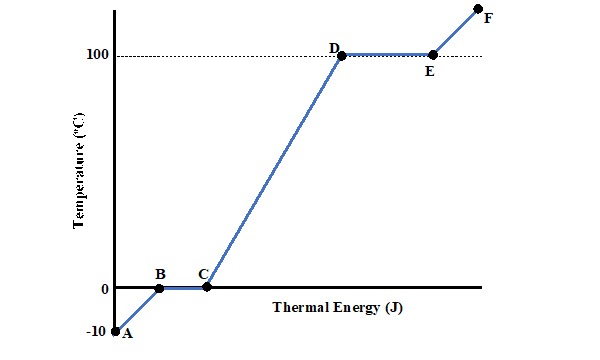
What state(s) of matter are present at D-E?
a)
Solid-liquid
b)
Liquid
c)
Liquid-gas
d)
Gas-Solid
7.

When water boils

a)

It gives off energy

b)

It absorbs energy

c)

Neither gives off nor absorbs energy

8.

When water freezes, it

a)

gives off energy

b)

absorbs energy

c)

Neither gives off nor absorbs energy

9.

Between which two points is the thermal energy increasing?

a)

A ----> B

b)

B <---- C

c)

C ----> D

d)

D ----> E

e)

E ----> F

10.

In which segment is the phase energy increasing?

a)
A-B
b)

E-F

c)

D-E

d)

C-D

11.

A measure of the average kinetic energy of the particles in an object is called

a)

Heat

b)

Temperature

c)

Kinetic energy

d)

Enthalpy

12.
2. A change of state from a liquid to a solid is called....
a)
Melting
b)
Freezing
c)
Evaporation
13.
The phase change from water vapor to liquid water is known as...
a)
evaporation
b)
precipitation
c)
condensation
d)
sublimation
14.
2. A change of state from a liquid to a solid is called....
a)
Melting
b)
Freezing
c)
Evaporation
15.
The phase change from water vapor to liquid water is known as...
a)
evaporation
b)
precipitation
c)
condensation
d)
sublimation
16.

Water molecules have the greatest kinetic energy in

a)

Ice at 0 ⁰C

b)

Water at 90 ⁰C

c)

Water at 373 K

d)

Steam at 150 ⁰C

17.

The heat absorbed by melting a solid is known as

a)

latent heat of fusion

b)

latent heat of solid

c)

latent heat of liquid

d)

latent heat of vaporisation

18.
When water is heated from 10°C to 15°C What is the change in temperature?
a)
10 °C
b)
5 °C
c)
15 °C
d)
25 °C
19.

Sweating is an ________ process because heat is released.

a)

endothermic

b)

exothermic

20.

Ice cream melting is an example of an ________ process.

a)

endothermic

b)

exothermic

21.
What happens to the energy of particles in a substance as it changes from gas, to liquid, to solid?
a)
KE decreases
b)
KE increases
c)
KE stays the same
d)
KE goes up and then goes down
22.
An ice cube feels cold when we hold it. Which of the following best explains why?
a)
Heat moves from our hands into the ice cube.
b)
Cold moves from our hands into the ice cube.
c)
Heat moves from the ice cube into our hands.
d)
Cold moves from the ice cube into our hands.
23.

What is holding molecules in a solid close to each other?

a)

Intermolecular forces

b)

Chemical Bonds

c)

Heat

d)

Cold

24.

Which of these conditions is always true for an exothermic process?

a)

They absorb energy from the surroundings

b)

They release energy into the surroundings.

25.

Which of these conditions is always true for an endothermic process?

a)

They absorb energy from the surroundings

b)

They release energy into the surroundings.

26.
What line segment represents only the solid state?
a)
A-B
b)
B-C
c)
C-D
d)
D-E
27.

When we add heat to a substance and the graph plateaus, there is no temperature change because energy is needed to

a)

It is a phase change

b)

The kinetic energy is increasing

c)

The kinetic energy is decreasing

d)

nothing happens.

28.

Between which two points is Heat of Fusion?

a)

A <----> B

b)

B <----> C

c)

C <----> D

d)

D <----> E

e)

E <----> F

29.
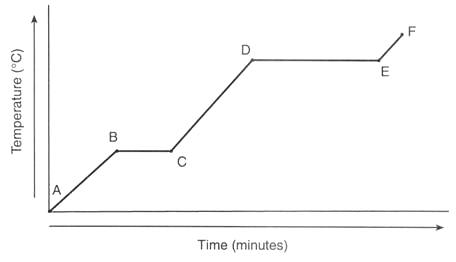
A substance's heating curve is shown in the graph.  What is its boiling point?
a)
100 C
b)
60 C
c)
80 C
d)
20 C
30.
True or false: melting and freezing occur at the same temperature!
a)
True
b)
False
c)
I don't know
31.
Between which points is the temperature of the substance increasing?
a)
A-B only. 
b)
A-B, C-D, E-F
c)
B-C only. 
d)
B-C, D-E
32.
Between which points is the temperature of the substance remaining constant?
a)
A-B only. 
b)
A-B, C-D, E-F
c)
B-C only. 
d)
B-C, D-E
33.
What line segment represents only the solid state?
a)
A-B
b)
B-C
c)
C-D
d)
D-E