
Font size
 Worksheets
Unit 4: Cell Cycle and DNA Replication
Total questions: 33
Worksheet time: 23mins
Reorder the following phases of mitosis:


Label the phases in the image shown.
cytokinesis
interphase
prophase
metaphase
anaphase
telophase

A student studying mitosis captures an image of cells from an onion root tip with a camera mounted on a microscope. Which events occur after the phase circled in the student's image?
chromosomes condense
paired chromosomes separate
the nuclear membrane disappears
chromosomes attach to spindle fibers
the cytoplasm separates into two cells
A student studying mitosis captures an image of cells from an onion root tip with a camera mounted on a microscope. Which events occur before the phase circled in the student's image?
chromosomes condense
paired chromosomes separate
the nuclear membrane disappears
chromosomes attach to spindle fibers
the cytoplasm separates into two cells
Scientists determined the total mass of DNA from a sample of animal cells. The masses of equal number of cells were taken during three different stages of the cell cycle. Stage I contains cells massed during G1 of the cell cycle.
Using the graphic below, indicate which stage is described by the statement:
"The cells have replicated their DNA, but have not completed mitosis and cytokinesis."
The model of the cell cycle includes two arrows that represent a process in the cycle.
Fill in the blanks to describe the two arrows.
Arrow 1 represents -
Arrow 2 represents -
telophase
anaphase
metaphase
mitosis
interphase
cytokinesis
prophase
Cells pass through a G2 checkpoint before entering mitosis. Ideally, if DNA damage is detected, the cells do not enter mitosis until the damage is repaired. Why is DNA damage repaired before cells enter mitosis?
So that another round of DNA synthesis does not have to take place
So that the chromosomes can align at the metaphase plate during mitosis
So that the cytoplasm can be divided equally between the two daughter cells
So that healthy daughter cells are produced, allowing the organism to continue growing
Which of these properties is found only in cancer cells?
Unregulated cell division
Regulated gene expression
Response to signals outside of the cell
Presence of mitochondria
Which of these is MOST LIKELY an indication that cells may have become cancerous?
Cells undergoing slower rates of mitosis
Cells with few or no mutations
Cells not responding to checkpoints in the cell cycle
Cells with decreased rates of protein synthesis

Normal cells have a contact inhibition feedback mechanism that prevents the cells from replicating when other cells are touched. A diagram of cells with contact inhibition and cells without contact inhibition is shown.
Which statement best describes what will happen to cells in an organism that lack contact inhibition?
The cells will continue to grow, causing a tumor in the body.
The cells will replicate normally, replacing body cells that die.
The cells will replicate until the food supply for each cell is used, causing each cell to die.
The cells will stop replicating once one layer is produced, as other body cells will crowd them out.
Cells typically respond to DNA damage in three ways: by ceasing to grow and divide until the damage is repaired, by permanently ceasing to grow and divide, or by dying. In 2010 a group of scientists reported that a certain kind of immune reaction can cause DNA damage that leads to a fourth response. DNA damage can turn off genes involved in cell-signaling pathways. Turning off these genes can cause less-mature cells to divide too rapidly, often leading to the development of —
tumors
allergies
hemophilia
cardiovascular disease
What components make up the backbone of a DNA molecule? Select 2 correct answers
purines
deoxyribose
pyrmidines
ribosomes
phosphate groups
In Texas Longhorn cattle, coat coloration is an inherited trait. What is the genetic basis of coat-color variation in Texas Longhorn cattle?
Differences in the nucleotide sequences of genes
Differences in the numbers of chromosomes in cells
Differences in the diets of individual cattle
Differences in the environmental conditions of different geographic areas
During which phase does DNA replication occur?
G1
S
G2
M
Two DNA molecules are the result of DNA replication. Which of the following is a true statement regarding DNA replication?
Each DNA
molecule has two
new strands
One of the DNA
molecules has two new strands while
the other has two original strands
Each DNA
molecule has two
original strands
Each new DNA
molecule is made
up of one new
strand and one
original strand.
A student is investigating mitosis by examining detailed pictures of the process. The student wants to observe the formation of the nuclear envelope around the chromosomes.
The student should focus on pictures of which phase of mitosis?
Prophase
Metaphase
Anaphase
Telophase
Helicase is a protein that breaks the hydrogen bonds between complementary strands of DNA to allow DNA replication to occur. What type of biomolecule contains the code for making helicase?
Carbohydrates
Lipids
Proteins
Nucleic Acids
Which of the following best describes the main purpose of the sequences of nitrogenous bases in DNA?
Gives DNA the shape needed for translation
Prevents mutations when coding for amino acids
Forming the hydrogen bonds between bases
Carries instructions for the traits of an organism
Which of the following correctly identifies the proper nitrogen base pairing in DNA replication?
A:T; G:C
T:C; G:A
T:U; C:G
A:U; G:C
The following represents a small section of one strand of DNA:
5’ TACATGTGGCCACT 3’
How should the complementary strand of DNA be represented?
5’ TACATGTGGCCACT 3’
3’ ATGTACACCGGTGA 5’
5’ UTGTUCUCCGGTGU 3’
3’ AUGUAGAGGCCUGA 5
What part of the cell cycle results in daughter cells?
Mitosis
Prophase
Cytokinesis
G2 Checkpoint
What occurs at G1?
Chromatin
condenses to form
chromosomes
Cleavage of
cytoplasm and
formation of cell
plate
Period of growth
and development
between mitotic
divisions
Nuclear membrane nucleolus, and
chromatin fade
In 1952, Rosalind Franklin took an X-ray photograph revealing the structure of DNA. James Watson and Francis Crick follwed up on this discovery in 1953. They discovered that the molecule has a shape specific to just that molecule.That shape can best be described as —
a single strand containing 4 different bases that vary depending on the type of DNA
ladder shaped, containing 5 nitrogenous bases that bond to one another
triple stranded, with bonds between each strand holding the three strands togethe
double stranded and twisted, with a base bonded to another base holding the strands together
Of the following bases, which one is not found in DNA?
Adenine
Guanine
Uracil
Thymine
A sample of human DNA is made up of approximately 30% adenine. Based on this information, and the base pairing rules, approximately how much cytosine is found in human DNA?
10%
20%
30%
70%
What are the products of photosynthesis?
water
oxygen
glucose
carbon dioxide
light energy
What are the products of cellular respiration?
water
oxygen
glucose
carbon dioxide
chemical energy

Based on the image, ______ is used as chemical energy to form ______, a source of energy for cellular processes.
(a)
What occurs inside of a cell while it performing the process of respiration?
Sugar is broken down to generate adenosine triphosphate (ATP) molecules that are used for energy.
The negative charge inside of the cell is used to increase the concentration chemicals inside of the cell.
Light reactive chemicals combine carbon dioxide (CO2) and water to form glucose molecules that are stored as food.
The cell membrane forms around air bubbles to create a vacuole that is used to separate the oxygen from the rest of the air.
What occurs inside of a cell while it performing the process of photosynthesis?
Sugar is broken down to generate adenosine triphosphate (ATP) molecules that are used for energy.
The negative charge inside of the cell is used to increase the concentration chemicals inside of the cell.
Light reactive chemicals combine carbon dioxide (CO2) and water to form glucose molecules that are stored as food.
The cell membrane forms around air bubbles to create a vacuole that is used to separate the oxygen from the rest of the air.
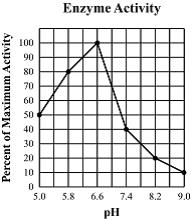
Which category of macromolecules do enzymes belong to?
Carbohydrates
Proteins
Fats/Lipids
What does an enzyme need in order to work properly?
The right amount of oxygen & CO2
The right temperature & amount of water
The right temperature & pH
The right temperature & pressure

