
 Worksheets
Solar System Unit 8 Assessment
Total questions: 16
Worksheet time: 8mins
All objects in our solar system revolve around which of the following?
faraway stars
gas giants
the moon
the sun
What is a planet?
a ball of hot, glowing gases
a ball of rock and frozen gases
a large, round body that revolves around a star in a clear orbit
a region of space where the temperature range allows life to thrive
During a visit to an observatory, Cecilia observed the moon, Venus, the sun, and the star Capella. Which of these objects is outside of our solar system?
Capella
the moon
the sun
Venus
Identify the position of the planets in relation to the sun. What is the order in distance from the sun?
Mercury, Venus, Earth, Mars, Jupiter, Saturn, Uranus, Neptune
Venus, Earth, Mercury, Mars, Neptune, Uranus, Saturn, Jupiter
Earth, Saturn, Venus, Mars, Jupiter, Neptune, Mercury, Uranus
Jupiter, Saturn, Earth, Venus, Mars, Mercury, Neptune, Uranus
Which of these characteristics applies only to inner planets?
very cold temperatures
gases surrounding a solid core
largest planets in the solar system
revolve around the sun more quickly
A student sees a small object streak across the night sky. It trails a bright stream of light behind it. Which of the solar system's objects does the student see?
moon
comet
inner planet
outer planet
Cleo is studying a planet that is made up mostly of gases. It does not have a solid surface. The planet has many moons. Which planet could Cleo be studying?
Mars
Jupiter
Venus
Mercury
Dominic is studying the solar system, and he knows the sun is a star. Why is the sun considered the center of the solar system?
It is closer to Earth than other stars.
The sun produces light and heat.
The sun is the largest object seen from Earth.
Everything in the solar system revolves around the sun
Venus and Mars are the two planets closest to Earth. Which statement about Venus and Mars is true?
They have the same number of moons.
Their orbits are the same size.
They have hard, rocky surfaces.
They have surfaces covered with water.
Desiree observed the moon through a telescope. She observed that the surface of the moon is covered with craters. Which planet shares this characteristic with the moon?
Earth
Jupiter
Mercury
Uranus
Mel is studying the outer planets. Which feature does Neptune have in common with Jupiter, Uranus, and Saturn?
irregular shape
small diameter
no atmosphere
presence of rings
Identify which of these are the planets in Earth's solar system.
Earth, Mars, Saturn, Triton, and Venus
Jupiter, Earth, Saturn, the sun, and Uranus
Venus, Comet, Earth, Mars, and the moon
Earth, Jupiter, Mars, Mercury, Neptune, Saturn, Uranus, and Venus
Which planet has a thick atmosphere, a rocky surface, and the hottest surface temperatures?
Venus
Jupiter
Saturn
Neptune
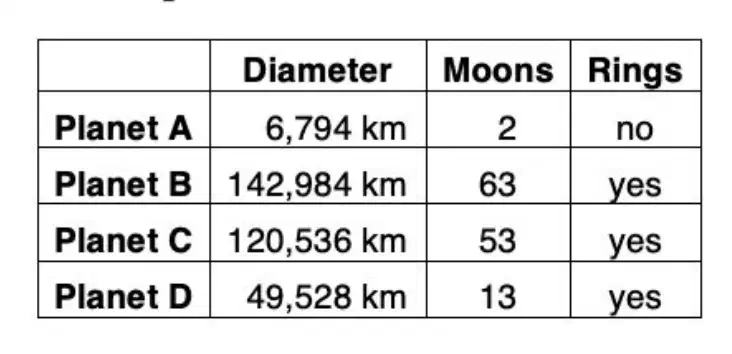
Look at the table.
Based on the data, which planet is an inner planet?
Planet A
Planet B
Planet C
Planet D
Which planet is closest to the sun?
Earth
Venus
Saturn
Mercury
Which characteristic does each planet in Earth's solar system share?
solid surface
orbits the sun
gaseous surface
orbited by the moon

