
 Worksheets
P4 - ELECTRICAL QUANTITIES - REVISION
Total questions: 41
Worksheet time: 60secs
A current of 12 A flows for 20 minutes into an electric cooker.
How much charge has the cooker used?
14400 C
280 C
100 C
0.6 C

What is the resistance in this circuit?
0.05Ω
1.8Ω
20Ω
What is the resistance of an object that draws 0.24 A when connected to a 120 volt circuit?
0.024 ohms
28.8 ohms
124 ohms
500 ohms
What is the current drawn by a 10 ohm resistor when it is connected to a 12 V car battery?
22 amperes
1.2 amperes
0.83 amperes
120 amperes
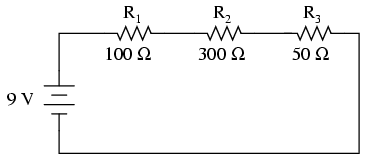
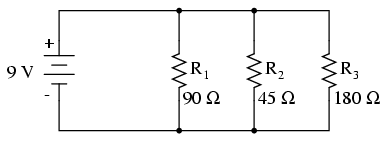
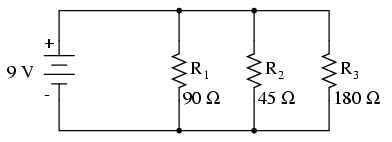

Which physical quantity is the same for both R1 and R2 if they have different resistance?
Current
Potential difference
Power
Resistance
What is the name of the Law that relates current, voltage and resistance in an electrical circuit?
Ohm's Law
Lenz's Law
Faraday's Law
Maxwell's Law

This symbol represents a ..............
valve
voltmeter
Voltage
Vacuum

This symbol represents a .............
Anode
Alternator
Amplifier
Ammeter

This symbol represents a .........
Resistor
Battery
Twix
buzzer

This symbol represents a ...........
A snapped wire
Electrical junction
Switch
L.E.D.
What is the resistance of an object that draws 0.24 A when connected to a 120 volt circuit?
0.024 ohms
28.8 ohms
124 ohms
500 ohms
Current is defined as...
work done per unit charge
rate of flow of charge
opposition to flow of charge
work done by energy source on external circuit
The unit of current is the ...
ohm
volt
coulomb
ampere
p.d. is measured using ....
an ohmeter
a voltmeter
an ammeter
a coulombmeter
Ammeters should be connected ...
in parallel
in series
in line
from + to -
Which of the following is correct?
R = IV
R = I/V
I = R/V
V = IR


A resistor converts 350J of electrical energy to other forms of energy. What is the amount of charge that flows through it when a p.d. of 7V is applied across it?
0.20 C
50 C
350 C
2450 C

A 30 Ω resistor is connected in series with another resistor and a 6.0V battery. The current in the circuit is 0.12 A. A voltmeter is connected across the other resistor. What is the reading on the voltmeter?
6.0V
9.6V
2.4V
3.6V
A small potential difference V is applied across a filament lamp. The current I in the lamp is measured. V is increased in stages and I is measured at each stage.
Which graph shows the results obtained?


In the circuit shown, the ammeter reads 2.0 A and the voltmeter reads 12 V. How much energy is transferred by the resistor in 10 seconds?
1440J
240J
14.4J
2.4J
A resistor of resistance R is connected to a battery of e.m.f. V.
There is a current I in the resistor.
Power P is dissipated by the resistor, and in time t the energy transferred is E. Which expression is correct?
P=VIR
E=IVt
E=PIt
P=V/R
The current in a lamp is 0.2 A. If the lamp is switched on for 2 hours then the total electric charge passing through the lamp is (a) C.



