
 Worksheets
Cell Membrane and Water Movement Practice
Total questions: 38
Worksheet time: 23mins
A cell membrane is:
Osmosis
Diffusion
Transpiration
Selectively Permeable
Permeable
Water enters or leaves cells by:
Osmosis
Diffusion
Transpiration
Selectively Permeable
Permeable
Oxygen enters or leaves cells by:
Osmosis
Diffusion
Transpiration
Selectively Permeable
Permeable
Water evaporates from a plant by:
Osmosis
Diffusion
Transpiration
Selectively Permeable
Permeable
Why might a plant with a huge stem system and a tiny root system have difficulty surviving?
It cannot absorb enough water and nutrients.
It will grow too quickly.
It will produce too many leaves.
It will attract too many insects.
Why are cells specialized in multicellular organisms?
To perform specific functions efficiently.
To increase the size of the organism.
To make the organism more colorful.
To reduce the need for energy.
Name the main types of specialized cells in animals.
Muscle, nerve, blood, and epithelial cells.
Root, stem, leaf, and flower cells.
Bone, cartilage, tendon, and ligament cells.
Skin, hair, nail, and gland cells.
The structure of a specialized cell is related to its function in the body of a multicellular organism.
The structure is adapted to perform its specific function.
The structure is identical to all other cells.
The structure is random and not related to function.
The structure is designed to change functions frequently.
List some advantages that multicellular organisms have over unicellular organisms.
Multicellular organisms can perform more complex functions.
Unicellular organisms have specialized cells.
Multicellular organisms are always smaller in size.
Unicellular organisms can survive in more environments.
Name the five levels of organization in a multicellular organism and give an example of each.
Cells, Tissues, Organs, Organ Systems, Organisms
Atoms, Molecules, Cells, Tissues, Organs
Cells, Organs, Organ Systems, Populations, Communities
Tissues, Organs, Organ Systems, Organisms, Ecosystems
Give two examples of systems in plants and explain their functions.
Digestive and Respiratory systems
Vascular and Root systems
Nervous and Circulatory systems
Skeletal and Muscular systems

Study the two photographs of red blood cells. One cell was part of a group of cells placed in distilled water, while the other was placed in a strong salt solution. Make an inference about which one was in which solution, giving your reasons for your inference.
Cell A is in distilled water; Cell B is in salt solution.
Cell A is in salt solution; Cell B is in distilled water.
Both cells are in distilled water.
Both cells are in salt solution.
What is the property of cell membranes that allows only certain substances to pass through while blocking others?
Permeable
Impermeable
Selectively Permeable
Diffusion
What is the movement of particles from an area of high concentration to an area of low concentration until evenly distributed called?
Osmosis
Diffusion
Transpiration
Permeability
Which type of vascular tissue in plants transports water and dissolved minerals from the roots to the stems and leaves?
Phloem Tissue
Xylem Tissue
Root Hairs
Specialized Tissues
What are tiny extensions of root cells that increase the surface area for absorbing water and nutrients from the soil?
Phloem Tissue
Xylem Tissue
Root Hairs
Specialized Tissues
What is the hierarchical structure in living organisms, organized from smallest to largest?
Tissues → Cells → Organs → Systems → Organism
Cells → Organs → Tissues → Systems → Organism
Cells → Tissues → Organs → Systems → Organism
Systems → Organs → Tissues → Cells → Organism
What is the primary function of phloem tissue in plants?
Transport water and minerals from roots to leaves.
Transport sugars and nutrients from leaves to other parts of the plant.
Absorb water and nutrients from the soil.
Provide structural support to the plant.
Which of the following is a characteristic of a selectively permeable membrane?
Blocks all substances from passing through.
Allows only water to pass through.
Allows all substances to pass through freely.
Allows only certain substances to pass through while blocking others.
What is the role of root hairs in plant roots?
To conduct photosynthesis.
To increase the surface area for water and nutrient absorption.
To transport sugars throughout the plant.
To provide structural support to the plant.
What is a manipulated variable in an experiment?
The variable that is changed or controlled to test its effects on the dependent variable.
The variable that is not involved in the experiment.
The variable that is kept constant throughout the experiment.
The variable that is measured and observed.
What is osmosis?
The movement of water molecules through a selectively permeable membrane from a region of lower solute concentration to a region of higher solute concentration.
The movement of solute particles from a region of higher concentration to a region of lower concentration.
The process of water evaporation from plant leaves.
The active transport of nutrients across a cell membrane.
Which of the following is an example of osmosis in living organisms?
Water absorption by plant roots.
Carbon dioxide entering a leaf.
Oxygen diffusing into the bloodstream.
Glucose being transported in the blood.
How does osmosis differ from diffusion?
Osmosis involves the movement of solutes, while diffusion involves the movement of water.
Osmosis requires energy, while diffusion does not.
Osmosis is the movement of water across a selectively permeable membrane, while diffusion is the movement of particles from high to low concentration.
Osmosis occurs only in plants, while diffusion occurs only in animals.

What is a reasonable prediction for this system?
Water will move across the semi-permeable membrane from side A to side B.
Water will move across the semi-permeable membrane from side B to side A.
Water will move equally in both directions.
The solute will move from side B to side A.

The cell membrane is selectively permeable.
What is the definition of selective permeability?
The ability of the cell membrane to let all substances pass into and out of the cell
The movement of substances into and out of the cell without the need for energy
The ability of the cell membrane to let only selected substances pass into and out of the cell
The movement of substances into and out of the cell using chemical energy

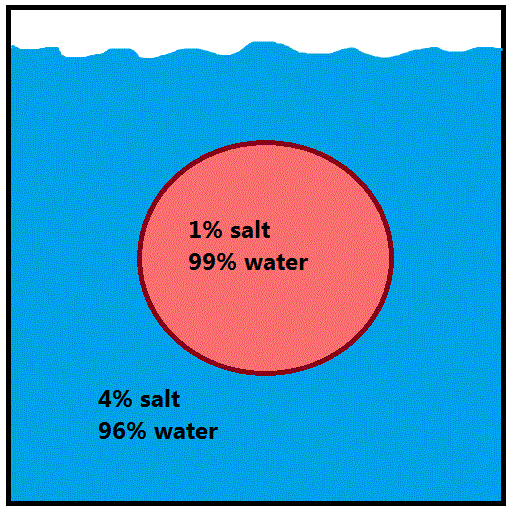
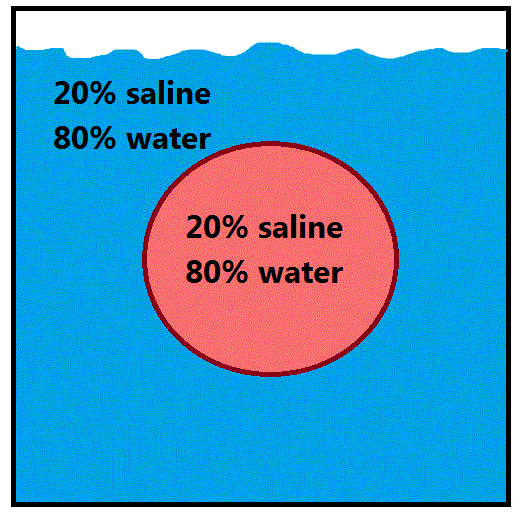
Which cell would water move out of?


If the percentage represents sugar, what direction will water flow?
Into the cell
Out of the cell
Into and out equally (equilibrium)

If the dots represent sugar which is more concentrated
Inside the cell
Outside the cell
Neither they are equal (equilibrium)
Which way will water move (net movement)
Inside the cell
Outside the cell
Equally both in and out (equilibrium)

_______ regulates what enters and leaves a cell.
Cell Membrane
Nucleus
Mitochondria
Cytoplasm

Osmosis
diffusion of water molecules through a semi-permeable mebrane from an area of low concentration to an area of high concentration
the diffusion of particles from an area of high concentration to an area of low concentration
diffusion of water molecules through a semi-permeable membrane from an area of high concentration to an area of low concentration
the diffusion of particles from an area of low concentration to an area of high concentration

Which option shows a possible consequence of this cell?


Which option shows a possible consequence of this cell?

Which option shows a possible consequence of this cell?

