wayground logo

Free Printable Worksheets

Font size

S
M
L
XL
Worksheets

Physical Science Review Exam - Physics

Total questions: 67

Worksheet time: 2hrs 14mins

Name
Class
Date
1.

A runner moves at an average speed of 3.0 m/s and covers 9.5 km. In seconds, how long did the run take?

a)

4800 sec.

b)

3200 sec

c)

3800 sec

d)

1200 sec

2.

A train with an average speed of 125 km/hr takes 2.5 h to travel between two cities. What is the approximate distance between these two cities by rail?

a)

499 km

b)

299 km

c)

312 km

d)

340 km

3.

A roller coasters accelerates from an initial velocity of 12.0 m/s to a final velocity of 90 m/s over 6 seconds.  What's the acceleration?

a)

24 ms224\ \frac{m}{s^2}

b)

18 ms218\ \frac{m}{s^2}

c)

16 ms216\ \frac{m}{s^2}

d)

13 ms213\ \frac{m}{s^2}

4.
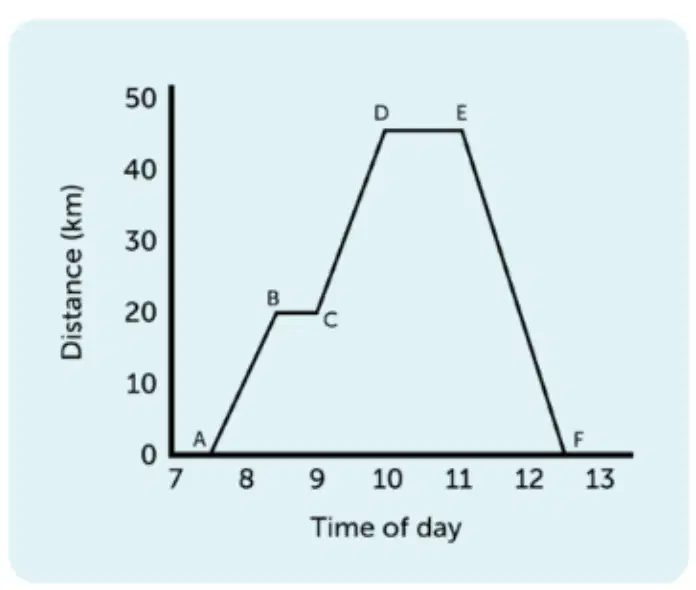
What is happening at E?
a)
Stationary
b)
Accelerating
c)
Fast steady speed; moving away from the starting position
d)
Steady speed; returning to start position
5.
What does this graph represent?
a)
Constant speed
b)
Acceleration
c)
Not moving
6.
What is the equation to calculate speed?
a)
speed = distance/time
b)
speed = time/distance
c)
speed = time x distance 
d)
speed = speed/time 
7.
What is the equation to calculate time?
a)
time = speed/distance
b)
time = distance/speed 
c)
time = speed x distance 
d)
time = distance x speed
8.
How many times does this object STOP moving?
a)
None
b)
Once
c)
Twice
d)
Three times
9.
What does this graph represent?
a)
Constant speed
b)
Acceleration
c)
Not moving
10.
If you leave your house and go for a 5 mile run, and finish at your house, what is your displacement?
a)
5 miles
b)
10 miles
c)
0 miles
d)
15 miles
11.
How long did it take this object to travel 10 m?
a)
0 s
b)
10 s
c)
15 s
d)
20 s
12.
How long did it take this object to travel back to its reference/starting point?
a)
20 s
b)
30 s
c)
60 s
d)
100 s
13.
At 60 seconds, how far had this object traveled? 
a)
0 m
b)
10 m
c)
20 m
d)
40 m
14.
The distance-time graphs shown represent the motion of a car. Which of the following graphs represents the car at constant speed?
a)
graph A
b)
graph B
c)
graph C
d)
graph D
15.
In which of the following graphs (click the image) are both runners moving at the same speed (note that graph c is the bottom right graph, and graph d is the bottom right graph)? 
a)
Graph A
b)
Graph B
c)
Graph C
d)
Graph D
16.
Which of the graphs shows that one of runners started 10 yards further ahead of the other (note that graph c is the bottom right and graph d is the bottom left)? 
a)
Graph A
b)
Graph B
c)
Graph C
d)
Graph D
17.
A plane flies due west for 4 1/2 hours.  It travels a total of 5400 km.  What was its velocity?
a)
1500 km/h
b)
1200 km/h, west
c)
400 km/h
d)
2000 km/h
18.

Which of the following systems is not accelerating

a)

A car slowing down to a stop

b)

An airplane on the runway speeding up for take off

c)

A boy on a bicycle going 10 mph

d)

A girl swinging on a swing

19.

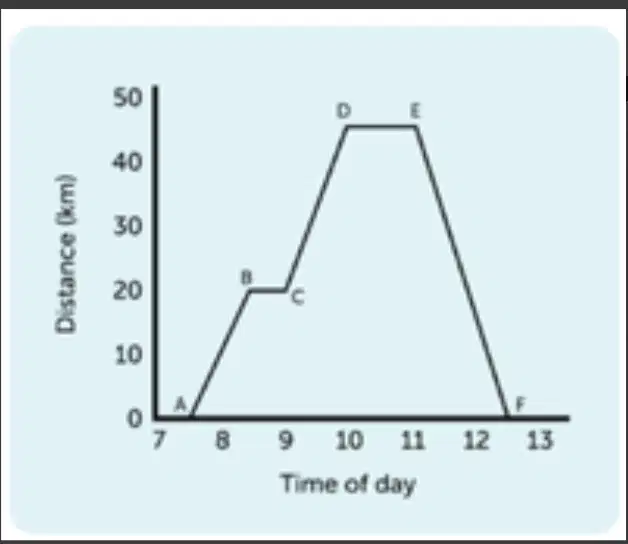
The following graph is tracked by a GoPro GPS system for a Tour de France Bicyclist. Using the graph, and the data you collected from the previous questions, when did the cyclist move the fastest?

a)

during segments a and b

b)

during segments b to c

c)

during segments c to d

d)

during segments e to f

20.

Using the following graph, what is the average speed between segments b to c?

a)

The object is traveling at 20 km/hr

b)

The object is not moving, thus it is traveling 0 km/hr

c)

The object is traveling at 25 km/hr

d)

The object is traveling at 45 km/hr

21.

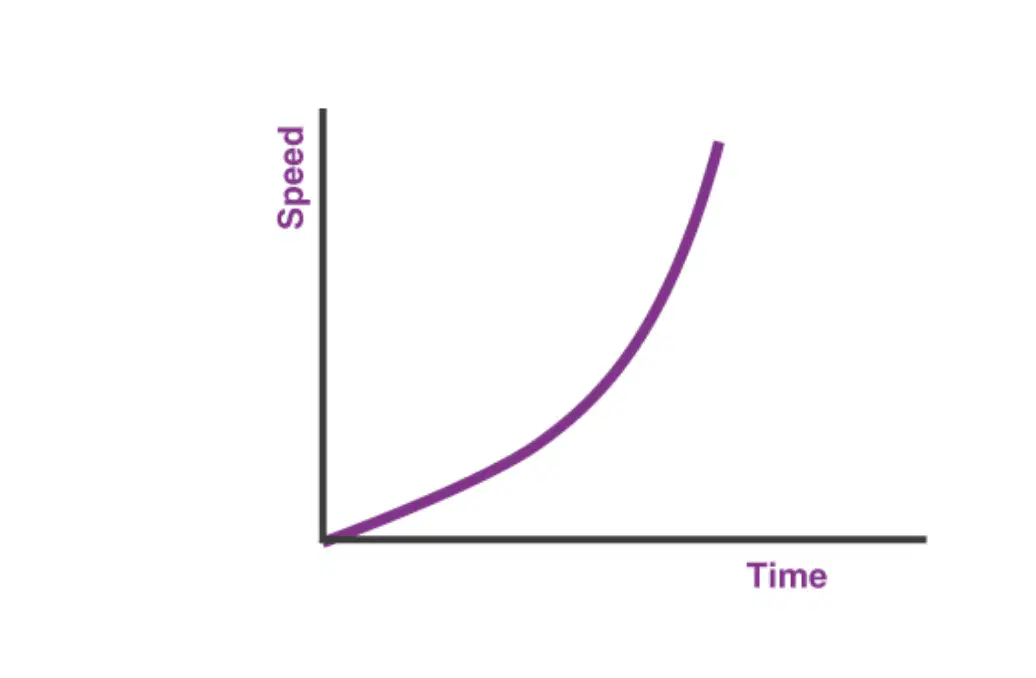
Explain what the object in motion is doing in this speed vs. time graph

a)

The object is slowing down thus is decelerating over time

b)

the object is speeding up over time so this object is increasing acceleration over time

c)

the object is maintaining the same speed within a given time interval

d)

the object is slowing down to a stop

22.
How will this object move? 
a)
It won't move. 
b)
It will move to the right. 
c)
It will move to the left. 
d)
It will move up. 
23.
The force needed to move an object depends upon:
a)
the mass of the object
b)
the volume of the object
c)
the density of the object
d)
the shape of the object
24.
If an object is accelerating, then the forces acting on it must be:
a)
balanced
b)
unbalanced
c)
increasing
d)
zero
25.
Forces that are equal in magnitude but opposite in direction are:
a)
unbalanced
b)
balanced
c)
increasing
d)
decreasing
26.
A block is pushed from four sides with forces of different magnitude, as shown in the picture. In which direction will the block move?
a)
east
b)
west
c)
north
d)
south
27.
How will this object move? 
a)
It won't move. 
b)
It will move to the right. 
c)
It will move to the left. 
d)
It will move in both directions. 
28.

Forces are scalar quantities because they have size and direction.

a)

True

b)

False

29.

Contact forces cause all observed changes in motion.

a)

True

b)

False

30.

Balanced forces cause an object, if it is in motion, to maintain its motion.

a)

True

b)

False

31.

How can you tell when the forces acting on a system are balanced?

a)

There is no motion.

b)

There is no displacement.

c)

There is no acceleration.

32.

A microscopic organism like a protozoan can exert a gravitational force.

a)

True

b)

False

33.

Which of the following is the result of a contact force?

a)

A ball thrown into the air falls down to the ground.

b)

Two magnetic compass needles repel each other.

c)

A hammer drives a nail into a piece of wood.

d)

Your hair stands on end, when you are touching a Van de Graaff generator.

34.

Which of the following fundamental forces is comparatively the weakest?

a)

the strong nuclear force

b)

the weak nuclear force

c)

the electromagnetic force

d)

the gravitational force

35.

Which of the following is the result of a force field?

a)

An apple press squeezes out apple cider.

b)

An airplane is jostled around because of wind shear.

c)

Girls win against boys in tug-of-war.

d)

When you jump into the air, you land on the ground.

36.

A soccer ball is sitting in the middle of a field. The ball will remain at rest until an outside force like a players foot or the wind acts upon it. Which of Newton's laws is represented by this?

a)

1st

b)

2nd

c)

3rd

37.
Oil between machine parts would be an example of which type of friction?
a)
static
b)
sliding
c)
fluid
d)
rolling
38.
When does the pendulum have maximum Kinetic Energy (Use the First Image to the Left!!!!)?
a)
A
b)
D
c)
F
d)
G
39.
When does the pendulum have maximum Gravitational Potential Energy (Use the First Image to the Left!!!!)?
a)
A
b)
Both A and G
c)
F
d)
G
40.
At which point does the roller coaster have maximum kinetic energy?
a)
1
b)
2
c)
3
d)
4
41.
At which point does the roller coaster have the greatest gravitational potential energy (GPE)?
a)
1
b)
2
c)
3
d)
4
42.
If I throw a baseball across the room, did I do work on the baseball?
a)
Yes - Work = Force x Distance, thus you performed work on the baseball, and transferred your mechanical energy to the baseball
b)
No, even though work = force x distance, there was no energy transfer through the ball. This is because the ball cannot receive energy like other working systems.
43.
What is elastic potential energy?
a)
Energy that results from the position or shape of an object
b)
Potential energy related to an object's height
c)
The energy associated with objects that can be compressed or stretched.  
44.
What is gravitational potential energy 
a)
Potential energy related to an object's height 
b)
Energy that results from the position or shape of an object
c)
The energy associated with objects that can be compressed or stretched.  
45.

What are the moving particles that move to create an electrical current?

a)

Protons

b)

Neutrons

c)

Atoms

d)

Electrons

46.

Which particle is NEGATIVELY charged?

a)

A - electron

b)

B - Neutron

c)

C - Proton

47.

If you walk across a floor and scuff electrons from your feet to the floor, are you more negatively or positively charged

a)

Positively Charged

b)

Negatively Charged

48.

The energy being used is __________ and it is producing _______ energy.

a)

Electrical energy to sound energy.

b)

Electrical energy to mechanical energy.

c)

Sound energy to electrical energy.

d)

Sound energy to light energy.

49.

What type of circuit is this?

a)

Series Circuit

b)

Parallel Circuit

50.

What type of circuit is this?

a)

series circuit

b)

parallel circuit

51.

A path along which electric charges can flow

a)

Series Circuit

b)

Parallel Circuit

c)

Circuit

d)

Conductor

52.

Match the following

a)
1.

Insulator

b)
2.

power source

c)
3.

conductor

d)
4.

Output Device

e)
5.

Switch

53.
Waves move ___ through vibrations
a)
Energy
b)
Matter
c)
Mass
d)
Weight
54.
Longitudinal waves are ______.
a)
Parallel
b)
Perpendicular
c)
Crazy
55.
Transverse waves are ___.
a)
Parallel
b)
Perpendicular
c)
Weird
56.

The highest point on a wave is:

a)

the crest

b)

the trough

c)

the top

d)

the coast

57.
What kind of wave is pictured below?
a)
compressional wave
b)
transverse wave
c)
sound wave
d)
mechanical wave
58.

You can't hear sounds in outer space because there is no

a)

medium

b)

light

c)

energy

d)

heat

59.
Which part of the wave is shown at letter E?
a)
trough
b)
crest
c)
resting point
d)
amplitude
60.

A 6-meter rope is tied to a hook in the wall. Which of the following wavelengths can produce a standing wave?

a)

1.5 m

b)

2.5 m

c)

3.5 m

d)

4.5 m

61.

What is the wavelength of an earthquake wave if it has a speed of 5 km/s and a frequency of 10 Hz?

(a)  

62.

A motorboat is tied to a dock with its motor running. The spinning propeller makes a surface wave in the water with a frequency of 4 Hz and a wavelength of 0.1 m. What is the speed of the wave?

(a)  

63.

A wave on a rope has a wavelength of 2.0 m and a frequency of 2.0 Hz. What is the speed of the wave?

(a)  

64.

One end of a rope is vibrated to produce a wave with a wavelength of 0.25 meter. The frequency of the wave is 3.0 hertz. What is the speed of the wave? DON'T FORGET THE UNITS

(a)  

65.

Which wave property increases as the energy of a wave increases?

a)

period

b)

frequency

c)

wavelength

d)

amplitude

66.

What is the speed of an earthquake wave if it has a wavelength of 2.3 km and a frequency of 3 Hz

a)

6.9 km

b)

5.3 km

c)

6.0 km

d)

1.3 km

67.

While wading in shallow waters, six waves crash into your legs in a 24-second span. What is the frequency of the waves

a)

4 Hz

b)

18 Hz

c)

0.25 Hz

d)

2 Hz