
 Worksheets
Health Science Core: Body Structure- Intro to Anatomy
Total questions: 59
Worksheet time: 30mins
Why is anatomy important?
Helps us understand how the brain works
Helps us understand how our muscles and bones work together
Helps us understand how our body keeps us healthy
Helps us understand how medicine works
Anatomy is the study of ___________________.
The study of the body (both inside and out)
The study of how oxygen passes through the blood
The study of the muscles
The study of bones and the nerves
Frontal means ______; Mental means _____
Chin; forehead
Forehead; Chin
Eyes; Chin
Chin; brain
The posterior body cavity contains:
Thoracic and Abdominal
Thoracic and Spinal
Pelvic, Abdominal, and Thoracic
Spinal and Cranial
Which of the following is not a quadrant?
Upper left
Upper Right
Lower Left
Middle
Which cavity contains the brain?
Oral
Cranial
Orbital
Abdominopelvic
The foot is ______ to the ankle.
Lateral
Posterior
Superior
Inferior
Transverse planes divide
into right v left
into top v bottom
into unsymmetrical parts
into front v back
Anatomy means:
the study of the form of all living things
the study of the body
the study of how living things work
None of the above
What body position is considered the “starting point” for describing body positions?
SOFT Planes
Anatomical Position
Quadrants
Cavities
Sagittal Planes divide the body
into right v left
into front v back
into unsymmetrical parts
into top v bottom


In multicellular organisms, cells are organized
into groups that work together to perform a
specific function. What are those groups of
cells called?
Systems
Bones
Tissues
Joints

Organisms that are made up of a single cell.
Humans
Flowers
Multicellular Organism
Unicellular Organism
Group of organs with similar functions.
Cell
Tissue
Organ
Organ System

Group of tissues with similar functions.
Cells
Tissues
Organs
Organ Systems

Group of cells with similar functions.
Cells
Tissues
Organs
Organ Systems

This is an example of ...
Organ
Organ system
Tissue
Cell
Cells that can carry messages to and from your brain.
Blood Cells
Neurons
Skin Cells
Epithelial Cells
A group of similar cells that perform the same function.
organelle
tissue
cells
organ system

What type of plane is shown in #3?
midsagittal plane
sagittal plane
frontal plane
transverse plane
What type of plane is shown in #1?
midsagittal plane
sagittal plane
frontal plane
transverse plane

What type of plane is shown in this image?
midsagittal plane
sagittal plane
frontal plane
transverse plane
What type of plane is shown in #2?
midsagittal plane
sagittal plane
frontal plane
transverse plane

What direction is the arrow pointing?
Inferior
Proximal
Superior
Superficial

What direction is the arrow pointing?
Inferior
Proximal
Superior
Superficial

What direction are the arrows pointing?
Deep
Medial
Lateral
Distal

What direction are the arrows pointing?
Deep
Medial
Lateral
Distal
the transverse plane
is a horizontal plane that divides the body into superior (upper) and inferior (lower) portions
refers to the back of the organ or body
means toward the lower part of the body
The ________ plane divides the body into anterior (front) and posterior (back), also known as the coronal plane
superior
proximal
frontal
The midsagittal plane is
a horizontal plane that divides the body into superior (upper) and inferior (lower) portions
also known as the "midline" and it divides the body into equal left and right halves
referring to the front of the body
Posterior
behind
in front
away from midline
further from trunk
Inferior
in front
above
below
behind
Deep
Above
Below
Toward Surface
Toward Core (internal)
_______ means towards the side of the body.
distal
proximal
medial
lateral
Which structure is most medial?
nose
ears
heart
femur

This plane divides the body into superior and inferior parts.
coronal plane
frontal plane
transverse plane
sagittal plane

What plane is shown?
Coronal (Frontal) Plane
Sagittal (Vertical) Plane
Transverse (Horizontal) Plane
Oblique Plane

What plane is shown?
Coronal (Frontal) Plane
Sagittal (Vertical) Plane
Transverse (Horizontal) Plane
Oblique Plane

What plane is shown?
Coronal (Frontal) Plane
Sagittal (Vertical) Plane
Transverse (Horizontal) Plane
Oblique Plane
away from the surface of the body
superficial
deep
medial
lateral
toward the surface
superficial
deep
medial
lateral
Away from the head.
Inferior
Lateral
Deep
Distal
Closer to the head.
Anterior
Proximal
Superior
Medial
The little toe is _______ to the big toe.
Medial
Distal
Superior
Lateral
The big toe is ______ to the little toe
Medial
Distal
Superior
Lateral
The auxiliary region is ______ to the hip
Medial
Distal
Superior
Lateral
The arm is ______ to the hand
Medial
Distal
Proximal
Lateral
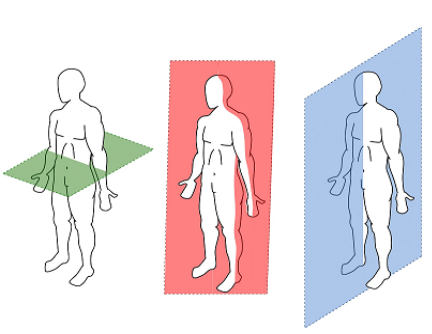
Divides the body into front and back portions.
Sagittal
Frontal
Transverse
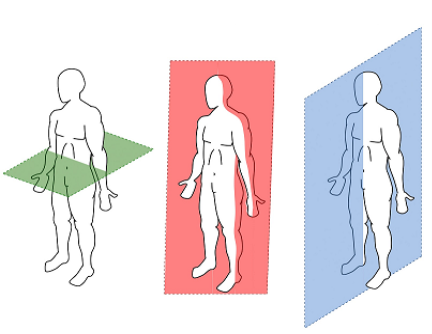
Divides the body into left and right portions.
Frontal
Transverse
Sagittal.

What body plane is this?
Transverse
Midsagittal
Coronal
Air

