
 Worksheets
IB ESS Unit 2 Ecosystem and Energy Flow
Total questions: 144
Worksheet time: 4hrs 45mins
A fungi absorbs nutrients from dead and decaying organisms. It is ......
A heterotroph
An autotroph
A chemotroph
none of these
An autotroph can also be called a
animal.
consumer.
heterotroph.
producer.
Which of the following heterotrophs are help keep the ecosystem alive by recycling nutrients between dead and living organisms?
Carnivores
Omnivores
Decomposers/ Detritvores
Herbivores
A difference between photosynthesis and chemosynthesis
Photosynthesis doesn't use light and chemosynthesis does
Photosynthesis makes sugar and chemosynthesis doesn't
Photosynthesis uses light and chemosynthesis doesn't
Photosynthesis doesn't make sugar and chemosynthesis does
in an energy pyramid, which way does the energy transfer?
from top of the pyramid to the bottom
from the bottom of the pyramid to the top
all of these
none of these

100%
10%
50%
75%

if birds eat insects that feed on corns, discuss which pyramid level would birds occupy.
A
B
C
D

Look at the above energy pyramid, if the producers have 7000 kcal of energy, how much energy will be available for the sheephead fish?
7 kcal
70 kcal
700 kcal
7000 kcal

The arrows in a food chain or web represents what?
They point to the organism that is being eaten.
It shows how sunlight flows within an ecosystem.
They show the direction the energy is flowing between organisms.
They represent how water is transferred within a habitat.


If only 10% of the energy in the pyramid is available as you move from one trophic level to the next, what happens to the other 90%?
Passed on to decomposers
Metabolized and "lost" as heat energy and waste
Assembled into tissues of producers permanently
False statement - 100% of the energy is available

If the average Bluefin Tun weighs 20 pounds, how many pounds of secondary consumers are needed in the third trophic level to support it?
20 pounds
200 pounds
2,000 pounds
20,000 pounds
What does the first law of thermodynamics state?
That energy can not be created or destroyed, only transformed
That energy is a form of work
That energy is able to be created and destroyed
That energy is heat
What does the second law of thermodynamics state?
That entropy (disorder) always increases.
That entropy (disorder) decreases
That entropy is heat
That entropy is order
Why is 10% of energy lost to the environment as it goes up a trophic level?
Remember this energy is lost not destroyed (per the 1st law of thermodynamics)
Because the animals are lazy and leave 10% of their food behind
Because energy is lost as heat.
Because decomposers generate energy

Which of these organisms are in a trophic level that receives a larger percentage of the energy captured by the producers than the percentage received at the bat’s trophic level?
Mountain Lions
Snakes
Hawks
Ground Squirrels

Identify and explain ONE effect that the removal of mice would have on the food web. Review the food web carefully. Then, answer your explanation in the box provided.

An arctic food web is shown. Suppose that the lemming population is removed from the web. Which of the following would be a likely short-term effect of this change?
The arctic fox population will increase.
The polar bear population will increase.
The caribou population will decrease.
The snowy owl population will decrease.

A team of ecologists observed feeding patterns of several populations in the desert. Which of the following best explains the difference in the amount of available energy in the trophic levels of the desert ecosystem?
There is less energy in the producers because they are at the bottom.
There is more energy in the producers because they provide energy for all the consumers in the ecosystem.
There is more energy available in the tertiary consumers because they need the energy to hunt.
There is more energy in the level containing the top predators because they are larger in size.
Read the following passage to answer the question that follows.
Ducks and snails often eat grass and algae in freshwater ponds. The snails are eaten by mice and ducks. Foxes prefer to eat mice but will eat a duck if the opportunity arises.
Which of the following food chains correctly represents the information in the passage?
snails --> algae --> mice --> fox
fox --> ducks --> mice --> algae
grass --> snails --> mice --> fox
fox --> duck


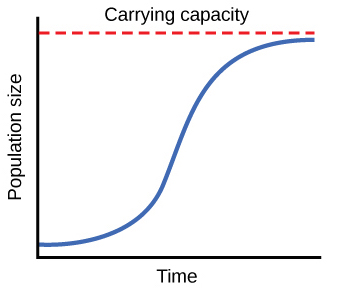
What point on the graph represents the carrying capacity?
A
B
C
D
A population is...
All members of one species in one area
All members of all species that live in one area
All of the living and nonliving things in an area
None of these

What is happening at the 'A' on the graph?
the population overshoots above the carrying capacity
the population stops growing
growth begins to slow down due to limited resources
growth is speeding up due to an abundance of resources

Two male Giraffes are fighting over the last green leaf of a tree that is dying.
Intraspecific Competition
Mutualsim
Predation
Commensalism
Interspecific Competition
Population increases at a constant rate over time.
Exponential Growth
Logistic Growth
Stable Growth
Strategic Growth

Bird & Tree: A bird builds a nest in a hole in the trunk of the tree. It is protected from the rain and predators. The tree is not harmed or helped by the bird.
Mutualism
Commensalism
Parasitism
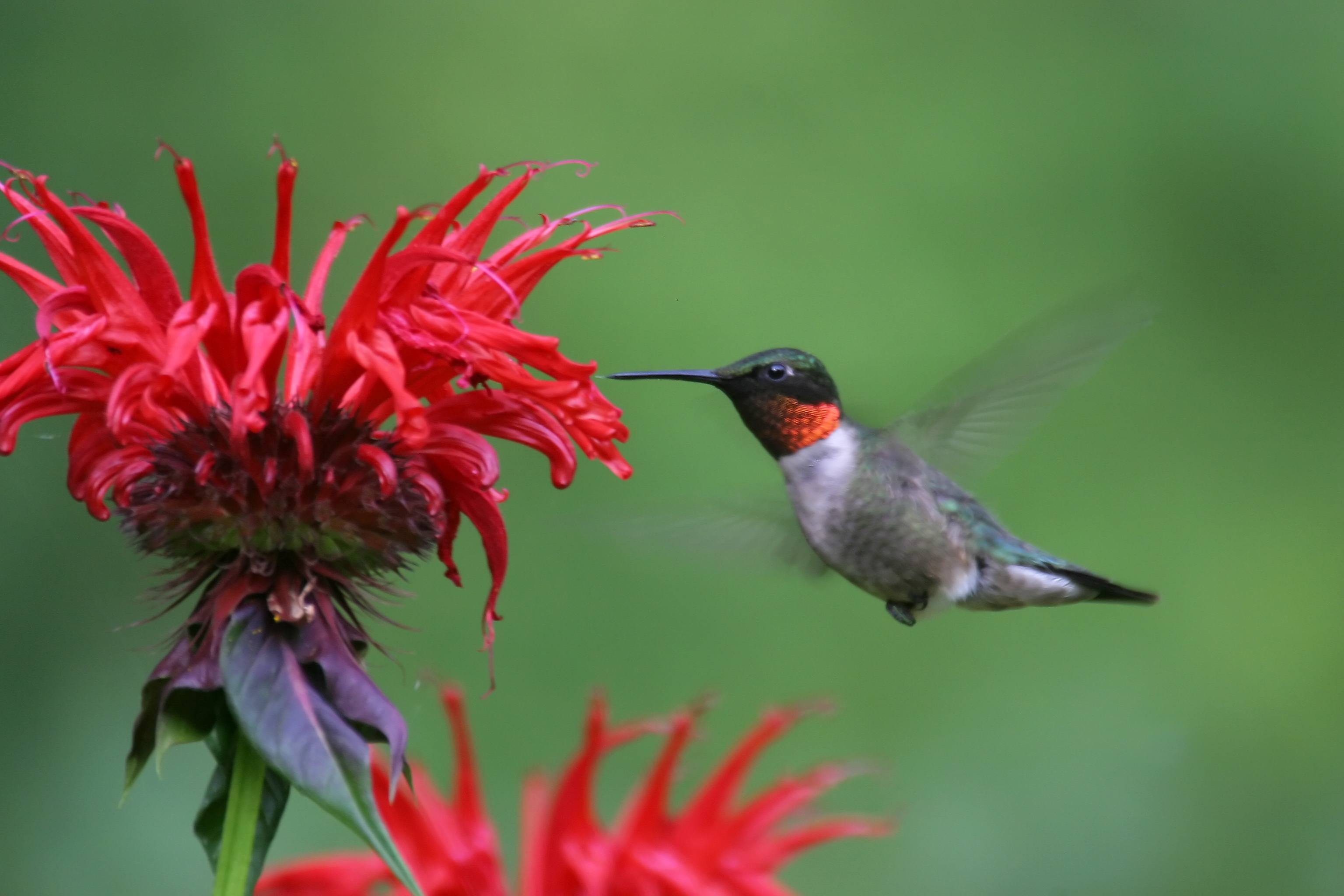

Which statement best describes the relationship between species A and B?
Species A is the prey of Species B
Species A is a parasite of Species B
Species A is a consumer and B is a producer
Species A and B has a mutualistic relationship

The BEST example of a population is
groups of different species living in a specific place and potentially interacting with each other
rabbits upon whom bobcats prey
a community of different species interacting with each other and their nonliving environment
a group of cats known as Felis concolor living and interbreeding in one area at the same time
Solar energy flowing to the earth does all of the following EXCEPT
a. evaporate water
b. warm the atmosphere
c. generate winds
d. promote cellular respiration
Which of the following is a correctly diagrammed food chain?
a. Apple tree → worm → salmon → mayfly
b. Algae → filter-feeding clam → octopus → shark
c. Crocodile → antelope → lion → vulture
d. Hawk → snake → mouse → grass

Consider the food chain in the picture:
Using the 10% rule, how many calories of corn will be needed to support a snake that consumes 200 calories of lizard biomass per feeding?
a. 20,000 calories
b. 2000 calories
c. 200,000 calories
d. 20 calories
The rate at which producers in an ecosystem convert solar energy into chemical energy is called
a. range of tolerance
b. gross primary productivity
c. energy flow
d. biological diversity
Generalized pyramid energy flow has only a 10% efficiency because 90% of the energy is lost to the environment as heat. This phenomenon is explained by
a. the second law of thermodynamics
b. the law of limiting factors
c. the law of conservation of matter
d. the greenhouse effect

What is the percent change in striped bass catch at Lake Sagamore from 1994 to 1999?
500%
50%
100%
200%


A Density Independent Limiting Factor is a limiting factor of a population that can affect population growth no matter what the population density. What is a density independent limiting factor that can affect the human population growth of North Carolina?
disease
hurricanes
food supply
water supply

Describe the first law of thermodynamics...
Energy trends toward a less-organized state over time.
Energy is not created, nor is it destroyed. It changes forms.
Matter is neither created nor destroyed.
Energy always moves in the same direction.
This process converts carbon dioxide into glucose by using energy from sunlight...
chemosynthesis
photosynthesis
cellular respiration
aerobic respiration
Which of the following are INPUTS for photosynthesis?
CO2
H2O
C6H12O6
O2


What type of growth is shown with an "S"- shaped curve?
Carrying Capacity
Exponential Growth
Long Term Growth
Logistic Growth
What type of symbiotic relationship is indicated when one organism benefits and the other is neither helped nor harmed?
Predation
Parasitism
Competition
Commensalism
The sum total of the organism's use of abiotic/biotic resources in the environment - or the organism's role.
Niche
Mimicry
Diversity
Succession
The total primary production, or the amount of light energy converted to chemical energy, of an ecosystem is known as:
Net primary production (NPP)
Gross primary production (GPP)
Respiration
Cultivated production
A forest has a GPP of 10 kilograms C/m^2/year and the rate of cellular respiration is 4.5 kilograms C/m^2/year. What is the NPP?
14.5 kg C/m^2/year
5.5 kg C/m^2/year
10 kg C/m^2/year
4.5 kg C/m^2/year
6.5 kg C/m^2/year
Choose the correct sequence for energy flow within an ecosystem
Herbivores --> producers --> carnivores --> scavengers
Producers --> herbivores--> carnivores --> scavengers
Producers --> carnivores --> herbivores--> carnivores
Scavengers--> carnivores --> herbivores--> producers


An ecosystem is...
The food web in an area
The populations in an area
The living and non-living things interacting in an area
The organisms interacting in an area
Which value is always the largest?
GPP
NPP
Respiration
Photosynthesis
The total range of physical, chemical, and biological factors a species can utilise or survive under ideal conditions is known as
realised niche.
fundamental niche.
habitat niche.
hypervolume niche.
Which is the correct equation to calculate NPP and GPP?
NPP = GPP + energy loss
NPP = GPP - energy loss
GPP = NPP + energy loss
GPP = NPP - energy loss
Which of the pyramids below shows the relationship of the amount of organic material produced found at different trophic levels?
Number pyramid.
Energy pyramid.
Trophic pyramid.
Biomass pyramid.
Which of the following curves shows "boom and bust"?
S growth curve
J growth curve
NPP off the coast of California is 250g C/m2/year. Approximately 115g C/m2/year is lost through respiration. What is the GPP?
135
365
2.17
300
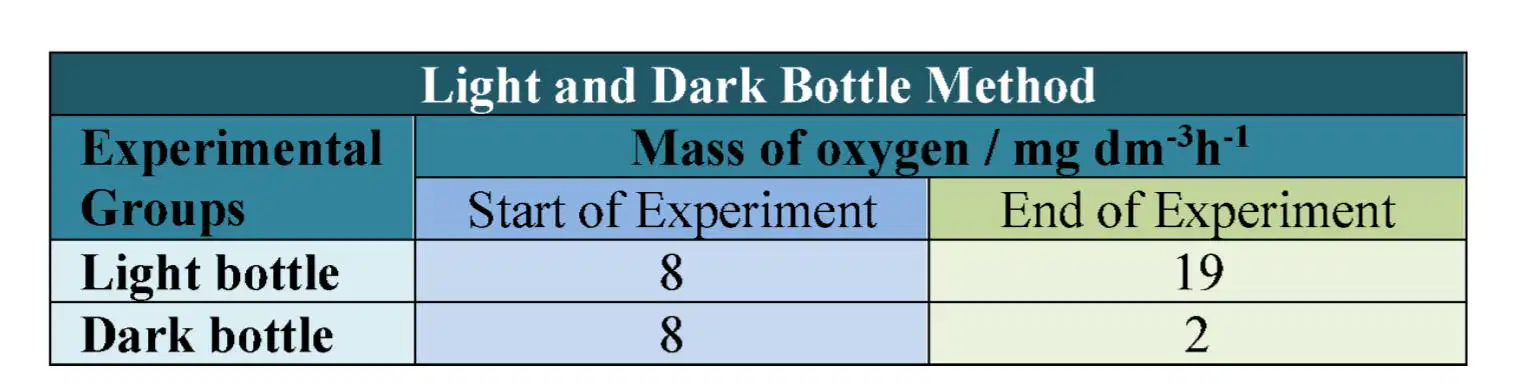
In the light and dark bottle method of measuring Productivity, the following results were produced. Calculate the respiration based on the data.
2mg O2 dm-3h-1
11mg O2 dm-3h-1
17mg O2 dm-3h-1
6mg O2 dm-3h-1
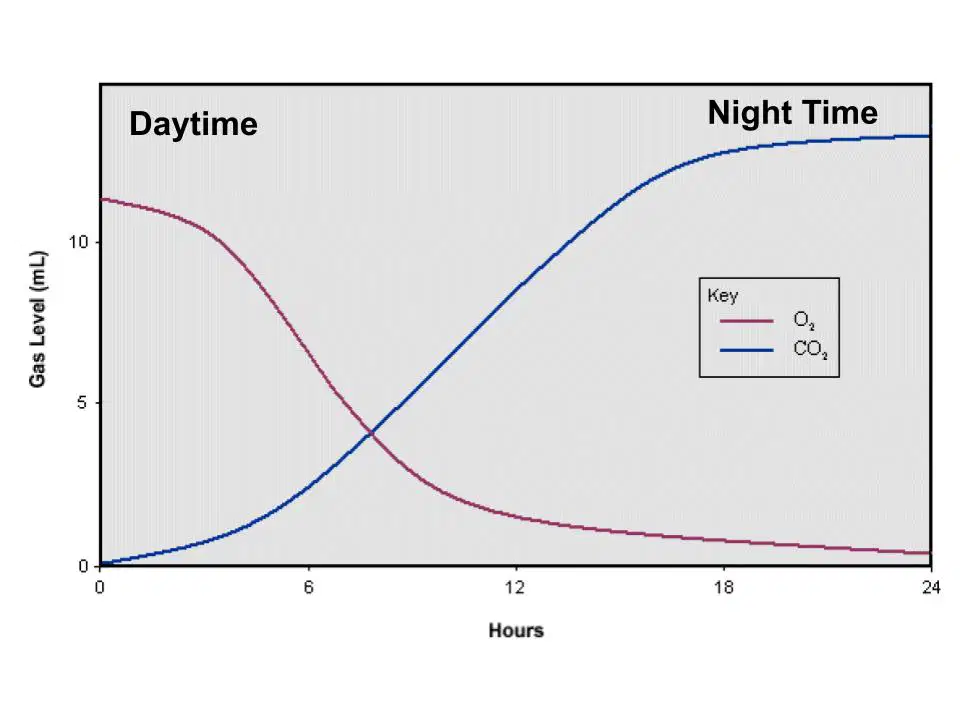
Explain the difference in oxygen and carbon dioxide levels between daytime and night time in this graph.
carbon dioxide will decrease at night without photosynthesis.
Carbon dioxide will decrease during the day due to photosynthesis.
Oxygen will increase at night due to more photosynthesis
Measuring productivity by monitoring changes in biomass is limited because
It does not account for the biomass consumed by herbivores.
biomass is added through photosynthesis in primary producers.
biomass is not easily measured or estimated.
biomass is not related to productivity
Which best describes the concept of gross primary production?
Total amount of energy available to primary consumers
Total amount of energy available from the Sun
Total amount of solar energy that producers capture via photosynthesis
Total amount of energy available within an ecosystem
Total amount of cellular respiration conducted within an ecosystem
A wetland ecosystem has an NPP of 1.02 kg C/m2/year and a GPP of 2.80 kg C/m2/year. How much carbon is being used during respiration of producers?
3.82 kg C/m2/year
1.76 kg C/m2/year
1.78 kg C/m2/year
2.86 kg C/m2/year
2.75 kg C/m2/year
Looking at an ecological pyramid , what would be the most likely number of joules to fill in x, y, and z? X being the top of the pyramid and Z being the bottom
x =100; y =1000; z =10,000
x =1; y=500; z =10,000
x =50; y=50,000; z =500,000
x =10,000; y =1000; z =10


How many kcal will become incorporated in the tissues of the tertiary consumers?
A forest has a GPP of 10 kilograms C/m^2/year and the rate of cellular respiration is 4.5 kilograms C/m^2/year. What is the NPP?
14.5 kg C/m^2/year
5.5 kg C/m^2/year
10 kg C/m^2/year
4.5 kg C/m^2/year
6.5 kg C/m^2/year


What is the carrying capacity mean?
The number of individuals an area can carry
the number of births
The number of deaths an area has
not sure


What percentage of incoming solar radiation is absorbed at the earth's surface?
100%
75%
50%
2%
Which of the following statements defines productivity?
The mass of living organisms in a given area expressed as dry weight of mass per unit of area or g m–2.
The conversion of energy into biomass in a given time expressed as J m-2 yr-1.
The total amount of stuff made.
What is left over after losses.

Using the graph below which statement is correct.
Swamps and marshes, estuaries and tropical rainforests have an NPP of 9,000 kilocalories m-2 yr-1.
Boreal and deciduous temperate forests have a NPP range of 3,500 - 6,000 kilocalories m-2 yr-1.
Grasslands have an NPP of 2,000 kilocalories m-2 yr-1.
All of the responses are correct.
Which of the following statements defines a pyramid of productivity?
A graphical representation of the amount of energy that is generated and available as food for the next trophic level. Expressed as a whole number.
A graphical representation of the amount of energy that is generated and available as food for the next trophic level. Expressed as J m-2 yr-1.
A graphical representation of the amount of energy that is generated and available as food for the next trophic level. Expressed as J m-2.
All of the statements given here can be used to define a pyramid of productivity.
The length of food chains is restricted because the amount of sunlight entering the ecosystem is limited. Answer true or false.
true
False
What causes the length of food chains to be restricted?
the biomass is taken up in skeletal formation
10% of the energy fixed at one trophic level is available for the next trophic level
because the amount of sunlight entering the ecosystem is limited.
much smaller organisms at the base of the chain
What do you call the process in which there is an increase in the concentration of a pollutant in an organism as it absorbs or ingests it from its environment.
Bioaccumulation
Biology
Biomagnification
Biodiversity
Which of the following statement(s) is an accurate fact about DDT?
DDT is a POP.
It is fat soluble and therefore does not leave the body through urination or sweating.
DDT has a half life of 15 years.
All these statements are facts about DDT.
What do you call the increase in the concentration of the pollutant as it moves up through the food chain
Bioaccumulation
Biology
Biomagnification
Biodiversity
What is primary productivity?
The rate at which solar energy is transformed into organic compounds
The rate at which plants grow
The rate at which animals consume plants
The rate at which sunlight is reflected off plants
What does ecological efficiency refer to?
The portion of sunlight captured by plants and converted into biomass
The portion of sunlight reflected off plants
The portion of sunlight that passes through plants without being captured
The portion of sunlight used by plants for cellular respiration
Which factor contributes to high net primary productivity?
Low temperature
Low nutrient availability
Low water availability
High nutrient availability
What is the relationship between primary productivity and biodiversity?
Higher primary productivity leads to lower biodiversity
Higher primary productivity leads to higher biodiversity
Primary productivity and biodiversity are unrelated
Biodiversity has no impact on primary productivity
If gross primary productivity in a wetland is 3 kg C/m^2/year and respiration is 1.5 kg C/m^2/year, what is the net primary productivity of the wetland?
Impossible to determine from the given information
3 kg C/m^2/year
1.5 kg C/m^2/year
2 kg C/m^2/year
4.5 kg C/m^2/year
If the first trophic level has 1,500 energy units how much energy will be available to organisms in the second trophic level?
(a)
Pyramid of biomass- model that illustrates the relative amount of living (a) matter in each trophic level of an ecosystem
Pyramid of numbers- model that shows the relative number of individual (a) at each trophic level in an ecosystem
1. Why is it unusual for a large number of organisms to be present at the top of an ecological pyramid?
A. Animals at the top of the pyramid are the largest.
B. Animals at the top have shorter lives.
C. The amount of energy available by the time the top of the pyramid is reached is not enough to sustain many individuals.
D. Humans are most interested in hunting animals occupying the top level of the ecological pyramid.
Think and suggest one disadvantage that comes to your mind of the biomass pyramids.

Which kind of a pyramid of numbers does this figure seem to represent?
inverted
partially inverted
upright

A
B
C
D

A
B
C
D

A
B
C
D

A
B
C
D

A
B
C
D

A
B
C
D

A
B
C
D

A
B
C
D
What does a pyramid of numbers compare?
the number of individual organisms at each trophic level
the number of individuals in each population
the number of predators and prey in an ecosystem
the number of different populations at each trophic level
Why might a pyramid of numbers be inverted?
because there is far more predators than prey
because there are more primary carnivores than secondary carnivores
because there are more herbivores than producers
because there are more secondary carnivores than producers
Which of the following examples would result in an inversion of a pyramid of numbers?
a tree with thousands of spiders
a forest of trees with a small herd of deer
a tree with a spotted owl
a forest of trees with a pack of wolves
What is biomass?
the total dry weight of organisms in an ecosystem
the total weight of organisms in an ecosystem
the total dry weight of producers in an ecosystem
the total weight of animals in an ecosystem
What type of ecological pyramid is never inverted?
ecological pyramid
energy pyramid
numbers pyramid
biomass pyramid
Which of the following would result in an inverted biomass pyramid?
A grassland ecosystem with a small number of herbivores
A lush rainforest with hundreds of herbivores
A marine ecosystem with more zooplankton than phytoplankton
A swamp ecosystem with hundreds of frogs
Why are energy pyramids never inverted?
because energy is always lost from one trophic level to the next
because energy is always gained from one trophic level to the next
because energy cannot be measured as it transfers from one trophic level to the next
because it just never is
What does an energy pyramid compare?
the total amount of energy retained in each trophic level
the total amount of energy produced by each trophic level
the total amount of energy used in each trophic level
the total amount of energy lost in each trophic level

In the ecological pyramids above, which type(s) of pyramid provides an example with an inversion?
pyramid of numbers only
pyramid of numbers and of energy
pyramid of numbers and of biomass
all of them

What is biomass?
the total dry weight of organisms in an ecosystem
the total volume of organisms in an ecosystem
the total dry weight of producers in an ecosystem
the total volume of animals in an ecosystem

What type of organisms could box J contain?
herbivores
decomposers
carnivores
producers
What type of organisms could box K contain?
herbivores
decomposers
carnivores
producers

What are the "producers" levels in the two pyramids most likely referring to?
different ecosystems, the numbers are different
the same ecosystem, looking whole verses parts of the producer
the same ecosystem, during different times
there is no correct answer, not enough information is given

What can you infer about the biomass of the herbivores verses the autotrophs in this ecosystem?
There are more autotrophs than herbivores
There are more herbivores than autotrophs
The dry weight of the herbivores is greater than that of the autotrophs
The dry weight of the autotrophs is greater than that of the herbivores

Ecological pyramids show the feeding relationships between the groups of organisms. Which of the following correctly names the ecological pyramids in this diagram?
A: pyramid of productivity
B: pyramid of numbers
C: pyramid of productivity
A: pyramid of biomass
B: pyramid of productivity
C: pyramid of numbers
A: pyramid of numbers
B: pyramid of biomass
C: pyramid of productivity
A: pyramid of productivity
B: pyramid of biomass
C: pyramid of numbers

In this diagram which one is biomagnification. Answer A or B
(a)

