
 Worksheets
Unit 5 Test: Genetics
Total questions: 12
Worksheet time: 6mins
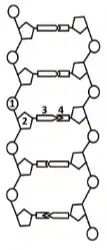
Elijah, Aiden, and Anika are studying the structure of a DNA molecule for their biology project. They labeled four parts of the DNA molecule. What can they infer about the bonds between part 1 and 2 versus the bonds between part 3 and 4?
The bonds between part 3 and 4 are weaker because they are held by hydrogen bonds
The bonds between part 1 and 2 are weaker because they are held by covalent bonds
The bonds between part 1 and 2 are stronger because they are held by hydrogen bonds
The bonds between part 3 and 4 are stronger because they are held by covalent bonds
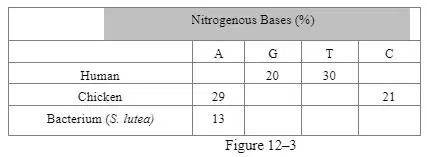
Benjamin, Arjun, and Noah are studying the DNA of several different organisms for their biology project. They are specifically looking at the percentages of the four bases in the DNA. Some of the values are missing from their data table. Based on Chargaff’s rule, they are trying to figure out the amount of guanine bases in chicken DNA. Can you help them determine what percentage it should be?
29%
20%
21%
13%
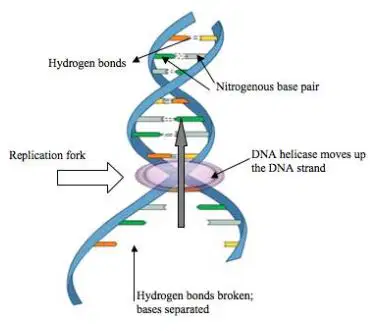
Henry, Emma, and Mia are studying for their biology exam. They are discussing the process of DNA replication. They know that the nitrogen bases of DNA, T-A and C-G, act as a template in building new DNA molecules during replication. But before replication can begin, they are confused about which enzyme must do what, starting at the replication origin. Can you help them fill in the blanks with the correct set of words below?
DNA primase; split open the DNA
DNA polymerase; match nitrogen bases
helicase; split open the DNA
ligase; insert the correct nitrogen bases
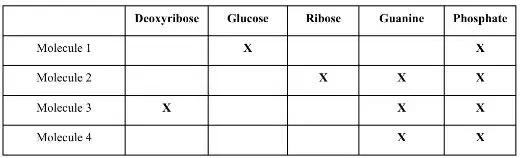
Mason, a young scientist, is conducting an experiment in his school's lab. He is trying to extract DNA from a common bacterium found in soil. During the extraction process, he ends up with a preparation that contains only four types of molecules. Some components of these molecules are listed in his lab manual. According to the manual, Molecule 2 would most likely be which type of molecule?
DNA
RNA
carbohydrate
protein
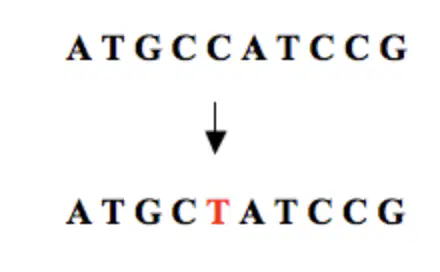
Liam is studying the DNA replication process in his biology class. He noticed a mutation in the DNA segment of a somatic cell from a lab sample. He asked Mia and William to identify the type of mutation and explain the impact of this mutation on the production of a protein. What type of mutation has occurred? If this DNA molecule proceeds to transcription and translation, what would be the impact of this mutation on the protein production?
Mia suggests: This is a point mutation, resulting from the addition of one nitrogen base. This strand can no longer be used for transcription or translation due to its mutation.
William suggests: This is a frameshift mutation, resulting from the substitution of one nitrogen base. If this strand of DNA is used for transcription, it will result in all of the amino acids being placed incorrectly in the protein.
Liam thinks: This is a frameshift mutation, resulting from the addition of one nitrogen base. This strand can no longer be used for transcription or translation due to its mutation. If this strand of DNA is used for transcription, it will affect the coding of multiple amino acids, causing an incorrect protein to be assembled.
Mia and William agree: This is a point mutation, resulting from the substitution of one nitrogen base. If this strand of DNA is used for transcription, it will affect the coding of ONE amino acid, resulting in placing the correct amino acid in the protein, placing the wrong amino acid in the protein, or coding for the protein to stop building.
Arjun, Olivia, and Kai are studying biology and they come across the terms Chromosome, DNA nucleotide, Codon, and Gene. They are trying to understand the size of these components. Can you help them place these components in order, from smallest to largest?
Chromosome-DNA nucleotide-Gene-Codon
DNA nucleotide-Codon-Gene-Chromosome
Codon-Gene-DNA nucleotide-Chromosome
Gene-Codon-DNA nucleotide-Chromosome
Nora, Isla, and Benjamin are studying biology. They are discussing the correct sequence of the transfer of information in most organisms. Can you help them identify the correct sequence?
protein to DNA to RNA
RNA to DNA to protein
DNA to RNA to protein
RNA to protein to DNA
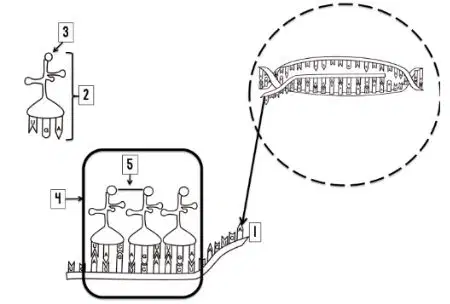
Priya is studying cell biology and she came across a diagram in her textbook. The diagram was labeled and she noticed that number 1 was pointing to a type of RNA. She learned that this RNA brings the information in the genetic code from the nucleus to other parts of the cell. Can you help Michael and Rohan identify which type of RNA is Priya referring to?
rRNA
tRNA
mRNA
RNA polymerase
Kai, Abigail, and James are studying biology. They are trying to figure out how many nucleotides are needed to specify three amino acids in a DNA sequence. Can you help them?
3
6
9
12

Sophia, Luna, and Ava are studying biology. They come across an mRNA code: AUG CCC UAU GAA UAG. Using the codon chart, they need to translate this mRNA code to make a protein. What protein sequence will they get?
Met-Pro-Phe-Asp-Stop
Met-Leu-Ile-Glu-Stop
Met-Pro-Tyr-Glu-Stop
Met-Thr-Gly-Arg-Stop

